Laminated GCL. Choose the carrier, clay mass and film.
Choose Standard or Heavy Duty carriers, 3,700 or 4,000 g/m² dry bentonite, unmodified or polymer-modified powder, and 0.20 mm LDPE or 0.50 mm LLDPE film.
Choose the laminated range or a separate unlaminated GCL to suit the ground, contact liquid and lining design.
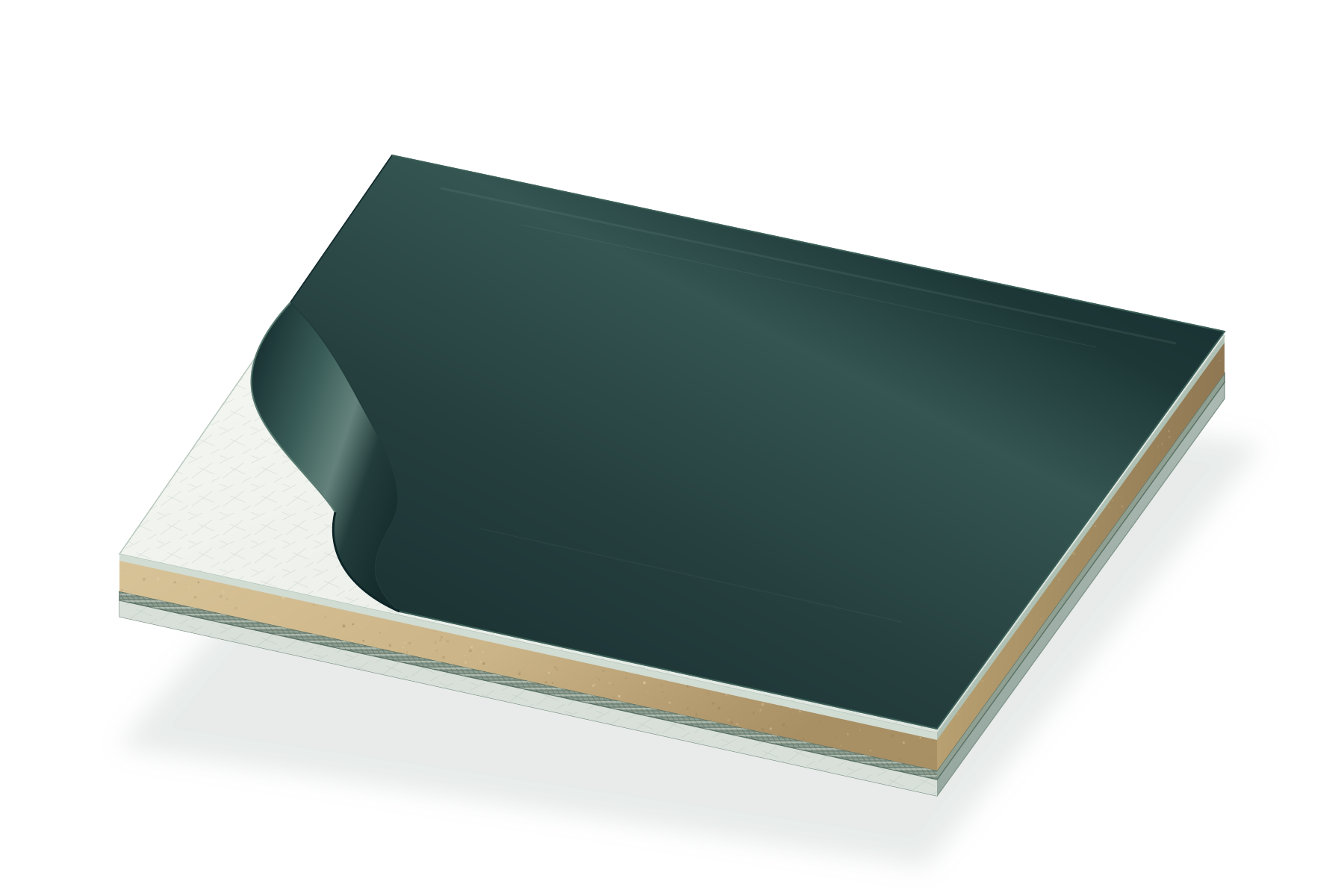
Conceptual Heavy Duty construction. Standard grades omit the lower carrier nonwoven. Layer thicknesses exaggerated.
LAMINATED RANGE
Four constructions. Unmodified or polymer modified.
Standard 37 and Standard 40 use a woven carrier of at least 100 g/m². Heavy Duty 37 and Heavy Duty 40 use a composite carrier of at least 300 g/m²: 100 woven plus 200 nonwoven. The cover nonwoven is at least 200 g/m². The 37 and 40 designations specify 3,700 and 4,000 g/m² minimum dry bentonite, excluding polymer.
U identifies unmodified natural sodium bentonite and P identifies polymer modification. Natural origin and absence of polymer require source and batch confirmation before supply. Both formulations are available in each carrier, clay-loading and film combination.
HDL-GCL S37U/P-020 · U or P formulation
Kontain HDL-GCL Standard 37 020
Standard 37 specifies ≥3,700 g/m² dry bentonite, a woven carrier and bonded 0.20 mm LDPE film.
Dry bentonite
≥3,700 g/m²
Carrier minimum
100 g/m² woven
Film
0.20 mm LDPE
Available as HDL-GCL S37U-020 with unmodified natural sodium bentonite or HDL-GCL S37P-020 with polymer modification.
Unmodified bentonite is available for projects where typical low-salinity rainwater or compatible subgrade moisture hydrates the clay, subject to the project chemistry, confinement and hydraulic requirements. Consider polymer modification where higher resistance to drying and desiccation cracking is sought during extended exposure before covering, or where lime-affected water, highly saline water or certain leachates may hydrate the bentonite instead of typical rainwater. Select and verify the polymer formulation against the actual hydration liquid, pH, dissolved ions, confinement and exposure conditions. Polymer modification does not automatically qualify lime-treated fill or aggressive liquids. Cover promptly; permanent exposed service requires a separate design.
Technical data and test methods.
Four separate Revision F TDS cover polymer-modified and unmodified natural sodium bentonite, each with 0.20 mm or 0.50 mm film. The combined range guide remains Revision J. Values are specified minimum or maximum supply requirements, with nominal film thickness. Exact-grade manufacturer acceptance and traceable production verification are required before supply. Independent qualification of each finished laminate remains pending.
All named grades specify tensile strength ≥10 kN/m in each direction under ASTM D6768 and internal GCL peel ≥360 N/m under ASTM D6496. PE-to-cover peel is a separate ≥300 N/m requirement under an agreed procedure. These are acceptance requirements, not statistically established roll values.
Film, overlap and sealing options.
Product
Film
Longitudinal joint
Sealing
All -020 grades
0.20 mm LDPE
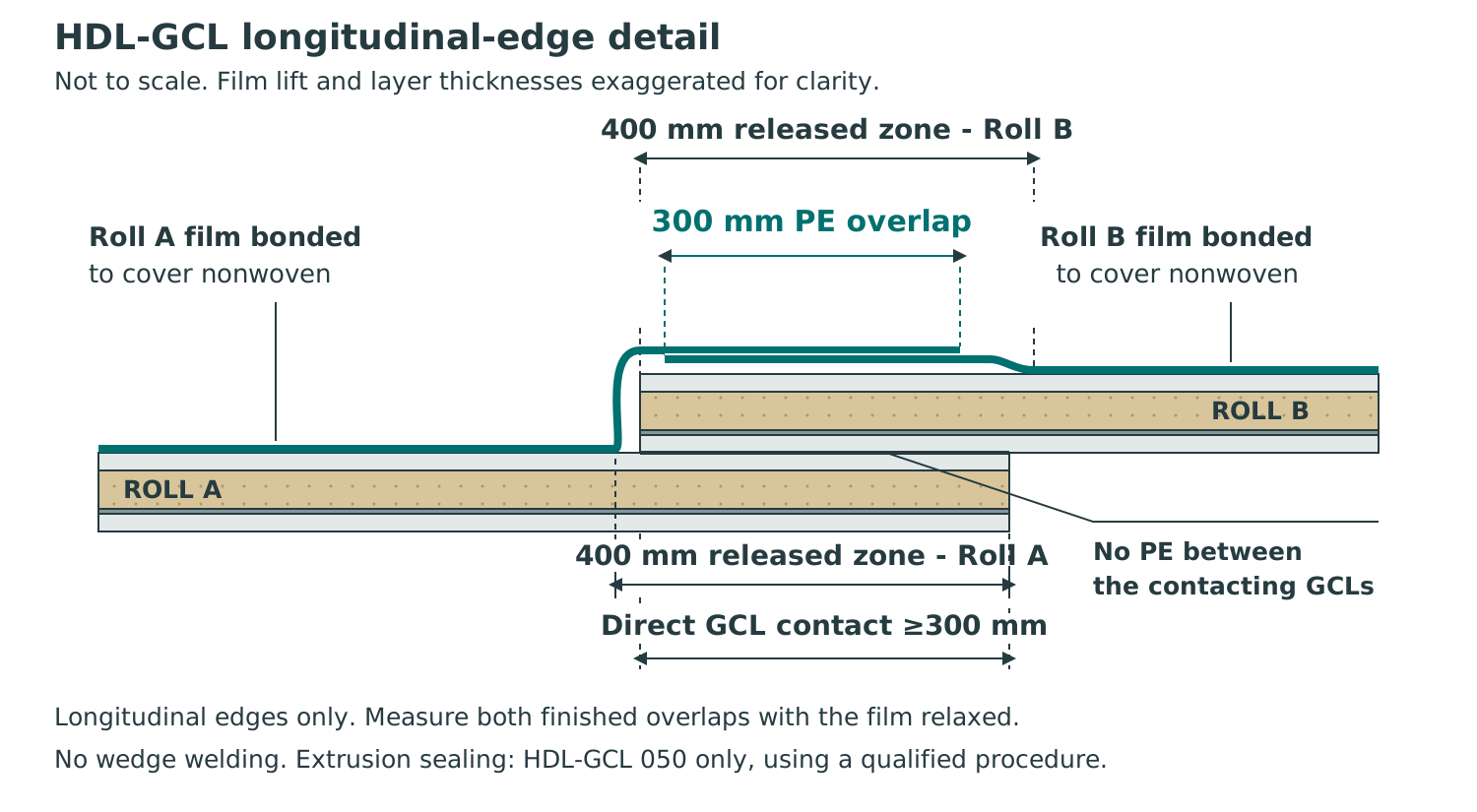
400 mm released film zone; ≥300 mm GCL contact and ≥300 mm PE overlap
No extrusion sealing or wedge welding
All -050 grades
0.50 mm LLDPE
Same longitudinal joint requirements
Manufacturing and extrusion qualification required; no wedge welding
The PE film is specified by resin type and nominal thickness. The 0.50 mm option requires manufacturing qualification. Extrusion sealing also requires a qualified procedure for the actual film, filler and laminated assembly. Do not extrusion-seal HDL-GCL 020. Neither grade is wedge weldable.
Longitudinal-edge detail: maintain at least 300 mm direct GCL contact and a separate 300 mm PE overlap. Open full-size drawing ↗
Film remains bonded across each roll and loose at the designated longitudinal edges. Lift the loose film clear to form direct GCL-to-GCL contact, then return the PE above the joint. Measure both finished overlap widths without stretching the film. Use the project detail for end laps and field cuts; the longitudinal release zone is not an end-lap detail. Replace damaged laminated panels or use a Kontain-issued repair detail. Do not strip bonded film.
Unmodified U grades specify ≥24 mL/2 g in reagent water under ASTM D5890. Polymer P grades specify ≥28 mL/2 g in reagent water and ≥22 mL/2 g in the defined saline solution under a modified procedure. Saline values are not transferred to unmodified grades.
Material and condition
Method or basis
Specified swell
U: unmodified bentonite in reagent water
ASTM D5890; minimum 16 h after final increment
≥24 mL/2 g
P: modified bentonite in reagent water
D5890-based modified method; 16 h after final increment
U grades: ASTM D5890 in reagent water, with a minimum 16 h hydration period after the final clay increment; extend and report readings as required by the method. P grades: D5890-based modified procedure, reporting at 16 h after the final increment in reagent water or 20,000 mg/L NaCl. Reagent water is distilled or deionised water meeting ASTM D1193. D5890-25 excludes polymer-containing clays, so P results are reported as modified tests. Supplier reference values for modified bentonite are ≥28 mL/2 g in tap water and ≥22 mL/2 g in unspecified 20,000 ppm salt water. The defined reagent-water, NaCl and 16 h conditions are acceptance requirements needing supplier confirmation. U-grade saline swell and saline conductivity are not declared.
Select the formulation for the actual subgrade, contact liquids, hydration sequence and confinement. Cover promptly to protect the liner through installation.
Bentonite quality requirements.
All laminated grades specify controlled sodium bentonite powder, supplied unmodified (U) or polymer modified (P). The mineral limits below apply to the parent bentonite before any polymer addition.
Property
Specified limit
Montmorillonite
>70 wt% by quantitative XRD
Carbonate minerals
<5 wt%
Powder grading
≥80% passing 75 µm
Cation exchange capacity
≥70 meq/100 g
Moisture
≤13%
Verify mineralogy, formulation and lot traceability for the order. This commercial range does not establish compliance with a landfill specification. Assess the actual contact liquid, subgrade chemistry, confinement and lining design.
UNLAMINATED RANGE
Standard, Heavy and Polymer GCL.
GCL-S, GCL-H and GCL-P are separate unlaminated constructions. Their properties are grade-specific. The HDL-GCL names identify the separate laminated powder range with U and P formulation choices.
GCL-S · Needle-punched sodium-bentonite liner
Kontain GCL Standard
A needle-punched liner for containment, combining sodium bentonite with a nonwoven cover and woven carrier.
Dry bentonite
≥3,700 g/m²
Construction
PP nonwoven / bentonite / PP woven
Long edges
Factory-treated, self-sealing under confinement
The standard granular grade contains at least 3,700 g/m² dry bentonite.
Choose a separate laminated TDS by bentonite formulation and film thickness. Each compares Standard 37/40 and Heavy Duty 37/40. The range guide, unlaminated sheets and installation guidance are also available.
Soils, slopes and penetrations need a project detail.
Assess lime-treated soils, limestone, recycled concrete, saline pore water and process liquids before direct contact with bentonite. Polymer modification does not remove the need for compatibility testing.
Verify protection against the actual aggregate grading, angularity, load and placement method for the selected construction. Design slopes using hydrated internal and interface shear properties for the complete lining system. Keep plant off uncovered GCL and place compatible confinement promptly.
Common rolls are 5 m × 30 m; dimensions and factory edge arrangements are agreed for each order. Confirm roll mass, core clear bore and lifting compatibility. The laminated range offers unmodified and polymer-modified powder. Unlaminated granular and powder options are selected by grade.
Send the liner section, slope geometry, soil grading and source, liquid chemistry, loading, penetrations and delivery location.