
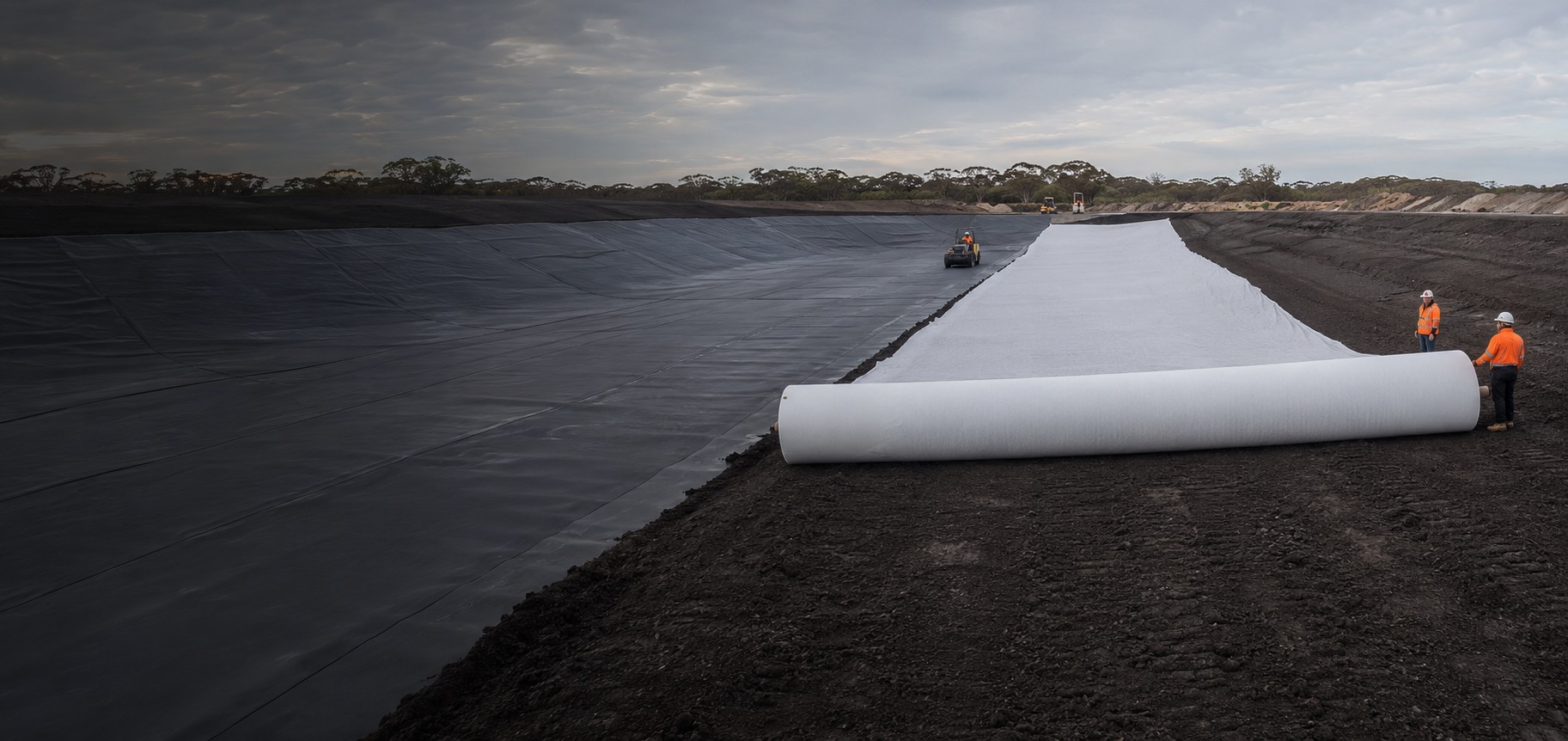
Filtration
Retain the base soil while allowing controlled water movement. Selection starts with soil grading, apparent opening size and hydraulic demand.
KNP Series · PET continuous filament
Needle-punched PET geotextiles for filtration, separation and geomembrane protection—supported by application-led grade selection, broken-needle controls and project-direct supply.
Published ISO and ASTM properties. Custom roll formats and mixed grade containers available by production confirmation.
Technical resources · 1 file
Current product documents are available here. Selection guidance, installation context and full technical detail continue below.
Function before grade
The right starting grade changes with the failure mechanism. Filtration is governed by soil compatibility; separation by installation survivability; protection by the stress and deformation at the liner interface.
Retain the base soil while allowing controlled water movement. Selection starts with soil grading, apparent opening size and hydraulic demand.
Limit intermixing between imported aggregate and the subgrade through construction and service, particularly where fines, water and trafficking interact.
Distribute localised contact stress and reduce strain imposed on adjacent geomembranes by angular support materials and construction activity.
Provide a stable filter boundary around drainage aggregate, pipework and geocomposites without treating one generic opening size as suitable for every soil.
Preliminary grade screen
Select the primary function to see the usual Kontain starting range and the project inputs that change the answer.
Civil separation
KNP-12 to KNP-25For roads, platforms, access tracks and earthworks where aggregate intermixing or loss of formation material must be controlled.
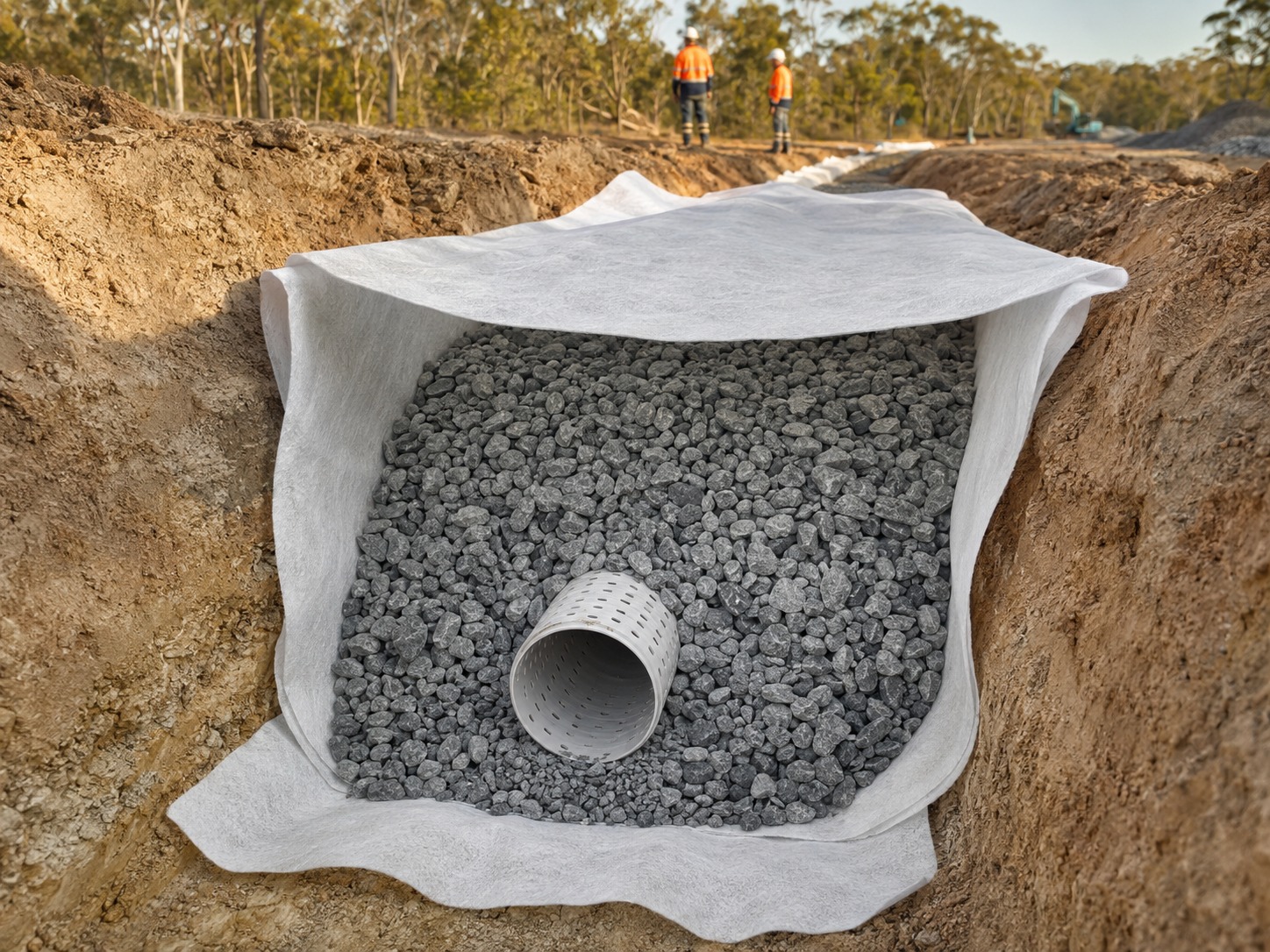
Filtration and drainage
A higher-strength grade does not automatically provide the right filter. Confirm retained-soil grading, opening size, permittivity, flow direction and clogging risk.
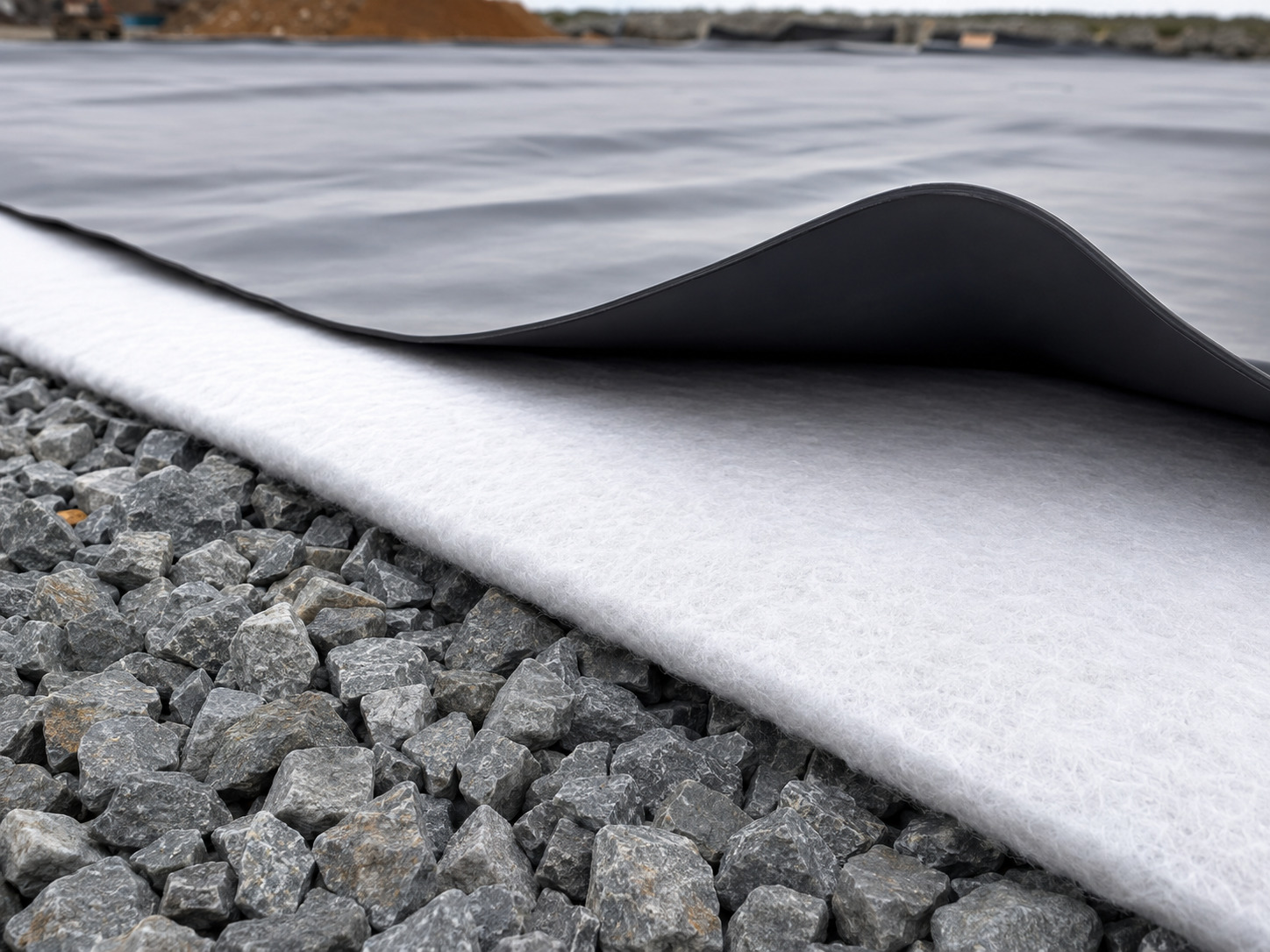
Geomembrane protection
Cushion selection should consider particle geometry, applied pressure, liner type, support condition, placement energy and long-term deformation—not one index number in isolation.
Standard production control
Residual metal fragments are a preventable risk where geotextile contacts a geomembrane. Kontain-supplied KNP production includes staged magnetic recovery, incident quarantine and 100% finished-roll tunnel metal detection as a standard control.
An in-line permanent magnetic roller recovers detached ferrous needle components across the fabric width.
Both surfaces are scanned with a magnetic recovery bar at intervals not exceeding 30 minutes.
Every roll passes through a tunnel detector, verified with a 1.0 mm ferrous test piece before release.
Triggered material is isolated, rewound, magnetically recovered and re-inspected; persistent contamination is removed and rejected.
after 500 hours
ASTM D7238
Exposure management
The published retention value provides a consistent laboratory comparison; it is not a direct conversion to allowable weeks or months on an Australian site. Keep rolls protected, secure deployed fabric and sequence cover placement to minimise unnecessary exposure.
Store wrapped rolls off the ground and protect packaging damage.
Record delivery, deployment and cover dates for exposed work.
Request project review where delayed cover or extended exposure is likely.
Published technical data
Strength-based identifiers keep the product schedule directly tied to the published tensile class. Values shown are minimum average roll values unless otherwise stated.
| Property | Test method | Unit | KNP-09 | KNP-12 | KNP-15 | KNP-18 | KNP-21 | KNP-25 | KNP-30 | KNP-36 | KNP-48 | KNP-54 |
|---|---|---|---|---|---|---|---|---|---|---|---|---|
| Tensile strength MD/CD | ISO 10319 | kN/m | 9 | 12 | 15 | 18 | 21 | 25 | 30 | 36 | 48 | 54 |
| Tensile elongation MD/CD | ISO 10319 | % | 40–80 | 40–80 | 40–80 | 40–80 | 40–80 | 40–80 | 40–80 | 40–80 | 40–80 | 40–80 |
| Grab tensile strength | ASTM D4632 | N | 450 | 710 | 970 | 1,100 | 1,300 | 1,500 | 1,800 | 2,000 | 2,200 | 2,500 |
| Grab elongation | ASTM D4632 | % | 40–80 | 40–80 | 40–80 | 40–80 | 40–80 | 40–80 | 40–80 | 40–80 | 40–80 | 40–80 |
| CBR puncture strength | ASTM D6241 / ISO 12236 | kN | 1.6 | 2.0 | 2.4 | 2.9 | 3.4 | 4.0 | 5.4 | 6.4 | 8.0 | 8.6 |
| Trapezoidal tear strength | ASTM D4533 / ISO 13937-2 | kN | 0.23 | 0.30 | 0.35 | 0.42 | 0.49 | 0.60 | 0.73 | 0.82 | 1.15 | 1.25 |
| UV resistance after 500 h | ASTM D7238 | % retained | 70 | 70 | 70 | 70 | 70 | 70 | 70 | 70 | 70 | 70 |
Controlled technical download
Kontain branded · document KNT-TDS-KNP-001 · Revision R01 · July 2026
Wholesale project-direct supply
Kontain works directly with production and keeps stockholding limited. That model is best suited to larger projects where manufacturing and freight can be planned efficiently—allowing competitive project-delivered pricing without stripping out technical support.
Coordinate widths, lengths and grade mix around panel layout, handling limits and container utilisation.
Start from function, soil, aggregate, geomembrane and construction conditions rather than a generic product substitution.
Receive exact-grade TDS, production and batch documentation, shipping coordination and nominated verification requirements.
Kontain supports the selection, proposal, delivery planning and site questions through one accountable project interface.
Project enquiry
For filtration, include soil grading and hydraulic duty. For separation, include subgrade, aggregate and construction plant. For protection, include liner, aggregate grading, particle shape and applied pressure.
Exact documents depend on the nominated grade, project specification and purchase scope.
Grade-specific data and the reasoning behind the proposed application range.
Manufacturing, inspection and broken-needle control documentation by agreement.
Widths, lengths, grade mix, quantity and coordinated project delivery.