Project-direct geosynthetic supply · AustraliaDownload capability statement PDF ↓
TRANSPARENT SUPPLY MODEL

Kontain KGCL value route × CETCO branded systems

Compare assurance

ENGINEERED BARRIER SYSTEMS

Choose the backing.
See the risk.

A complete Australian GCL offer: uncoated KGCL-ST, PE-laminated KGCL-C or branded CETCO systems, selected against chemistry, shear, hydraulic demand, evidence requirements and delivery programme. The differences stay visible.

ValueKGCL-ST + KGCL-C routes
BrandCETCO backed systems
Evidencerisk matched to the job
CETCO geosynthetic clay liner being deployed on a prepared containment subgrade

Reinforced GCL

Controlled deployment

Prepared subgrade

CETCO product deployment imagery
01
LandfillBase, cap and leachate containment
02
Mining & tailingsProcess liquids, brine and residue storage
03
Process waterPonds, canals and secondary containment
04
Civil containmentStormwater and infrastructure barriers

COMPLETE GCL PACKAGE

Five pathways.
No hidden equivalence claim.

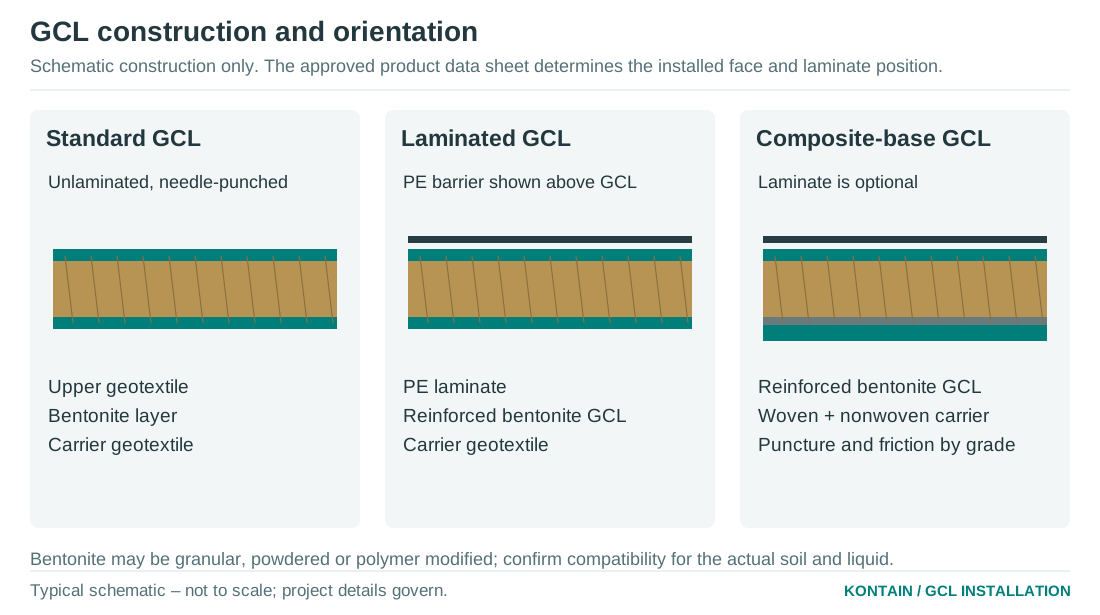
KGCL-ST gives cost-sensitive projects an uncoated private-label route; KGCL-C adds a separate 0.20 mm PE geofilm laminate. CETCO provides the branded standard, laminated and polymer-enhanced pathways.

01
Kontain technical diagram — not CETCO imagery

Kontain value-engineered GCL

KGCL-ST

Conventional, non-aggressive containment where lowest landed cost matters and the client accepts a clearly defined evidence and conformance plan.

MQC basis
GRI-GCL3 frequencies
Dry bentonite
≥ 3.7 kg/m²
Published MD tensile
8 kN/m

Uncoated construction: nonwoven upper face, bentonite core and woven underside. Price-led, not brand-led, with the manufacturing source, MQC evidence and traceability confirmed before release.

View Australian technical data
02
CETCO BENTOMAT geosynthetic clay liner product
CETCO product / project imagery

CETCO branded standard GCL

BENTOMAT® ST

Composite liners, landfill, mine infrastructure and civil containment where the contact liquid is relatively non-aggressive.

Bentonite
≥ 3.6 kg/m²
Hydraulic conductivity
≤ 5 × 10⁻¹¹ m/s
Internal shear
24 kPa typical*

CETCO's commonly specified reinforced, needlepunched GCL. Published slope guidance is not a substitute for project-specific stability testing.

View Australian technical data
03
Kontain technical diagram — not CETCO imagery

Kontain value-engineered PE-laminated GCL

KGCL-C

A cost-led laminated pathway for ponds and higher-head liquid containment where an integral 0.20 mm PE geofilm is preferred.

PE laminate
0.20 mm supplied
Dry bentonite
≥ 3.7 kg/m²
MQC category
GRI-GCL3 GM-GF

A discrete 0.20 mm PE geofilm is laminated to the nonwoven upper face; the woven carrier remains underneath. KGCL-C is an overlapped laminated GCL, not a welded geomembrane or a CETCO product.

View Australian technical data
04
CETCO BENTOMAT CL product close-up
CETCO product / project imagery

Coated composite GCL

BENTOMAT® CL

Ponds, canals and higher-head liquid containment where an integral polyethylene geofilm can reduce baseline flux.

Bentonite
≥ 3.7 kg/m²
Hydraulic conductivity
≤ 5 × 10⁻¹² m/s
Internal shear
24 kPa typical*

A laminated GCL is not a welded geomembrane. Overlaps, penetrations, confinement and cover placement still control field performance.

View Australian technical data
05
CETCO RESISTEX polymer-enhanced geosynthetic clay liner
CETCO product / project imagery

Polymer-enhanced GCL

RESISTEX®

Aggressive mining, industrial and waste liquids where ionic strength, divalent cations or pH may impair conventional bentonite.

Formulation
Project selected
U20 ST hydraulic k
≤ 3 × 10⁻¹¹ m/s†
Internal shear
24 kPa typical*

Polymer modification is not a universal pass. Kontain screens the chemistry and coordinates site-fluid compatibility testing before selection.

View Australian technical data

COMMERCIAL + TECHNICAL ASSURANCE

Pay for the backing the project needs.

Price, brand support and verification are separate decisions. The table makes the trade visible without diminishing either manufacturing route.

SystemCommercial positionPublished basisTechnical backingBest fitPrimary hold point
KGCL-STValue-engineered / private labelGRI-GCL3 GT-related MQC frequenciesKontain approval + order evidence packConventional, cost-sensitive worksChemistry, source evidence and project conformance
BENTOMAT STBranded standardCETCO published product programmeCETCO documentation + Kontain reviewStandard work where brand backing mattersChemistry, hydration and project interfaces
KGCL-CValue-engineered laminated / private labelGRI-GCL3 reinforced GM-GF-related MQCKontain film + GCL evidence packCost-sensitive higher-head containmentFilm evidence, overlaps, penetrations and interfaces
BENTOMAT CLBranded coated compositeCETCO published product programmeCETCO documentation + Kontain reviewHigher-head liquid containmentOverlaps, penetrations, uplift and interfaces
RESISTEXBranded specialistCETCO polymer-enhanced programmeFormulation review + site-fluid testingAggressive or saline liquidsRepresentative chemistry and long-term performance
READ THE CONDITIONS

KGCL values combine the supplier sheet dated 2 July 2026 with Kontain construction and GRI-GCL3 MQC acceptance requirements; order evidence still governs conformance. * CETCO published typical peak internal shear at about 9.6 kPa normal stress; not a design envelope. † Published RESISTEX U20 ST value in DI water and 0.02 M CaCl₂. Current order evidence and project testing govern.

CONTROLLED DEVELOPMENT PROGRAMME

0.5 mm and 1.0 mm LLDPE-laminated GCLs.

Kontain is developing thicker LLDPE-laminated variants with dual standard OIT and high-pressure OIT measured initially and after accelerated oven ageing. They remain development products: no availability, compliance or performance claim applies until the selected construction has independent evidence and an approved MQC plan.

GRI-GCL3 CATEGORYGeomembrane-related GCL

At 0.5 mm and 1.0 mm, the LLDPE layer is thicker than GRI-GCL3's geofilm definition. The laminate is therefore assessed as a geomembrane-related GCL, with LLDPE component durability referenced to GRI-GM17.

QUALIFICATION TARGETDual initial + retained OIT

Development target: Standard OIT >100 minutes and HP-OIT >400 minutes initially; after 90 days at 85°C, at least 35% Standard OIT and 60% HP-OIT retained for the EPA Victoria BPEM LLDPE cover-system pathway.

BPEM BOUNDARYNot one blanket compliance claim

EPA Victoria's Landfill BPEM prefers 1.5 mm LLDPE for final covers and permits 1.0 mm only with additional protective measures. A 0.5 mm laminate is not represented as meeting that thickness pathway.

RELEASE GATEEvidence before marketing claims

Thickness, resin and formulation control, OIT/HP-OIT, ageing retention, tensile, density, laminate integrity, finished-GCL properties, traceability and project-specific interfaces must be verified before release.

THE AUSTRALIAN MODEL

Two supply routes.
One accountable process.

CETCO remains the premium branded partner, with its published programme and specialist products presented on their own merits. KGCL-ST and KGCL-C are separate Kontain private-label routes for clients prioritising landed cost. Kontain owns the comparison, disclosure, evidence plan and technical hold points.

See the transparent approach →

APPLICATION SUITABILITY

Start with the failure mode — not the product name.

The preliminary matrix makes the selection logic visible. A green light means “reasonable starting point”, not automatic design approval.

SystemChemistryHydraulic headShearPrimary gate
KGCL-STKontain value-engineered GCLNon-aggressiveComposite / assessedProject testingFactory evidence + configuration approval
BENTOMAT STreinforced sodium GCLNon-aggressiveComposite / assessedTest actual interfacesHydration source + liquid chemistry
KGCL-C0.20 mm PE laminate on nonwoven faceNon-aggressiveValue higher-head optionFilm + interfacesFilm MQC, orientation and overlap detailing
BENTOMAT CLPE geofilm laminateNon-aggressiveHigher-head optionSeams + interfacesDetailing and confined overlaps
RESISTEXpolymer-enhanced familyAggressive / salineFormulation specificConfiguration specificRepresentative site-fluid testing
A completed CETCO Bentomat-lined pond containment system
BENTOMAT LIQUID CONTAINMENTCETCO published project imagery
Illustrated Bentomat liquid containment lining system
SYSTEM, NOT A SINGLE LAYERSubgrade, barrier, cover and contained liquid

OPEN PERFORMANCE POSITION

What the data proves.
What it does not.

This is how Kontain removes the usual sales noise. Every headline value is tied back to the specimen, liquid, confinement and test condition.

01
Natural sodium bentoniteA material description, not a complete performance specification.
+

Swell index, fluid loss and dry bentonite mass establish baseline consistency. Exchangeable sodium and CEC can support diagnosis, but the barrier still needs hydraulic verification under the relevant liquid and confinement.

02
Polymer modificationA formulation tool — not an automatic answer to every aggressive fluid.
+

Polymer type, loading and retention matter. RESISTEX selection should be tied to liquid chemistry, ASTM D6766 testing where applicable, pore volumes, equilibrium and any relevant wet–dry exposure.

03
Internal shear strengthOne published peak value is not a slope-stability envelope.
+

Normal stress, hydration, displacement and failure mode materially affect the result. Critical projects need project-specific peak and large-displacement behaviour plus every adjacent interface.

04
Index hydraulic conductivityDeionised-water data is a baseline, not proof of chemical compatibility.
+

Calcium, magnesium, salinity, pH and ionic strength can reduce bentonite swelling. Site liquid testing should begin early enough to influence product selection, not after procurement.

05
Laminated and coated GCLsLower baseline flux does not turn an overlapped system into a welded liner.
+

KGCL-C and BENTOMAT CL use a polyethylene geofilm laminate, while polymer-coated-geotextile GCLs are a different GRI-GCL3 category. In all cases, overlaps, penetrations, wrinkles, cover placement, hydration and confinement remain active design and construction issues.

06
Product equivalenceEquivalent mass and index values do not prove equivalent field behaviour.
+

KGCL-ST and BENTOMAT ST can share headline thresholds without being interchangeable. Kontain compares test conditions, manufacturing configuration, reinforcement, quality evidence, chemistry, interfaces and construction risk. Brand claims are not treated as design values.

SITE CHEMISTRY COLLABORATION

Test early enough to change the answer.

Product choice becomes commercially useful when factory evidence, site-liquid testing and stability verification are built into design and procurement early enough to change the answer.

01

Define the exposure

Application, design life, head, confinement, temperature and whether the GCL is primary, secondary or part of a composite system.

02

Characterise the liquid

pH, electrical conductivity, major ions, Ca²⁺, Mg²⁺, Na⁺, sulfate, chloride and representative variability — not pH alone.

03

Screen the product class

KGCL-ST or BENTOMAT ST for conventional exposure, KGCL-C or BENTOMAT CL for PE-laminated construction, or a RESISTEX formulation for aggressive chemistry.

04

Verify hydraulics

Baseline data first; ASTM D6766 site-fluid compatibility for applicable uncoated GCLs, with an agreed protocol and termination criteria.

05

Verify stability

Internal and interface shear with actual adjoining materials, relevant normal stresses, hydration and both peak and large-displacement response.

06

Lock supply and CQA

Current factory TDS, certificate of analysis, source and lot traceability, roll schedule, conformance frequency, logistics, installation details and hold points aligned before manufacture.

Important method boundary

ASTM D6766 applies to GCLs with geotextile backings and excludes geomembrane, geofilm and polymer-coated backings. Laminated or coated products need a project-agreed test approach rather than a careless method reference.

LEAD TIME + CONTAINER ECONOMICS

Order to the roll.
Price to the freight lot.

KGCL ROLL5.85 m wide × selected length

The standard reference length is 30 m, but KGCL-ST and KGCL-C roll length is customer-selectable. Factory roll mass, handling, payload and project overlap schedule are confirmed with the quote.

CETCO PLANNING ROLL≈ 209 m² gross

Planning basis of about 4.57 m × 45.7 m, or approximately 200 m² effective after standard overlaps. Current factory dimensions and origin still require confirmation.

BEST PRICINGFull production + freight lots

Part-container and urgent orders remain possible, but landed unit rates generally improve when manufacture, port handling and sea freight are optimised together.

PACK PLAN + PROGRAMMEConfirmed with every quote

KGCL container quantity changes with the selected roll length. CETCO's 18-roll lot remains a planning assumption. Factory slot, payload, testing, freight and local delivery are shown separately.

AUTOMATED BUDGET BUILDER

Build the supply brief now.
Release the price after review.

Inputs generate a transparent roll schedule and preliminary pathway. Kontain then verifies the selected supply route, technical risk, factory evidence, current pricing, freight, FX and programme before the client receives a commercial quote.

SOURCE MATERIAL

Show the data.
Link the original.

Client-facing pages should link to current manufacturer information and state exactly which published value has been used.

WHY KONTAIN

Technical sales that can defend the product after the meeting.

Kontain is an Australian-owned geosynthetics consultancy and supply business led by Ben Lewis. More than 14 years across geotechnical engineering, geosynthetics, technical sales and business development are applied to both a cost-led KGCL route and CETCO's branded product programme.

The point is not another generic catalogue. It is a defensible Australian route from early specification and chemistry screening through supplier evidence, testing, supply, installation support and construction QA — with clients able to choose what risk backing they buy.

Discuss a project →