
Unbound access roads
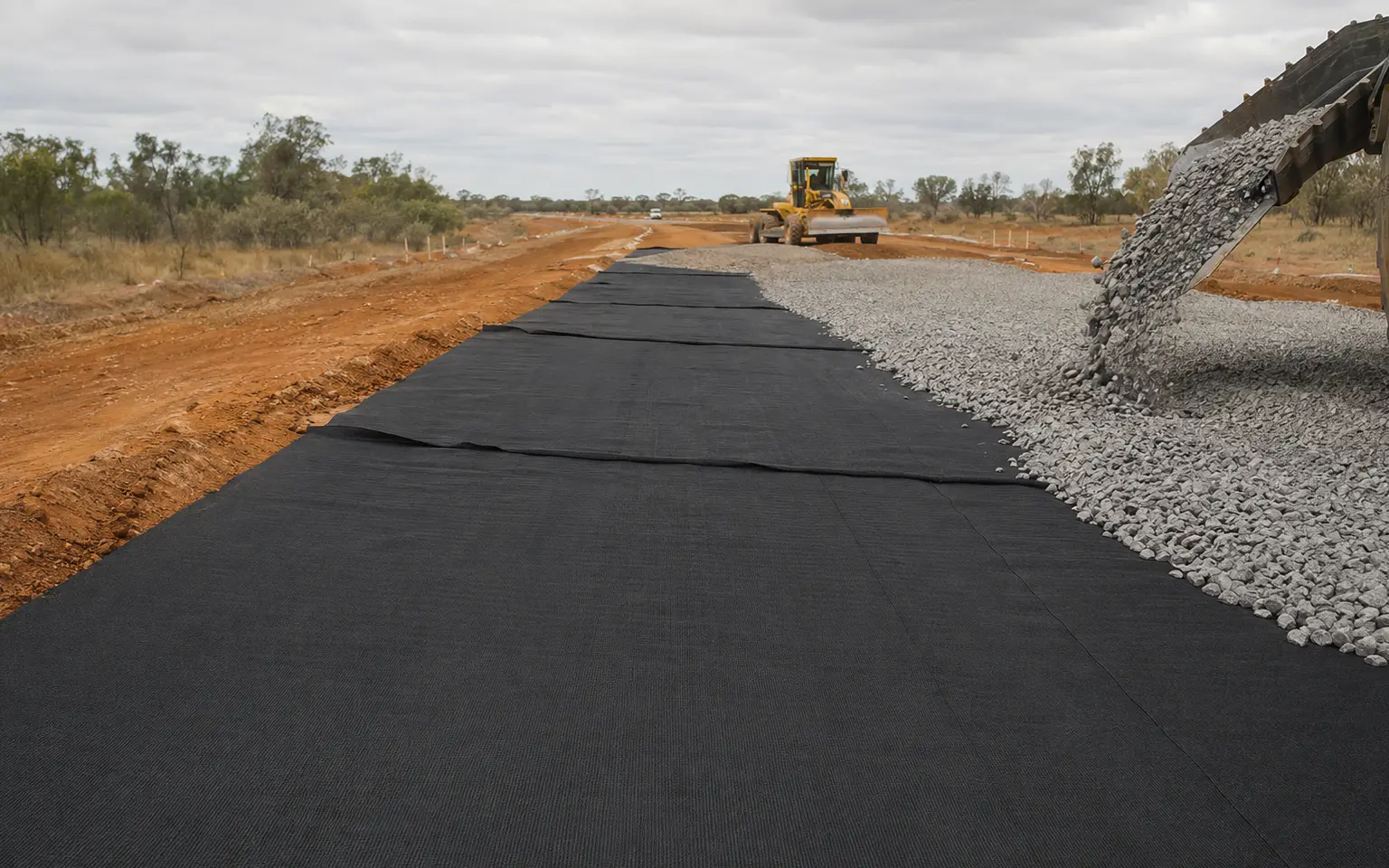
Separates imported pavement material from cohesive or weak subgrades and limits contamination during placement and trafficking.
BaseWoven · polypropylene road systems
BaseWoven PP provides separation, filtration and construction survivability. BaseWoven LS adds measured tensile response at 2% strain and interface data where deformation control is part of the road-platform design. Neither product is an extruded interlock grid.
Technical resources · 2 files
Current product documents are available here. Selection guidance, installation context and full technical detail continue below.
BaseWoven BW-PP
Use where keeping granular fill and subgrade fines apart is the first job. The grade is checked for puncture, tear, grab strength, opening size and hydraulic response against the fill, subgrade and placement method. Ultimate tensile strength is a supporting property—not the selection method by itself.
Separates imported pavement material from cohesive or weak subgrades and limits contamination during placement and trafficking.
Provides a continuous separator below granular working layers where installation survivability and filtration are required.
No published long-term design strength is assigned. Do not convert ultimate tensile strength into an embankment design resistance.
Manufacturer-published values
Mechanical values are MARV. Hydraulic values are manufacturer supplied. Standard rolls are 5.2 m × 100 m; project-specific lengths, widths, strengths and opening sizes are available.
| Grade | Wide-width tensile MD / CD · kN/m | Elongation MD / CD · % | CBR puncture kN | Grab N | Trapezoid tear N | Flow rate L/min/m² | Permittivity s⁻¹ | Opening mm |
|---|---|---|---|---|---|---|---|---|
| BW-PP40 | 40 / 40 | <10 / <10 | 5.5 | 1,410 | 500 | 1,900 | 0.64 | 0.425 |
| BW-PP50 | 52 / 52 | <10 / <10 | 7.5 | 1,880 | 610 | 2,000 | 0.67 | 0.425 |
| BW-PP70 | 67 / 60 | <10 / <10 | 8.5 | 2,400 | 690 | 2,500 | 0.83 | 0.450 |
| BW-PP80 | 80 / 80 | <10 / <10 | 8.8 | 2,600 | 800 | 2,000 | 0.67 | 0.450 |
| BW-PP90 | 90 / 90 | <10 / <10 | 9.0 | 2,700 | 1,300 | 2,500 | 0.83 | 0.420 |
BaseWoven BW-LS
Use this range where the road design needs reported strength at 2% strain, interface interaction and installation-damage evidence—not simply a higher ultimate tensile or puncture value. It remains a closed woven sheet and does not create geogrid-style aperture interlock.
Not simply a heavier woven
BW-LS reports tensile capacity at 2% strain in both directions. This is a stiffness reference for assessing how early tensile resistance may be mobilised, before large rutting or membrane deformation develops.
Selection evidence
The relevant evidence stack is low-strain tensile response, soil interaction, installation survivability, hydraulic compatibility and, where a pavement benefit is claimed, product-specific trafficking performance.
| Grade | 2% strength MD / CD · kN/m | Ultimate MD / CD · kN/m | CBR N | Grab N | Flow L/min/m² | Permittivity s⁻¹ | AOS / O90 mm | Install retained % | Pull-out coefficient |
|---|---|---|---|---|---|---|---|---|---|
| BW-LS70 | 10 / 20 | 70 / 90 | 6,650 | 1,520 | 3,059 | 0.90 | 0.40 / 0.35 | 90 | 0.89 |
| BW-LS85 | 10 / 27 | 85 / 90 | 9,500 | 2,120 | 3,056 | 1.00 | 0.40 / 0.32 | 90 | 0.90 |
Australian specification boundary
The following limits are deliberately explicit because nominal strength alone can create a false equivalence between products.
No Australian G-rating is published for these ranges. Do not infer a G-class from ASTM CBR, grab or tear results. A project requiring G-rating needs the specified Australian test data and rating procedure.
BW-LS reports 10 kN/m in the machine direction at 2% strain. Queensland MRTS58 Type 1 and Type 2 thresholds are higher, so authority use requires product-specific review—not an automatic compliance statement.
Reported retained strength is supported by ASTM D5818 results. Third-party tests ranged from RFID 1.03 to 1.18 for the tested low-strain fabric as fill changed from silty sand to graded aggregate base. Use project fill and placement energy for final adoption.
Permittivity under ASTM D4491, AOS under ASTM D4751 and O90 under ISO 12956 answer related but different specification questions. Match the tender method; do not rename one result as another.
When aggregate interlock is the design intent
The Giroud–Han comparison is based on an aperture-stability input for an extruded biaxial geogrid. It must not be used to assign the same thickness benefit to a closed road woven. A woven may still be required beneath the grid for separation and filtration.
Construction control
Remove protrusions and standing water where practical. Do not proof-roll very weak ground simply to create a smooth surface.
Lay flat, tension by hand and use the project overlap schedule. Increase overlap as subgrade support reduces; seek engineering advice on extremely soft ground.
End-tip onto placed fill and push forward. Do not traffic tracked plant directly on exposed woven; establish the specified cover before construction trafficking.
Patch tears with sound material extending beyond the damage by the project overlap. Record roll identification, location, overlaps and damage repairs.
Technical data
Use the range sheet for product comparison, then confirm project-specific acceptance criteria in the order or submittal.
Project specifications and the designer's adopted standard govern. Kontain data sheets do not replace project-specific design, authority acceptance or product conformance testing.
Project-specific supply
Send the subgrade CBR, aggregate grading, maximum particle size, lift thickness, plant and required specification. Kontain will nominate a standard grade or arrange project-specific manufacture.