
Commercial & industrial
Warehouses, factories, heavy slabs, commercial buildings, yards and operating facilities.
Geotechnical services · Adelaide & South Australia
Commercial, industrial and civil geotechnical investigations planned, coordinated, interpreted and reported by Ben Lewis, a Chartered Professional Engineer in Geotechnical Engineering (MIEAust CPEng NER), with a specialist focus on soft ground, foundations, subgrades and practical ground improvement.
Commercial, industrial, subdivision and civil work. Individual residential soil tests are outside the current service scope. View engineering credentials. For geosynthetic design and supply outside SA, explore global project support.
Technical resources · 1 file
A concise summary of the commercial investigation scope, field pathways, engineering outputs and current South Australian service boundaries. Full service detail continues below.
Project fit
The investigation is built around the proposed development and the engineering questions—not a fixed residential soil-test template. Complex multistorey and deep-foundation projects are scoped individually, with supplementary specialists and peer review where the risk requires it.
Warehouses, factories, heavy slabs, commercial buildings, yards and operating facilities.
Roads, services, platforms, earthworks, retaining structures and development infrastructure.
Apartments, mixed-use and larger developments, with investigation depth and specialist inputs matched to the structural concept.
Subgrade strength, existing pavement condition, construction access and rehabilitation inputs.
Foundation parameters for tanks, stormwater systems, plant, walls and other load-sensitive structures.
Variable fill, compressible soils, reactive clays and sites where settlement or constructability may control the solution.
Investigation scope
Fieldwork and reporting are scoped with reference to AS 1726:2017 and relevant field and laboratory test methods. Not every technique belongs on every site; the combination must suit the geology, structure and risk.
Desktop review, geological context, development inputs, investigation locations, depths, access, services and safety planning.
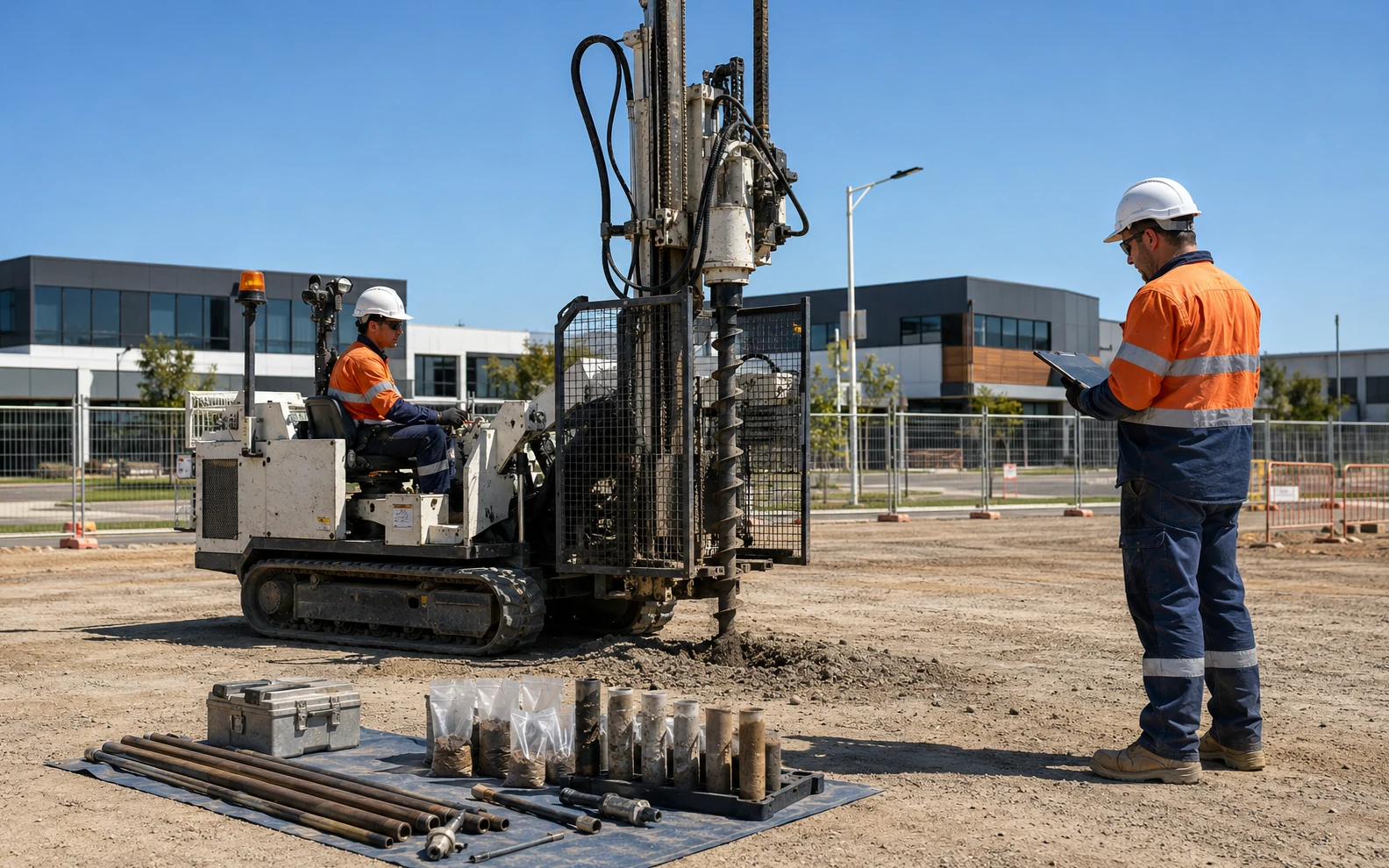
Mechanical boreholes, auger and push-tube sampling, soil recovery and engineering logging through suitable field providers.
Standard Penetration Testing within boreholes to support interpretation of density, consistency and foundation conditions.
Continuous cone and piezocone profiling coordinated through specialist providers, particularly useful across soft or variable ground.
Dynamic Cone Penetrometer testing, hand investigation and test pits where shallow variability and subgrade response are important.
Groundwater observations during drilling and, where the design question requires it, monitoring-well installation and repeat measurements.
Pavement coring, material sampling, DCP, FWD and complementary condition data selected to suit the assessment objective.
Project-specific classification, strength, reactivity, CBR, consolidation and chemical testing through suitable laboratories.
Field capability
Specialist plant is coordinated to suit the agreed scope. Provider availability, access, test standards, traffic controls and reinstatement requirements are confirmed in the project proposal.
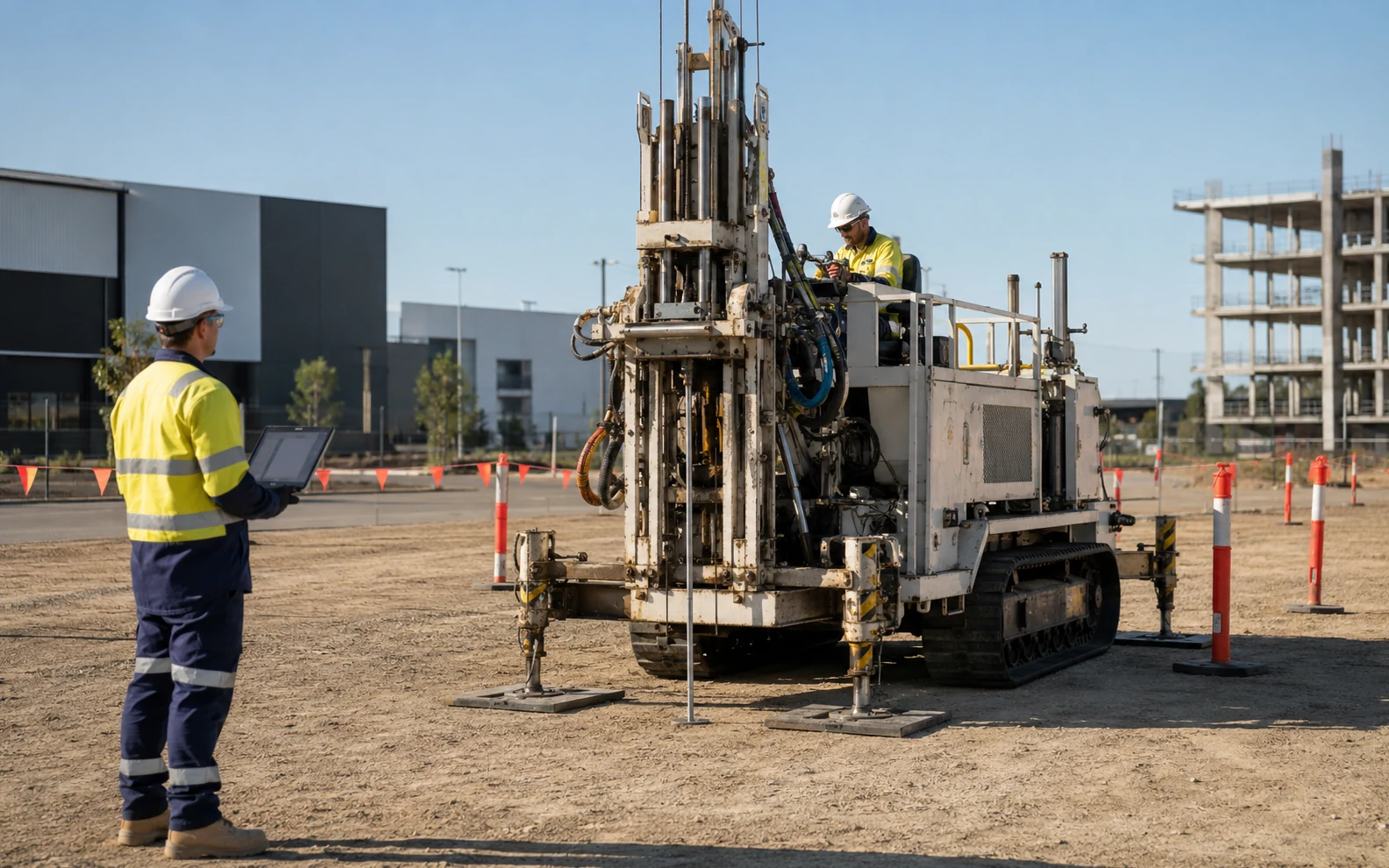
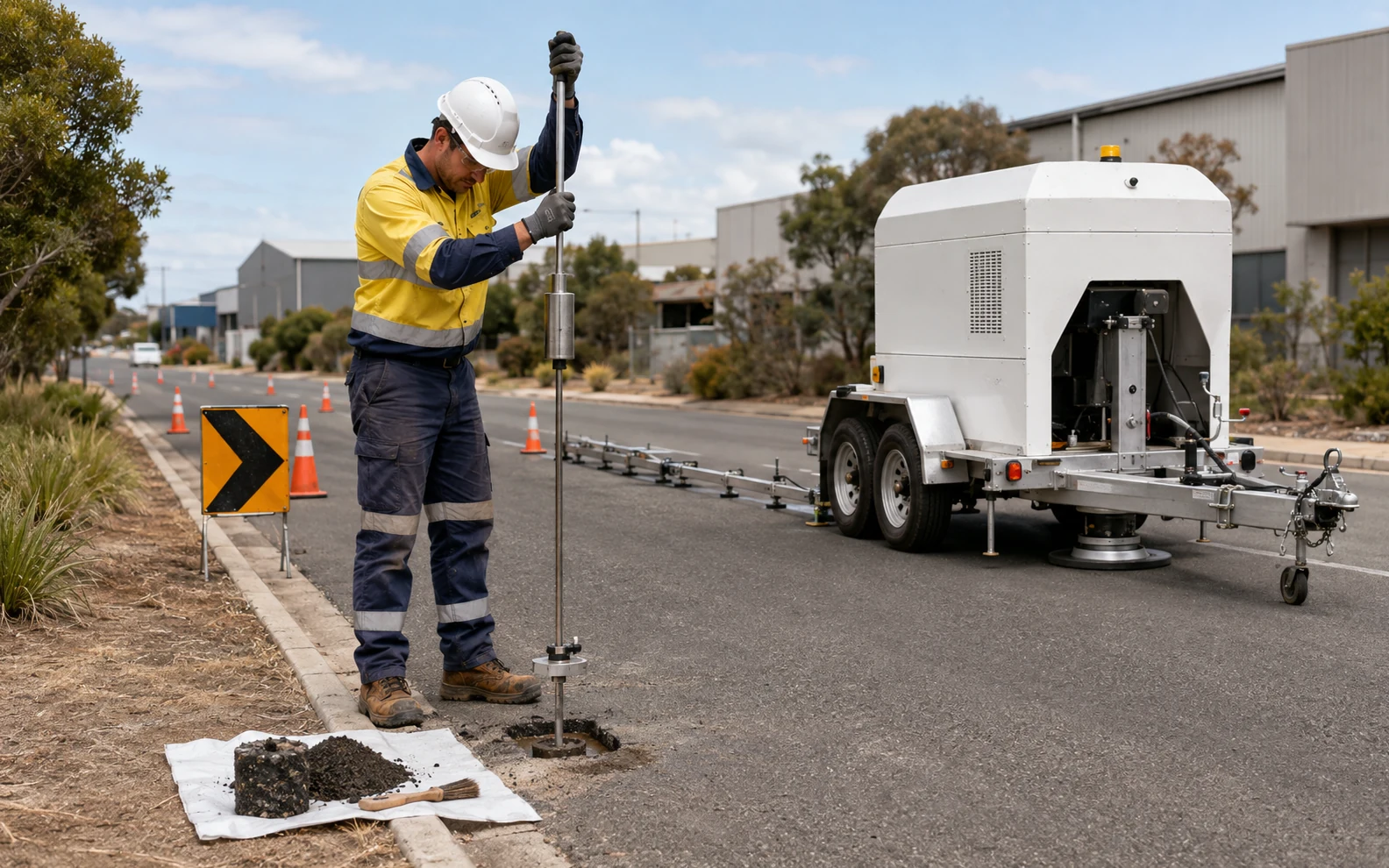
Illustrative field-capability images. Equipment and field providers are confirmed for each commissioned investigation.
Engineering interpretation
A geotechnical report should connect the encountered conditions to foundation selection, settlement, earthworks, construction risk and the information the structural or civil designer actually needs.
Specialist focus
Compressible and variable soils can make settlement, construction access, negative skin friction and time-dependent behaviour more important than ultimate bearing capacity. Investigation methods may include push-tube samples, CPTu, field vane testing, consolidation testing and groundwater monitoring where required.
Recommendations consider conventional excavation, replacement, stabilisation, staged construction, preload, deep foundations and geosynthetic reinforcement on their merits. Product supply is not treated as the default answer.
Discuss a soft-ground sitePavement & subgrade investigations
Existing pavements and new civil platforms can be assessed using a project-specific combination of visual condition data, coring, sampling, DCP, laboratory testing and Falling Weight Deflectometer measurements.
Project pathway
Kontain coordinates the investigation around the design decision while retaining clear responsibility for specialist field services, laboratory data, interpretation and any investigation limitations.
Review the proposed structure, loads, footprint, basements, programme and the decisions the report must support.
Select appropriate boreholes, in-situ testing, sampling, laboratory work and specialist field providers.
Coordinate access, utility information, traffic and site controls, then record the encountered conditions.
Interpret field and laboratory data together, identify variability and test the likely foundation or earthworks response.
Issue usable parameters, recommendations, limitations and construction hold points, then respond to the design team.
Scope clarity
Geotechnical capability flyer
Share the flyer with developers, builders, civil contractors and design teams planning a commercial, industrial, subdivision or significant-structure project in South Australia.
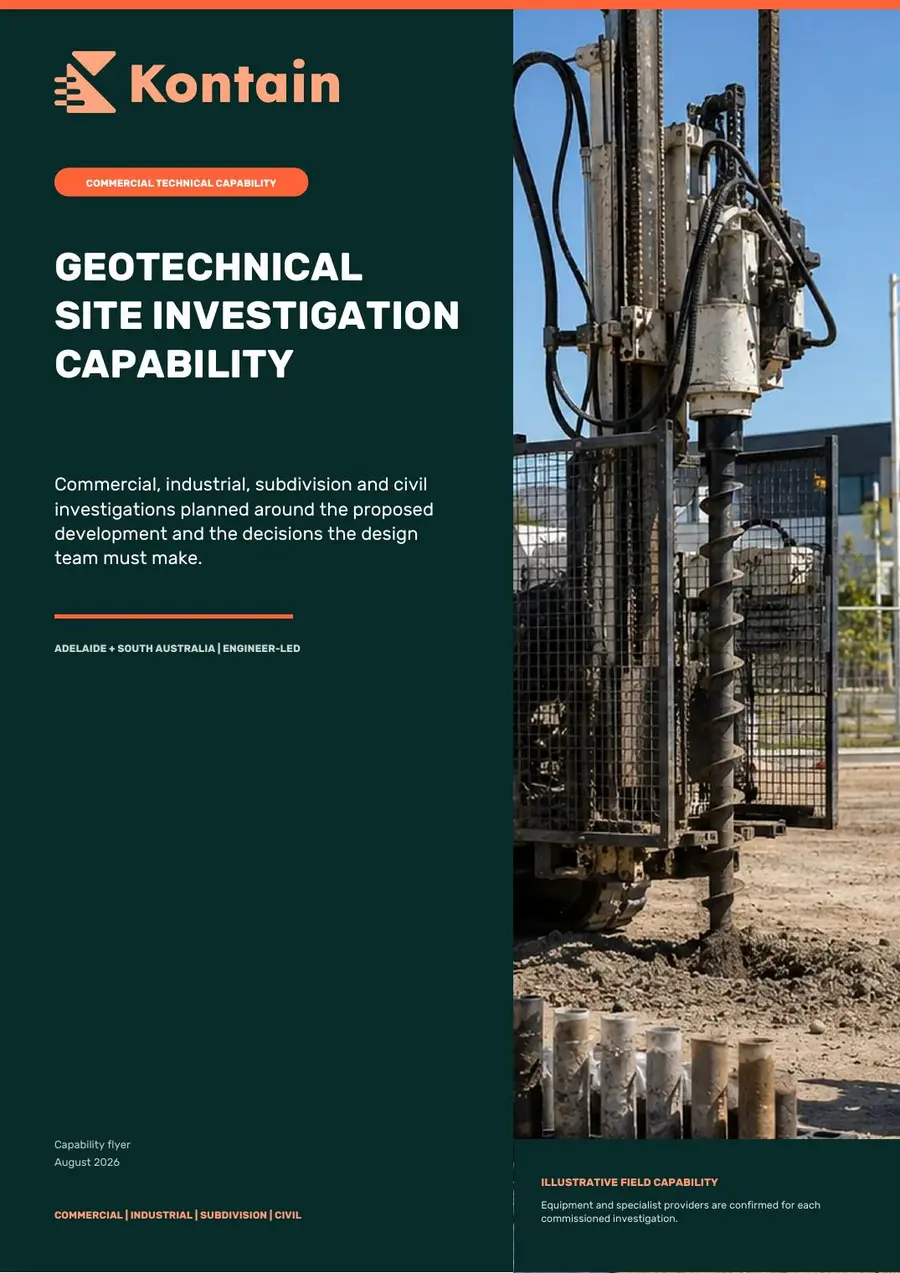 PDF · 4 PAGES
Adelaide & South Australia
Outlines project fit, drilling and in-situ testing, foundation and subgrade analysis, soft-ground capability, report outputs and current service boundaries.
Download capability flyerPlanning a South Australian development?