
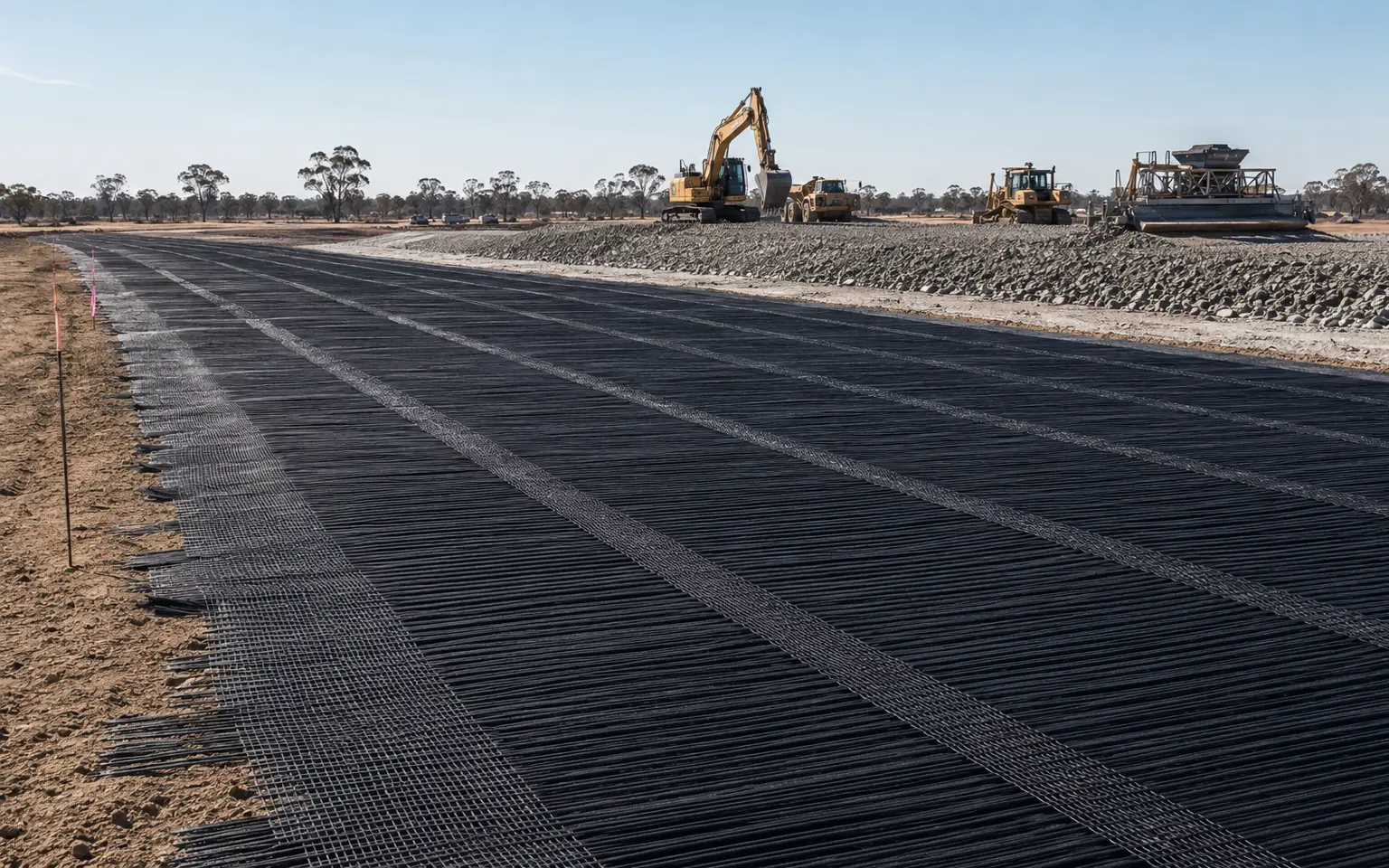
Basal embankment reinforcement
Provides tensile resistance below embankment fill over weak or very soft foundation soils, coordinated with stability and deformation analyses.
StructWoven · high-strength PET systems
StructWoven PET is the long-term reinforcement range: high tensile capacity, reported strength at 5% strain, creep-reduced values and published LTDS. Biaxial and uniaxial products are separated because orientation and load path are design decisions—not ordering details.
Technical resources · 2 files
Current product documents are available here. Selection guidance, installation context and full technical detail continue below.
Biaxial PET reinforcement with equal tensile capacity in both principal directions.
Revision 02 · July 2026 · 2 pagesDownload PDF ↓Technical data sheetStructWoven SW-UUniaxial PET reinforcement for a dominant tensile load path.
Revision 02 · July 2026 · 2 pagesDownload PDF ↓Application boundary
These products are used where stability, load transfer or differential settlement control relies on reinforcement strength over the design life. They are not positioned as routine road separators or as an interlocking pavement geogrid.
Provides tensile resistance below embankment fill over weak or very soft foundation soils, coordinated with stability and deformation analyses.
Spans between pile caps in the designed reinforcement direction. Layer arrangement, anchorage and construction sequence are project-specific.
Supports a defined tensile load path where void geometry, allowable deformation and anchorage have been engineered.
Use BW-PP or BW-LS when separation or road-level deformation control is the duty. PET is selected when structural long-term resistance is required.
StructWoven SW-B
Equal machine- and cross-direction ultimate strength suits two-way reinforcement, uncertain load directions and layouts that require comparable capacity across the full sheet.
| Grade | Ultimate strength MD / CD · kN/m | Elongation MD / CD · % | Strength at 5% MD · kN/m | CBR puncture kN | Creep-reduced MD · kN/m | Published LTDS MD · kN/m |
|---|---|---|---|---|---|---|
| SW-B50 | 50 / 50 | 10 / 10 | 20 | 5 | 36 | 30 |
| SW-B100 | 100 / 100 | 10 / 10 | 45 | 10 | 70 | 58 |
| SW-B150 | 150 / 150 | 10 / 10 | 68 | 14 | 108 | 88 |
| SW-B200 | 200 / 200 | 10 / 10 | 90 | 18 | 143 | 116 |
Hydraulic: opening size O90 ≤ 0.5 mm (EN ISO 12956); water permeability 15 L/m²/s (EN ISO 11058).
Standard rolls: 3.5 m, 4.5 m or 5.2 m wide × 50 m or 100 m long; custom manufacture available.
StructWoven SW-U
Higher machine-direction capacity with 50 kN/m cross-direction strength. Orient the machine direction with the governing force. Primary-direction joints and terminations must follow the design; they are not treated as ordinary overlaps.
| Grade | Ultimate strength MD / CD · kN/m | Elongation MD / CD · % | Strength at 5% MD · kN/m | CBR puncture kN | Creep-reduced MD · kN/m | Published LTDS MD · kN/m |
|---|---|---|---|---|---|---|
| SW-U100/50 | 100 / 50 | 10 / 10 | 45 | 6.5 | 71 | 58 |
| SW-U200/50 | 200 / 50 | 10 / 10 | 90 | 8.5 | 142 | 117 |
| SW-U300/50 | 300 / 50 | 10 / 10 | 135 | 9 | 214 | 175 |
| SW-U400/50 | 400 / 50 | 10 / 10 | 180 | 9.5 | 285 | 232 |
Orientation control
Show roll direction, layer sequence, development length, anchorage, secondary-direction laps and every termination on the drawings. Do not create a primary-direction joint unless the connection has a documented design resistance.
Reduction-factor method
Ultimate tensile strength is not allowable structural resistance. Apply component factors for time, construction and environment, then check the result against the published long-term design strength and the project material factor.
Preliminary design check
See how ultimate strength is reduced for creep, installation, durability and environment, then capped by the published long-term design strength.
Calculated result · primary direction
Screening tool only. Representative installation factors are from third-party testing of a 50/50 PET woven with three specific fills; they do not transfer automatically to every grade, fill or compaction method. Final design requires the engineer's adopted standards, ULS/SLS checks and current project evidence.
Evidence and durability
Independent ASTM D5262 regression on representative PET wovens reported creep reduction factors of 1.39 at 75 years and 1.40 at 114 years at 20°C. Temperature and product-family transfer remain design checks.
Representative ASTM D5818 testing on a 50/50 PET woven returned RFID values from 1.08 to 1.26 across silty sand, concrete sand and graded aggregate base. Final factors depend on the selected fill, lift and plant.
PET is supplied for rapid burial. Protect rolls, minimise exposure and assess pH, temperature and hydrolysis over the design life. Do not use the published range as an exposed geotextile.
Pull-out, direct shear, anchorage and interface coefficients are selected for the project soil and stress range. Commission testing where the structure depends on a specific interaction value.
High-strength reinforcement specifications commonly require current installation-damage testing using representative project fill. Kontain will submit the published evidence and coordinate project testing where the authority or designer requires a current, fill-specific result.
Installation controls
Confirm founding level, drainage, soft spots and design assumptions before unrolling. Do not disturb a weak foundation unnecessarily.
Mark machine direction and layer sequence. Keep uniaxial primary strength aligned with the drawing and biaxial panels in the nominated orientation.
Use specified secondary laps, stitching, anchorage and development length. Primary-direction joints require designed load transfer.
Place specified fill forward over the sheet without direct plant trafficking. Maintain minimum cover, control aggregate size and repair documented damage before burial.
Technical data
Published long-term values are portfolio inputs. The project designer remains responsible for reduction factors, design models, strain limits, load combinations and authority requirements.
Project specifications and the designer's adopted standard govern. Kontain data sheets do not replace project-specific design, authority acceptance or product conformance testing.
Project-specific supply
Send the ground model, design life, geometry, fill, construction sequence and required tensile direction. Kontain will map the design demand to a standard grade or project-specific manufacture.