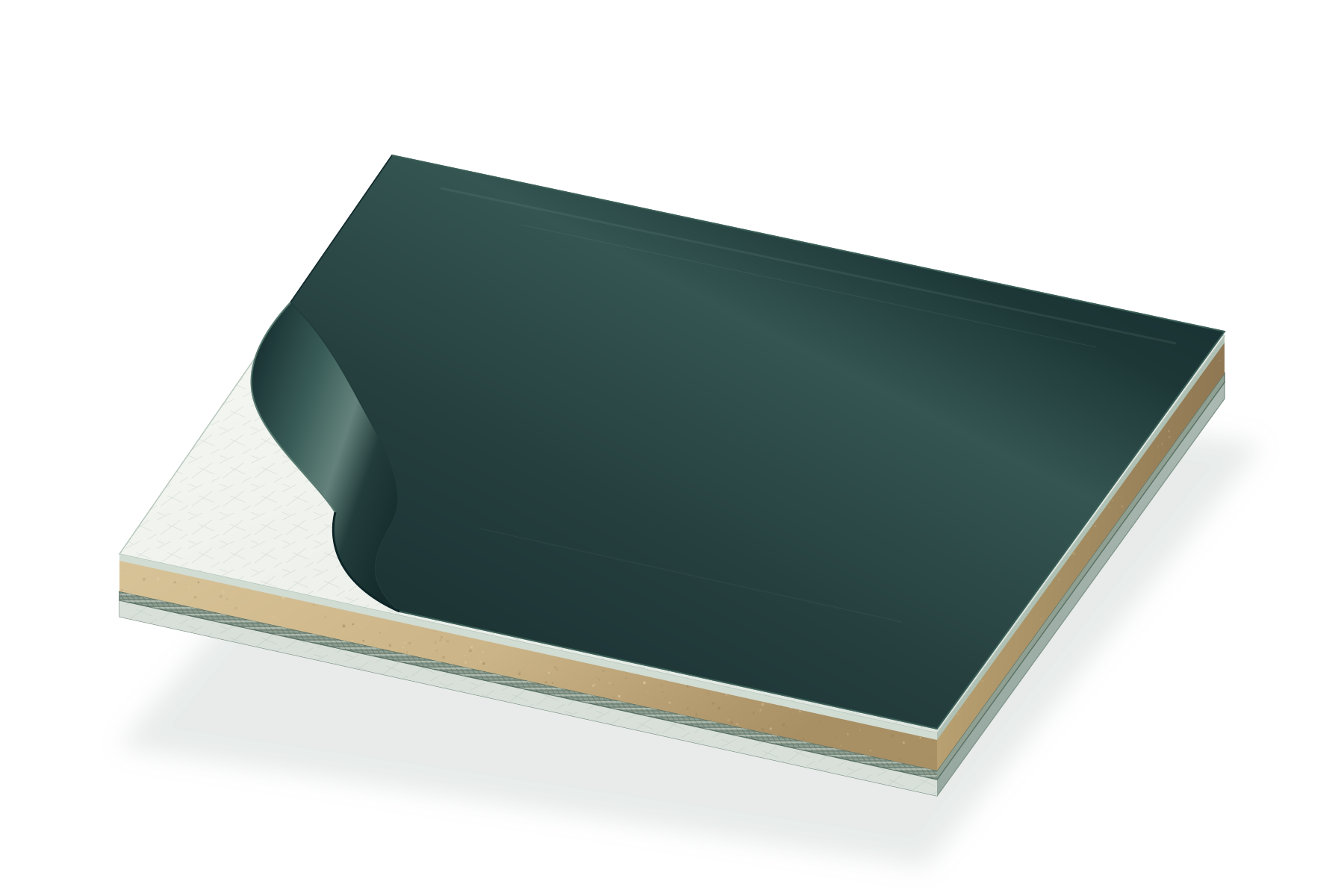
PE-laminated geosynthetic clay liners combine a polyethylene film with a bentonite clay barrier in one factory-made product. Choose the film, carrier construction and bentonite formulation around the lining design.
0.20 / 0.50 mm LDPEStandard / Heavy DutyGranular / polymer-modified
A thicker PE film bonded to the GCL cover nonwoven. Manufacture and any extrusion-sealing procedure require qualification for the actual film, filler and assembly.
Available with either bentonite formulation and all four base constructions. Neither option is wedge weldable.
The film is specified by resin type and nominal thickness. GM13/GM17 compliance is not declared for this thin-film range.
Four base constructions
Standard or Heavy Duty, with 3,700 or 4,000 g/m² dry bentonite.
Standard grades use a woven carrier. Heavy Duty grades add a nonwoven to form a composite carrier. Both use a cover nonwoven of at least 200 g/m². Dry bentonite mass excludes polymer, geotextiles, adhesive and PE.
Construction
Dry bentonite minimum
Carrier minimum
Formulation and film
Standard 37
≥3,700 g/m²
100 g/m² woven
U or P; 0.20 or 0.50 mm LDPE
Standard 40
≥4,000 g/m²
100 g/m² woven
U or P; 0.20 or 0.50 mm LDPE
Heavy Duty 37
≥3,700 g/m²
300 g/m² composite (100 woven + 200 nonwoven)
U or P; 0.20 or 0.50 mm LDPE
Heavy Duty 40
≥4,000 g/m²
300 g/m² composite (100 woven + 200 nonwoven)
U or P; 0.20 or 0.50 mm LDPE
U identifies sodium bentonite granules without polymer addition. P identifies polymer-modified sodium bentonite powder. The full grade code identifies the selected carrier, clay loading, formulation and film.
These terms describe related lining products and systems, but they do not establish the same construction or performance. Check how the polymer barrier is applied, which face carries it, and how the joints are formed.
Laminated GCL
A film is bonded to the geotextile-backed clay liner. Kontain HDL-GCL uses LDPE film bonded to the cover nonwoven, with released longitudinal edge zones for the overlap detail.
Coated GCL
PE-coated GCL products can use an extrusion-applied polymer layer. Extrusion coating and bonding a film are different manufacturing processes; confirm the exact layer, adhesion and seam requirements when comparing a coated GCL.
Composite GCL
For HDL-GCL, the PE film and bentonite GCL form the combined barrier product. A “composite carrier” specifically describes the woven and nonwoven base within a Heavy Duty grade.
Composite liner systems
A composite liner can also comprise a separate geomembrane placed over a GCL. That arrangement has its own interfaces, membrane seams, protection and construction QA requirements.
A bonded thin PE film does not automatically replace a separately specified geomembrane or meet a landfill lining specification.
Hydration and exposure
Granular sodium bentonite or polymer-modified powder.
Granules without polymer addition
Consider the granular U formulation where compatible, low-salinity rainwater or subgrade moisture hydrates the bentonite. Review the actual contact liquid, hydration sequence and confinement.
Polymer-modified sodium bentonite powder
Consider the P formulation where higher drying resistance is sought during prolonged exposure before covering, or lime-affected water, highly saline water or certain leachates may hydrate the clay instead of typical rainwater. Verify the actual liquid and formulation.
Polymer modification does not automatically qualify aggressive liquids or lime-treated fill. Cover promptly; permanent exposed service requires separate design. Source and formulation declarations identify the material supplied.
The TDS values are specified supply requirements, with the stated methods and qualifications. Independent qualification of each finished laminate remains pending. Refer to the project specification and the stated qualification requirements.
Design the overlaps as part of the barrier.
At designated longitudinal joints, maintain at least 300 mm direct GCL contact beneath a separate 300 mm PE overlap. A 400 mm released film zone is specified at those edges. End joints, field cuts, penetrations and repairs require the issued detail.
Current laminated GCL technical data sheets, product range guide and installation guidance. Choose the bentonite formulation and film thickness, then confirm the complete grade code.
Start with the lining section and contact chemistry.
Send the area, slopes, subgrade source, hydration water or liquid analysis, cover programme, joint requirements and delivery location. Kontain can help compare the laminated GCL and composite liner options around the project specification.