
Scope note. This article provides practical technical guidance for project and operational discussions. It does not replace project-specific investigation, testing, design, certification or the appointed project team.
Recover capacity through planned sludge management
Before committing to another treatment pond, establish how much useful volume has been lost to accumulated sludge. Desludging can recover existing capacity where deposits are the limiting factor. It cannot resolve incoming flows or organic loads that exceed the plant’s design capacity.
For WWTP engineers and managers, sludge management belongs in the asset maintenance programme: assess the inventory, understand its effect on the process and schedule removal before it becomes a reactive job.
Download the three-page Kontain technical note PDF for the capacity example, process distinctions and maintenance approach.
Sludge volume and organic loading are different
A pond may contain a large sludge inventory without the remaining material being highly biodegradable. Conversely, a pond with little accumulated sludge can still receive more organic load than its treatment process can manage. The following measures answer different questions.
| Measure | What it tells the operator |
|---|---|
| Sludge volume in cubic metres | How much pond space is occupied by settled deposits, including water within the sludge. |
| Dry solids mass in tonnes | How much solid material must be removed and managed. Needed for dewatering and disposal quantities. |
| Volatile solids as a proportion of dry solids | A useful indicator of organic content. It does not directly measure how rapidly the remaining material will biodegrade. |
| Incoming organic load in kg BOD per day | The daily biochemical oxygen demand entering the plant. This is a load rate, not the sludge inventory. |
Digestion reduces organics but does not eliminate deposits
Biological digestion converts degradable organic matter into other products, including gases and new biomass. Anaerobic digestion operates without oxygen. Residual solids still require management; dewatering is a separate step that removes water and concentrates those solids. Water Corporation describes digestion and dewatering as distinct parts of biosolids processing. [1]
A high organic percentage alone does not establish that a pond needs cleaning. Removal decisions should combine sludge profiling, solids characterisation, process performance and the pond’s intended function. Digestion time and any active biomass that must remain also need consideration.
How excess sludge affects treatment
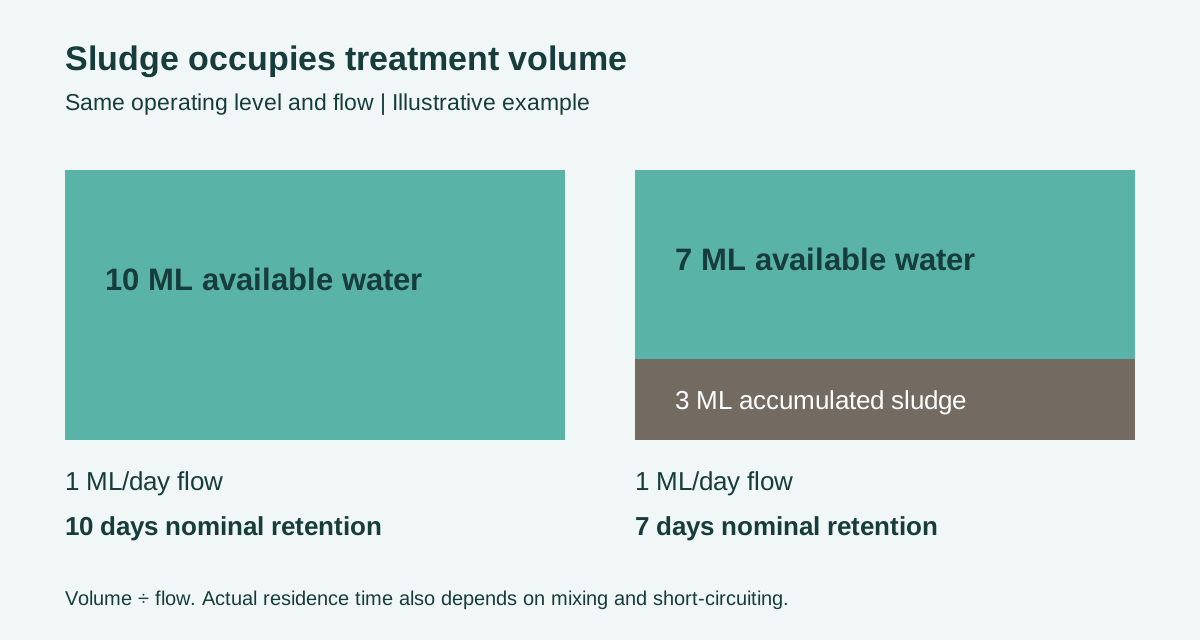
Accumulated sludge displaces water and reduces nominal retention time. Uneven deposits can also affect flow paths. EPA troubleshooting guidance identifies reduced retention time and poor treatment as consequences of excess accumulation, with possible indicators including low dissolved oxygen, high effluent BOD and ammonia. These symptoms require diagnosis because they also have other causes. [2]
| Illustrative condition | Available water volume | Flow | Nominal retention |
|---|---|---|---|
| Before excess accumulation | 10 ML | 1 ML/day | 10 days |
| With 3 ML displaced by sludge | 7 ML | 1 ML/day | 7 days |
Nominal retention time = available water volume ÷ wastewater flow. This example assumes fixed operating level and flow; it is not a prediction of treatment efficiency. Actual residence time also depends on mixing and short-circuiting.
Where oxygen fits
Aerated and facultative lagoons need an adequate oxygen balance in their aerobic treatment zones. Excess degradable material can increase oxygen demand; removing deposits can help where they contribute to overloading. It does not replace adequate aeration or reduce the incoming load. [2]
Anaerobic ponds intentionally operate without dissolved oxygen. Their maintenance objective includes preserving useful volume while retaining appropriate active biomass. Water Corporation advises that anaerobic pond sludge should not be removed entirely because of the loss of biomass. Sludge storage or digestion lagoons also require a process-specific assessment rather than an assumption that more oxygen is needed. [3]
Make assessment routine and removal condition based
Kontain recommends including lagoon sludge management in the asset maintenance plan. Routine management means recurring assessment, a forecast budget and an agreed removal trigger. It does not mean every pond should be dredged annually or stripped clean.
- Baseline the asset: confirm pond function, operating levels, liner type, sludge profile and available treatment volume.
- Track the trend: repeat surveys at an interval set by accumulation rate, risk and licence conditions; review influent load and effluent performance alongside them.
- Plan the intervention: agree the target removal depth or volume, residual biomass requirements, operating constraints and lawful solids destination.
- Verify and update: record quantities removed, confirm the remaining sludge profile and use the results to forecast the next campaign.
Recovering lost capacity may defer expansion where accumulation is the limiting factor. Genuine hydraulic or organic growth beyond design capacity still needs a separate upgrade assessment.
Geobags as part of a scheduled campaign
Water Corporation’s waste stabilisation pond guidance describes dredging sludge to geobags, with polymer conditioning to assist solids separation and provision for collecting drainage. It also recognises that drying beds or other methods may be preferable in some circumstances. [3]
For a planned geobag campaign, allow for the full cycle: sludge sampling and dewatering trials; pad preparation; controlled dredging, conditioning and filling; drainage and consolidation; then removal of dewatered solids. Online dredging may be possible where the plant’s operating constraints permit it. [3]
Kontain proposes scheduling bag filling and drying in stages so dewatering space is available when the next batch arrives. Bag dimensions, fill limits, polymer selection, filtrate quality and target handling condition should be established for the actual sludge. Drying time and final solids content should not be promised before testing and site assessment.
The work area needs suitable access, stable support, containment and drainage. Returned filtrate adds flow and potentially pollutants back to the plant, so its destination and return rate must be agreed with operations. Compare geobags with centrifuges, presses and drying beds on total cost, footprint, programme and handling requirements.
Start with a survey that measures the right thing
A bathymetric survey can help establish pond geometry and remaining water volume, but the survey brief needs to distinguish the water surface, top of sludge and underlying pond base. A water-depth surface alone does not necessarily establish sludge thickness.
For a feasibility review, check the survey method, datum, water level, coverage, interface interpretation and the reliability of the pond-base reference. Where that reference is uncertain, supplementary sludge probing or suitable interface measurements may be needed. Protect the liner during investigation and removal.
Surveyed wet sludge volume also needs representative solids testing before it can be converted into dry tonnes or a dewatering quantity. Record the assumptions so subsequent surveys and contractor prices are comparable.
Kontain can review existing bathymetric and sludge survey information with your operations team and survey specialist, identify gaps and help define a scope for the next assessment.
How Kontain can help
Kontain supplies Kontainer™ dewatering geobags and can work with the WWTP team and experienced dredging contractors to develop and price a coordinated clean-out package. Support can include:
- Reviewing available sludge surveys and site information to establish a preliminary scope and budget.
- Coordinating sludge sampling and dewatering trials with the project team, and selecting a suitable bag configuration and operating approach.
- Developing dewatering pad, containment, drainage and filtrate management requirements with the relevant designers and operators.
- Bringing together dredging and geobag supply pricing, with clear responsibilities for solids handling, transport, reuse or disposal.
For an initial assessment, provide the latest sludge survey, pond drawings and liner details, sludge test results, available laydown area, operating restrictions and required completion date. Kontain can then help define a practical scope for comparative pricing.
Dewatering alone does not demonstrate stabilisation, pathogen reduction or suitability for land application. Confirm the applicable state requirements, testing and approved end use or disposal pathway before mobilisation. [4]
Discuss a feasibility assessment with Kontain
Send through your pond drawings, latest bathymetric or sludge survey, available sludge test results and preferred timing. We can review the basis for sludge-volume estimates, recoverable capacity, dewatering footprint and programme, then work with experienced dredging contractors to develop comparative package pricing.
Contact Kontain about a feasibility assessment and bathymetric survey review, or explore our Kontainer™ geobag systems.
References
[1] Water Corporation. Biosolids. watercorporation.com.au/our-water/wastewater/biosolids
General technical guidance for lagoon assets. Removal targets and operating methods require site-specific agreement. References accessed 20 October 2026. | kontainsolutions.com

Ben Lewis
Founder and Technical Lead, Kontain. Technical geosynthetic selection and project-direct supply for Australian civil, mining, water and waste infrastructure.
About Kontain