
Scope note. This article provides practical technical guidance for project and operational discussions. It does not replace project-specific investigation, testing, design, certification or the appointed project team.
Originally published by Kontain on LinkedIn .
An intact GCL can still be a changed barrier
A composite liner can look physically continuous while its active mineral barrier no longer behaves like the material that left the factory. That distinction is easy to miss because routine inspection naturally focuses on tears, thinning, displacement and obvious loss of containment.
A 2026 study of a geosynthetic clay liner exhumed after 12 years provides a rare view of the less visible changes. The GCL remained beneath its HDPE geomembrane and retained measurable chemical membrane behaviour, but that behaviour was substantially weaker than in stored virgin material of the same product and similar age.
The result is more useful than a simple pass-or-fail label. It shows both resilience and change: the barrier mechanism survived an unusually severe exposure, yet its long-term condition could not be represented accurately by virgin-product data alone.
What the 12-year field comparison examined
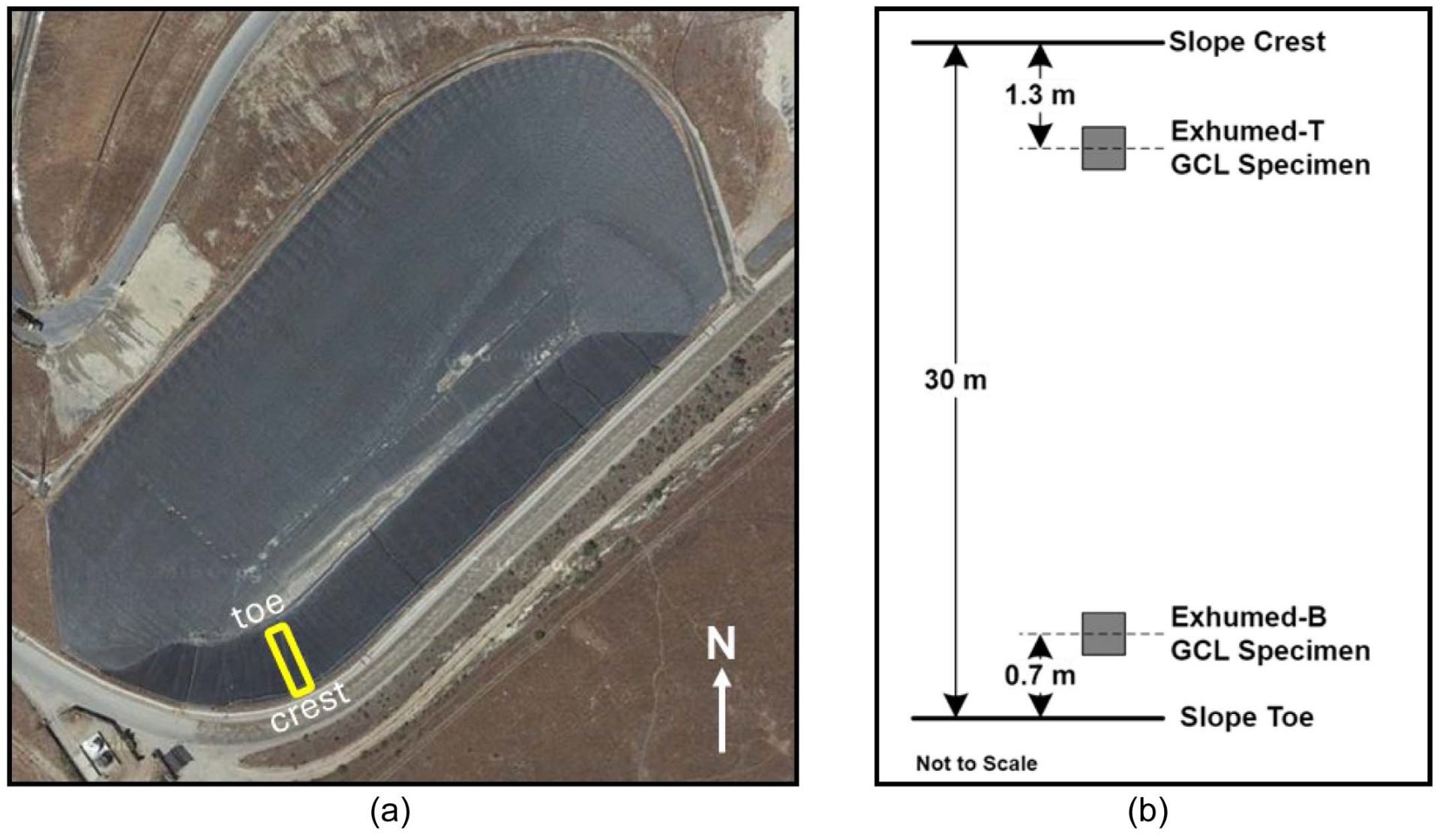
The researchers examined a needle-punched sodium-bentonite GCL installed beneath a 1.5 mm HDPE geomembrane at a municipal landfill in California. The liner was constructed in 2004, but operational changes left the cell unused and uncovered by protective soil, drainage aggregate or waste for 12 years.
That unusual history subjected the composite liner to long-term temperature cycling, condensation and moisture movement. Samples were recovered near the crest and toe of a roughly 30 m long, 2H:1V slope. A stored virgin roll of the same product and similar manufacturing age provided the comparison material.
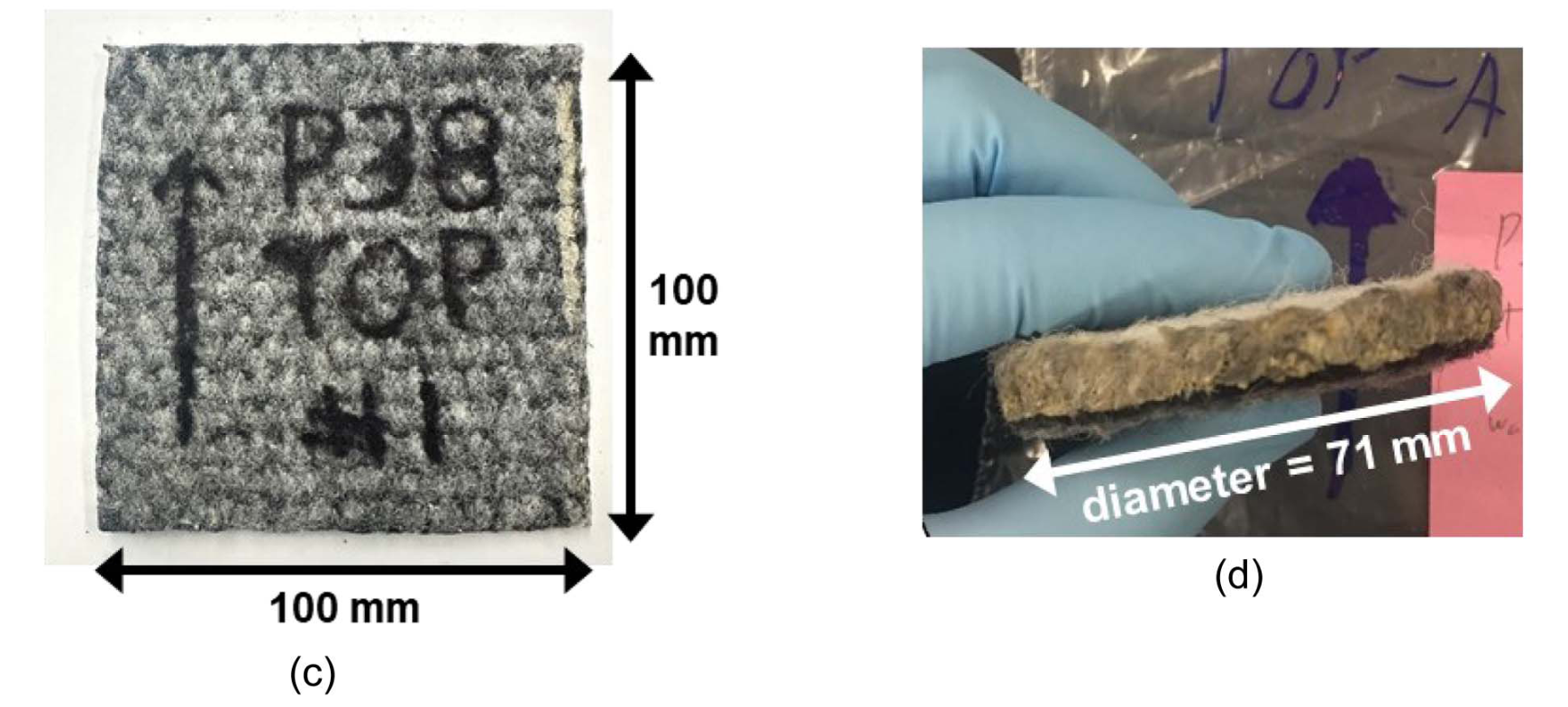
Testing used potassium chloride solutions between 5 and 50 mmol/L to assess chemical membrane behaviour. This behaviour is different from hydraulic conductivity. Hydrated sodium bentonite can act as an imperfect semipermeable membrane: its small, electrically charged pores partially restrict dissolved-ion movement and can reduce contaminant transport beyond the effect of low water flow alone.
Membrane performance survived, but fell sharply
The membrane efficiency coefficient expresses the strength of this ion-restriction effect. Zero indicates no membrane behaviour; 100% would represent a theoretically perfect semipermeable membrane. The maximum measured efficiencies were:
- Stored virgin GCL: approximately 34%
- Exhumed crest sample: approximately 7.7%
- Exhumed toe sample: approximately 7.2%
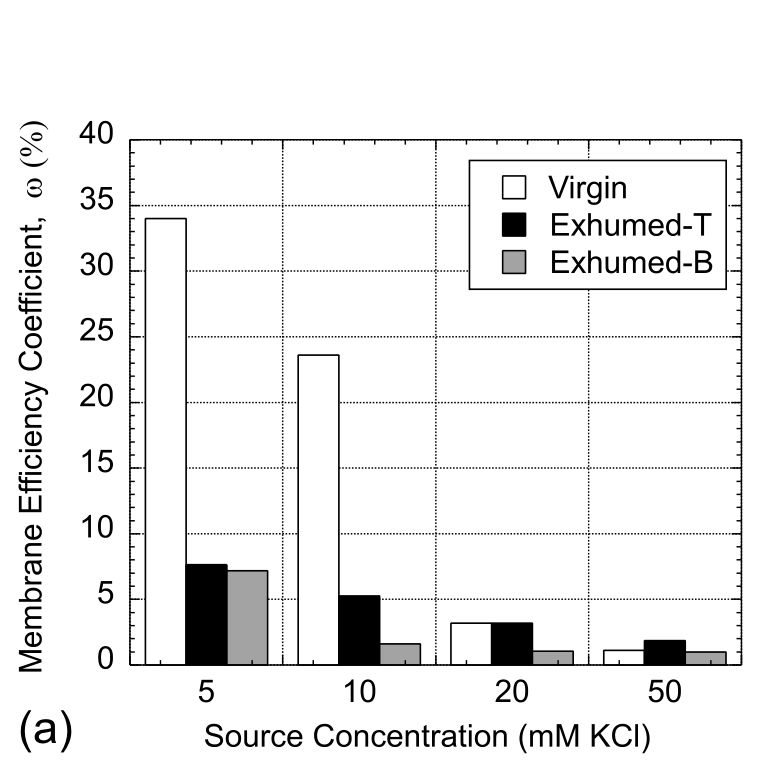
For the dilute solutions, the crest sample's membrane efficiency was about 78% lower than the virgin comparison. The GCL had not lost all membrane behaviour, but most of its original apparent effectiveness was no longer present.
That result should not be converted into a universal reduction factor. It does show why long-term contaminant-transport modelling needs to distinguish between the initial product and the material that exists after installation, hydration, exposure and chemical interaction.
Bentonite moved even though the geotextiles remained continuous
Temperature changes produced condensation between the geomembrane and GCL. Water then moved downslope and carried bentonite with it. The measured bentonite mass per unit area was approximately 4.3 kg/m² in the stored virgin GCL, 3.9 kg/m² at the exhumed crest and 4.9 kg/m² at the exhumed toe.
The pattern is consistent with loss from the upper slope and accumulation lower down. The geotextile components could remain apparently intact while the active bentonite layer became spatially non-uniform. Visual continuity therefore did not guarantee uniform barrier performance.
For design and forensic assessment, the location of the bentonite matters as much as the average quantity. A single sample or a mass-per-area result from one position cannot describe the condition of an exposed slope liner.
Chemistry mattered as much as bentonite mass
The toe contained more bentonite than the crest, but did not recover the stronger membrane behaviour of the virgin material. The wetter lower-slope material had also undergone substantial cation exchange: sodium in the bentonite was replaced by calcium associated with the underlying soil.
Calcium-dominated bentonite generally swells less than sodium bentonite. The associated change in pore structure can increase hydraulic conductivity and weaken the exclusion of dissolved ions. More bentonite mass at the toe therefore did not automatically produce better chemical containment.
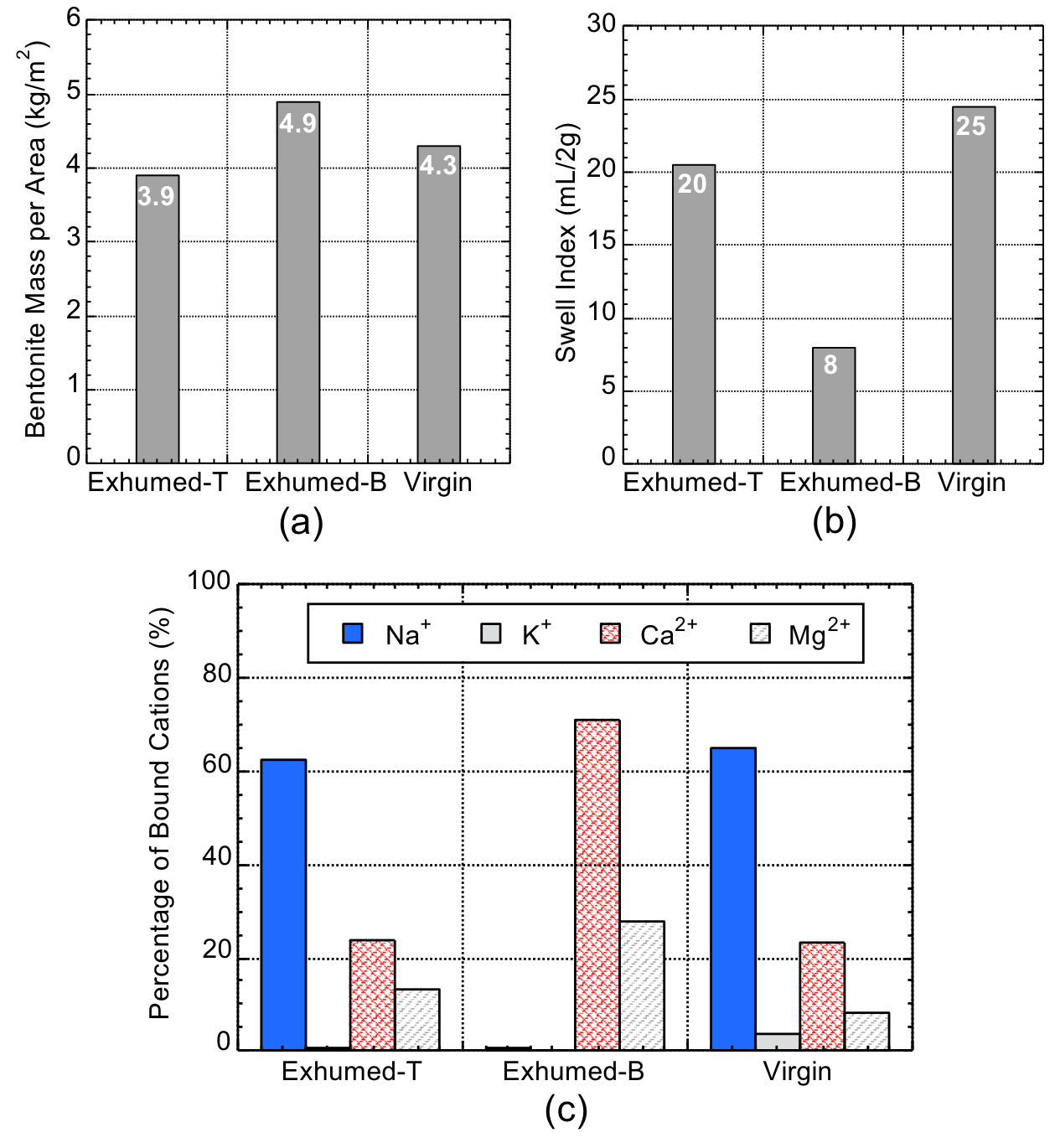
This is the central engineering lesson. Bentonite mass is an important manufacturing and conformance property, but it is not a complete description of an aged barrier. Distribution, hydration history, exchangeable cations, confinement and contact with the subgrade all influence the condition that develops in service.
What this changes for design and construction
The study points to several practical controls rather than a single new design number:
- Treat prolonged uncovered exposure as a potential permanent-performance issue, not only a programming or temporary-works concern.
- Limit the period before cover and confinement where the design and construction sequence allow it, particularly on slopes exposed to temperature cycling and condensation.
- Investigate crest, midslope and toe conditions separately when assessing an exposed liner; bentonite loss and chemical change may not occur in the same locations.
- Use condition testing that addresses the question being asked. Bentonite mass, hydraulic conductivity, swell index and exchangeable-cation testing provide different evidence.
- Separate virgin manufacturing properties, post-installation properties and long-term field-conditioned properties in contaminant-transport models instead of treating them as one fixed dataset.
These are evidence and risk-management decisions. The appropriate investigation still depends on the liner configuration, exposure history, consequence of leakage and the design model being verified.
The limits—and the useful conclusion
This was one landfill, one GCL product and an unusually long uncovered period. Only a limited number of specimens were tested for membrane behaviour, the GCL was not exposed to actual landfill leachate, and the study did not measure full-scale leakage through the composite liner. It does not demonstrate complete hydraulic failure, nor does it show that every exposed GCL will respond in the same way.
The survival of measurable membrane behaviour after 12 years can reasonably be read as evidence of resilience. At the same time, the large reduction from the virgin comparison shows why intact appearance and original product data are not enough to define long-term chemical performance.
The GCL still functioned, but the bentonite had moved, exchanged cations and become a materially different barrier from the stored virgin product.
Source study: Shan Tong, Kristin M. Sample-Lord, Sayed A. B. Rahman, Nazli Yeşiller, James L. Hanson and Fatih Polat, Membrane Behavior of Exhumed Geosynthetic Clay Liners, Journal of Geotechnical and Geoenvironmental Engineering, 152(4), 04026006 (2026).
Figure credits: the photographs, sampling diagram and results plots above are reproduced from the source study under the Creative Commons Attribution 4.0 International licence. Figure 1 is presented as two groups of panels and Figure 7(a) is shown separately; Figure 3 is reproduced in full. Surrounding page text has been cropped away, and the original image content, labels and data have been retained.

Ben Lewis
Founder & Technical Lead, Kontain. Technical geosynthetic selection and project-direct supply for Australian civil, mining, water and waste infrastructure.
About Kontain