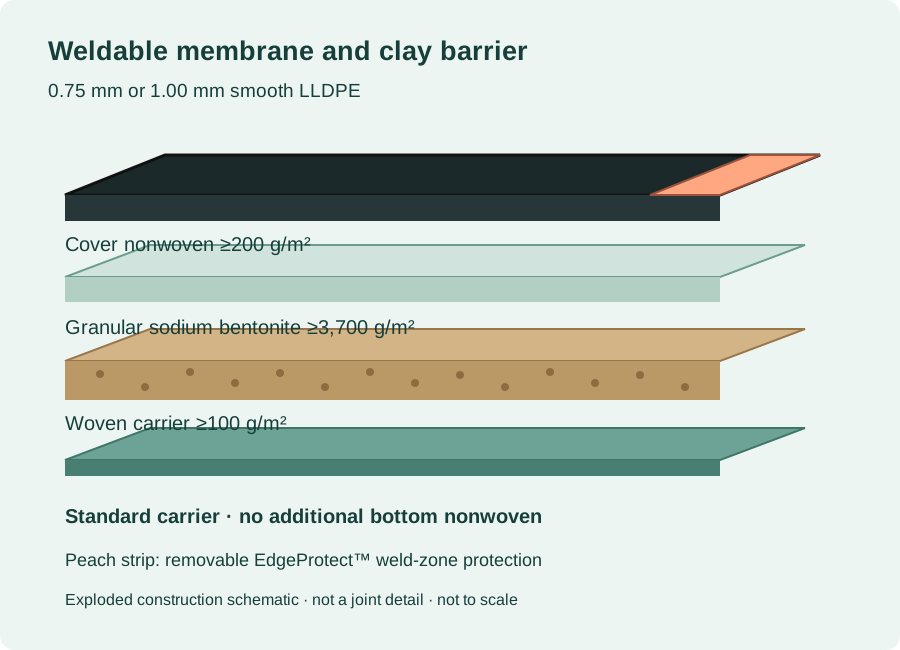
A 0.75 mm or 1.00 mm GM17 LLDPE membrane laminated to a granular sodium bentonite GCL. Join the free membrane margins by hot-wedge or extrusion welding to form the membrane seam.
GM17 LLDPE membraneGranular bentonite · no polymer dosingEdgeProtect™ weld strips
Standard woven carrier, with no additional bottom nonwoven. Exploded schematic; layer thicknesses exaggerated.
A separate weldable range
Two membrane thicknesses. The same granular GCL core.
GCL-W S37U-075
0.75 mm smooth black LLDPE
Membrane specified to GRI-GM17 Revision 17. Standard GCL construction with ≥3,700 g/m² dry granular sodium bentonite, ≥200 g/m² cover nonwoven and ≥100 g/m² woven carrier.
No bentonite polymer dosing and no additional bottom nonwoven. Includes protected factory weld margins for wedge or extrusion welding.
Membrane specified to GRI-GM17 Revision 17. Standard GCL construction with ≥3,700 g/m² dry granular sodium bentonite, ≥200 g/m² cover nonwoven and ≥100 g/m² woven carrier.
No bentonite polymer dosing and no additional bottom nonwoven. Includes protected factory weld margins for wedge or extrusion welding.
Values are specified supply requirements, not batch test results or statistically established MARV. The GM17 schedule applies to the smooth black LLDPE membrane component. GCL-core, lamination and installed-seam properties are declared separately.
GCL construction and properties.
Property
Test method or basis
Unit
Requirement
Bentonite
Source and formulation declaration
—
Granular sodium bentonite
Bentonite polymer dosing
Formulation declaration
—
None
Dry bentonite mass at 0% moisture
ASTM D5993 plus records
g/m²
≥3,700
Cover nonwoven polypropylene
ASTM D5261
g/m²
≥200
Carrier woven polypropylene
ASTM D5261
g/m²
≥100
Additional carrier nonwoven
Construction declaration
—
Not included
Swell in reagent water
ASTM D5890
mL/2 g
≥24
Fluid loss
ASTM D5891
mL
≤18
Moisture content
ASTM D5993
%
≤13
GCL tensile strength MD / CMD
ASTM D6768
kN/m
≥10 / ≥10
Internal GCL peel
ASTM D6496
N/m
≥360
GCL static puncture CBR
EN ISO 12236
N
≥1,600
Hydrated peak internal shear at 10 kPa normal stress
ASTM D6243
kPa
≥30
PE to cover peel in bonded field
Agreed PE/nonwoven procedure
N/m
≥300
Core freshwater hydraulic conductivity
ASTM D5084 GCL setup
m/s
≤5 × 10⁻¹¹
Core freshwater index flux q10
ASTM D5887
m³/(m²·s)
≤2.7 × 10⁻⁹
Dry bentonite mass excludes geotextiles, adhesive and membrane. Both grades use the Standard 37 GCL construction with sodium bentonite granules, no bentonite polymer dosing and no additional bottom nonwoven.
GCL hydraulic values apply to the clay core, excluding the LLDPE and joints. Specify hydration liquid, confinement, gradient and equilibrium criteria. The Standard-grade index-flux requirement needs construction-specific verification; chemical compatibility requires representative liquids and ASTM D6766 within scope.
GCL CBR puncture, membrane index puncture, internal GCL peel and laminate peel are separate tests. Peak shear is not a residual or interface design value. Supply roll dimensions, mass, core and edge configuration are order-specific.
Smooth black LLDPE
Full GM17 membrane schedule.
Membrane property
Method
Unit
0.75 mm
1.00 mm
Minimum MQC
Minimum average thickness
D5199
mm
≥0.75
≥1.00
Each roll
Lowest of ten thickness readings
D5199
mm
≥0.675
≥0.900
Each roll
Formulated sheet density
D1505 / D792
g/cm³
≤0.939
≤0.939
90,000 kg
Break strength MD / CMD
D6693 Type IV
kN/m
≥20
≥27
9,000 kg
Break elongation MD / CMD
D6693 Type IV
%
≥800
≥800
9,000 kg
2% secant modulus
D5323
MPa
≤414
≤414
Each formulation
Tear resistance
D1004
N
≥70
≥100
20,000 kg
Membrane index puncture
D4833
N
≥190
≥250
20,000 kg
Axisymmetric break strain
D5617
%
≥30
≥30
Each formulation
Carbon black content
D4218
%
2.0–3.0
2.0–3.0
20,000 kg
Carbon black dispersion
D5596
—
9 of 10 views Category 1 or 2; ≤1 Category 3
Same
20,000 kg
Initial standard OIT OR
D8117
min
≥100
≥100
90,000 kg
Initial high-pressure OIT
D5885
min
≥400
≥400
90,000 kg
90-day oven ageing at 85°C: retained standard OIT OR
D5721 + D8117
%
≥35
≥35
Each formulation
90-day oven ageing at 85°C: retained HP-OIT
D5721 + D5885
%
≥60
≥60
Each formulation
1,600-hour UV: retained HP-OIT
D7238 + D5885
%
≥35
≥35
Each formulation
Basis: GRI-GM17 Revision 17, 11 June 2025, smooth black LLDPE Table 1(b). Values follow the stated minimum averages, maxima or ranges; GM17 does not define these as MARV or MaxARV. Tensile averages use five specimens in each direction; break elongation uses a 50 mm gauge length and 50 mm/min.
Use either listed initial OIT route and either listed oven-ageing retention route. Standard OIT is not the UV acceptance route. UV exposure uses 20 hours at 75°C followed by 4 hours condensation at 60°C; HP-OIT retention is assessed relative to its initial value. Intermediate oven checks at 30 and 60 days are recommended.
Virgin resin with no more than 10% same or approved-formulation rework; no post-consumer resin. Alternative carbon-black methods D1603 or D6370 need correlation with D4218. ASTM prefixes apply to all methods. Incoming-sheet MQC and post-lamination checks must establish that processing preserves the specified membrane properties.
Factory-released membrane margins keep clay, textiles and adhesive clear of the weld path. Retain direct GCL contact beneath the welded membrane joint. Use the issued detail for end laps, cut edges, penetrations and repairs.
Seam property
Method
Unit
0.75 mm
1.00 mm
Hot-wedge shear strength
ASTM D6392
N/25 mm
≥197
≥263
Hot-wedge peel strength
ASTM D6392
N/25 mm
≥166
≥219
Extrusion-fillet shear strength
ASTM D6392
N/25 mm
≥197
≥263
Extrusion-fillet peel strength
ASTM D6392
N/25 mm
≥150
≥190
Laboratory shear elongation, both methods
ASTM D6392
%
≥50
≥50
Maximum peel separation, both methods
ASTM D6392
%
≤25
≤25
Seam requirements follow the GM17 Revision 17 appendix, Table 3(b). Require compliant strength and acceptable ductile break behaviour; all five shear specimens must meet the strength and laboratory elongation requirements, and all five specimens must show acceptable break patterns. Test both tracks of a dual-track weld. Field elongation measurements are omitted under the appendix.
Wedge welding forms primary seams; extrusion fillet welding forms compatible details, repairs and connections. Qualify the actual membrane, filler, machine and laminated assembly with site trial welds. Use non-destructive testing compatible with the seam geometry and destructive testing at the project CQA frequency. Seam compliance is the installer's responsibility.
Included weld-zone protection
Keep bentonite dust off the welding faces.
EdgeProtect™ removable film strips protect the designated mating LLDPE weld faces. Bentonite dust can contaminate a seam and impair fusion, so keep the strips in place during handling and deployment.
Factory-supplied EdgeProtect™ removable film strips protect both mating LLDPE weld faces at the designated welding margins during rolling, transport and deployment.
Leave the strips in place until immediately before preparation and welding. Bentonite dust in the seam can disrupt fusion and reduce weld quality.
Peel the strips away completely, contain loose bentonite and inspect both faces. Weld faces must be clean, dry and free of adhesive or film residue. Clean any recontamination and prepare extrusion areas under the qualified procedure.
Keep clay, geotextiles and lamination adhesive out of the weld path. Use factory-released margins with sufficient free LLDPE width for the welder, tracking and seam testing.
Retain at least 300 mm direct GCL contact beneath the membrane joint and a separate at least 300 mm LLDPE overlap at designated longitudinal joints. End laps, cut edges, penetrations and repairs use the issued welded-system detail.
Assess subgrade protection, hydration, contact chemistry, cover loading and hydrated internal/interface shear for the complete lining system. No added bottom nonwoven or bentonite polymer treatment is included. EdgeProtect™ reduces contamination exposure; it does not replace cleaning, trial welds or CQA. GM17 membrane requirements do not establish whole-system landfill compliance or an exposed service life.
Technical resources · 1 file
Key documents
A separate TDS for GCL-W S37U-075 and S37U-100. The thin-film HDL-GCL schedules cover different products.
Send the area, subgrade, hydration water and contained-liquid chemistry, slopes, cover or exposed-service requirements, penetrations, joint details and delivery location. Roll dimensions and handling provisions are specified for the order.