
Scope note. This article provides practical technical guidance for project and operational discussions. It does not replace project-specific investigation, testing, design, certification or the appointed project team.
A useful comparison for landfill cap design
For landfill caps exposed to calcium-rich water and repeated drying, this study gives a strong reason to favour a polymer-modified GCL backed by relevant testing. The benefit was substantial, and using the same base bentonite makes the comparison particularly useful.
Zhao and colleagues compared a conventional sodium-bentonite geosynthetic clay liner (GCL) with one made from the same bentonite plus 2% of a proprietary polymer blend. Both underwent wet–dry cycling with the same aggressive calcium-rich test solution and 10 kPa confinement. Each wetting stage involved at least four weeks of permeation, followed by controlled drying.[1]
Using the same bentonite removes a major source of uncertainty in comparing products: differences in the clay itself. That strengthens the evidence that the polymer treatment contributed to the improved performance.
The benefit was retained performance
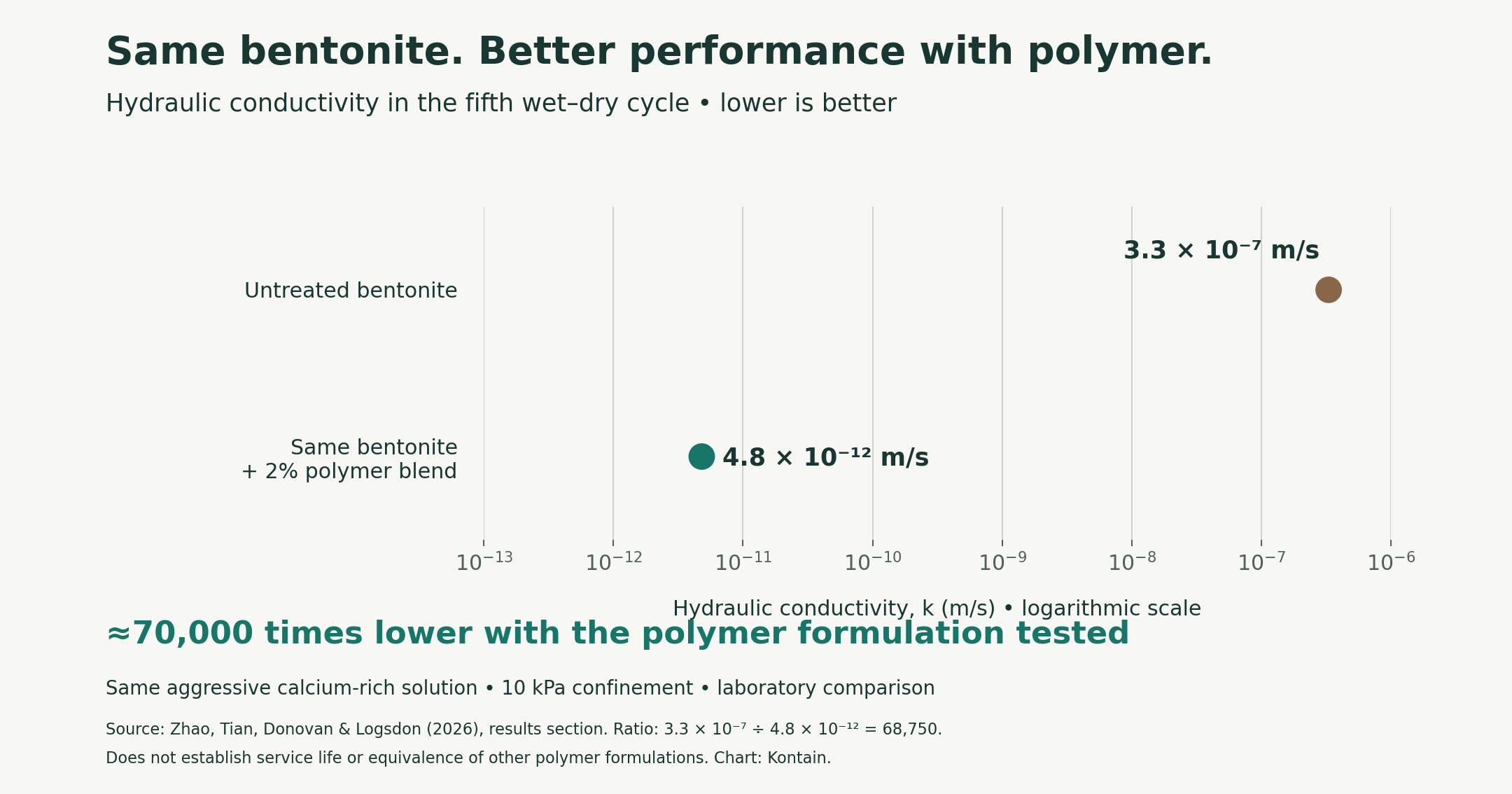
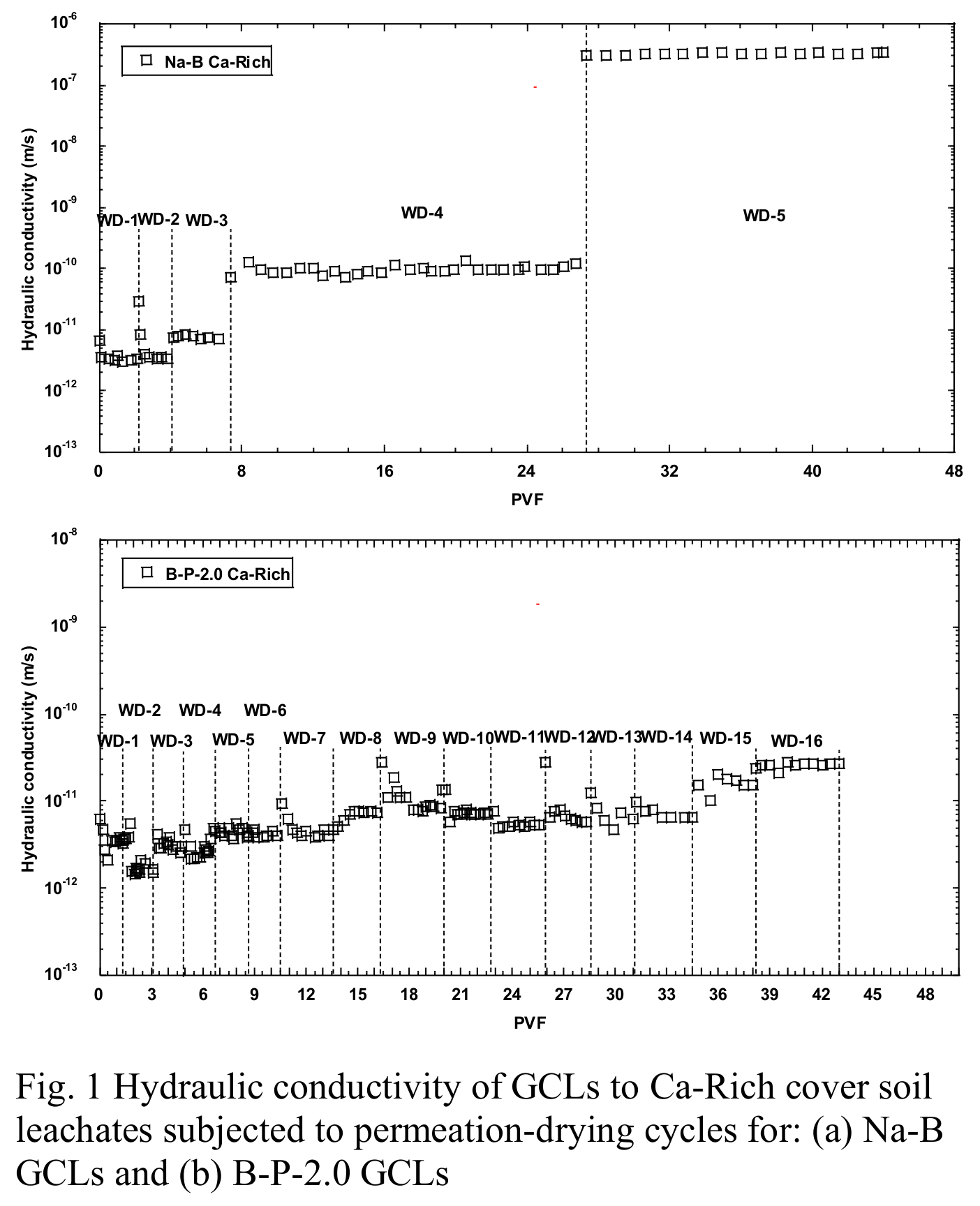
The untreated GCL started with very low hydraulic conductivity, around 3.4 × 10⁻¹² m/s. Its performance then deteriorated markedly. The paper’s results section reports the following values in the fifth cycle:[1]
| GCL | Hydraulic conductivity in the fifth cycle |
|---|---|
| Same bentonite, untreated | 3.3 × 10⁻⁷ m/s |
| Same bentonite, with 2% polymer blend | 4.8 × 10⁻¹² m/s |
Hydraulic conductivity measures how readily water moves through the material. The polymer-treated specimen’s value was approximately 70,000 times lower at that stage. It also maintained low conductivity across sixteen cycles, within a reported range of 1.8 × 10⁻¹² to 2.7 × 10⁻¹¹ m/s.[1]
The useful benefit here is retained performance after exposure. An excellent initial result did not protect the untreated material from subsequent deterioration.
The authors explain that drying can create cracks, while calcium exposure can suppress bentonite swelling and limit resealing. They attribute the treated material’s performance to the polymer hydrogel retaining swelling and helping seal flow paths. That provides a practical reason to consider polymer modification where those conditions are expected.[1]
What about polymer and bentonite washing out?
Concerns about polymer washing out deserve scrutiny. This paper does not measure polymer in the discharged liquid or quantify how much remained. It therefore cannot establish that no polymer was lost. What it does establish is that the treated material retained a substantial hydraulic advantage during repeated permeation and drying. For the duration and conditions tested, the concern that polymer treatment would lose its benefit was not borne out by the performance results.
Bentonite itself can also be lost through internal erosion; BPEM recognises this risk, including where a GCL sits over a permeable layer.[2] However, this paper does not measure bentonite loss. The untreated specimen’s deterioration cannot be presented as evidence that its clay washed away, and the results do not prove that polymer prevents bentonite washout.
Would the untreated bentonite meet BPEM?
On bentonite quality, the untreated material’s reported initial swell index of 24 mL/2 g matches BPEM’s numerical minimum. The paper provides no montmorillonite, carbonate or cation-exchange measurements to compare with BPEM’s material limits. Organic carbon, a further BPEM design consideration, is also unreported. Broader compliance cannot be established.[1,2] That gap does not erase the value of comparing treatment using the same bentonite.
| BPEM bentonite property | BPEM criterion / consideration | Evidence in this paper |
|---|---|---|
| Swell index | ≥24 mL/2 g | Initial untreated value: 24 mL/2 g; matches the numerical minimum |
| Montmorillonite | >70% by weight | Not reported |
| Carbonate content | <1–2% by weight | Not reported |
| Cation exchange capacity | ≥70 meq/100 g | Not reported |
| Organic carbon | Design consideration; no numerical limit in the E.4 table | Not reported |
Give polymer modification preference where the exposure warrants it
My view is that this is a strong case for giving polymer modification preference where a landfill cap faces comparable chemical exposure and wet–dry cycling. Designers and asset owners should ask suppliers to demonstrate that durability for the proposed formulation. Installers should retain the specified protection and confinement controls; this was a confined laboratory comparison.
The evidence supports the polymer formulation tested. It does not establish a service life or make every polymer blend equivalent. Within that scope, the polymer-treated GCL demonstrated a major performance advantage.
Research and references
[1] Hanrui Zhao, Kuo Tian, Michael Donovan and Jason Logsdon (2026). Hydraulic Conductivity of Bentonite-Polymer Geosynthetic Clay Liners Subject to Wet-Dry Cycles Used for Landfill Cover Applications. E3S Web of Conferences 740, 14003. DOI: 10.1051/e3sconf/202674014003. Read the study (PDF). The paper and reproduced figure are licensed under CC BY 4.0. Donovan and Logsdon list CETCO affiliations.
[2] EPA Victoria (2015). Siting, design, operation and rehabilitation of landfills, publication 788.3, Appendix E.4, printed page 104. BPEM document (PDF).
Data note: The fifth-cycle comparison follows the study’s results section and Figure 1; its abstract describes the headline comparison after four cycles. No field service-life prediction is made here.

Ben Lewis
Founder & Technical Lead, Kontain. Technical geosynthetic selection and project-direct supply for Australian civil, mining, water and waste infrastructure.
About Kontain