
Scope note. This article provides practical technical guidance for project and operational discussions. It does not replace project-specific investigation, testing, design, certification or the appointed project team.
What four years outdoors revealed
A liner can sit exposed for much longer than anyone planned. Approvals stall, construction slows, or commissioning gets pushed back. When work restarts, the practical question is whether the sheet and its welds are still fit for the intended service.
A 2026 study by Aparicio-Ardila and colleagues provides a useful field example. The researchers examined a dual-wedge welded seam in a 2.0 mm smooth HDPE geomembrane after approximately four years of outdoor exposure at a landfill in Brazil. The liner had remained exposed before operations began.[1]
The seam still met the mechanical acceptance criteria used in the study. However, testing also showed that the welded material and the adjacent heat-affected zone had lower oxidative stability than the sheet away from the weld.
That is a useful reminder to consider both the strength of a seam today and the factors that affect its durability over time.
What the researchers found
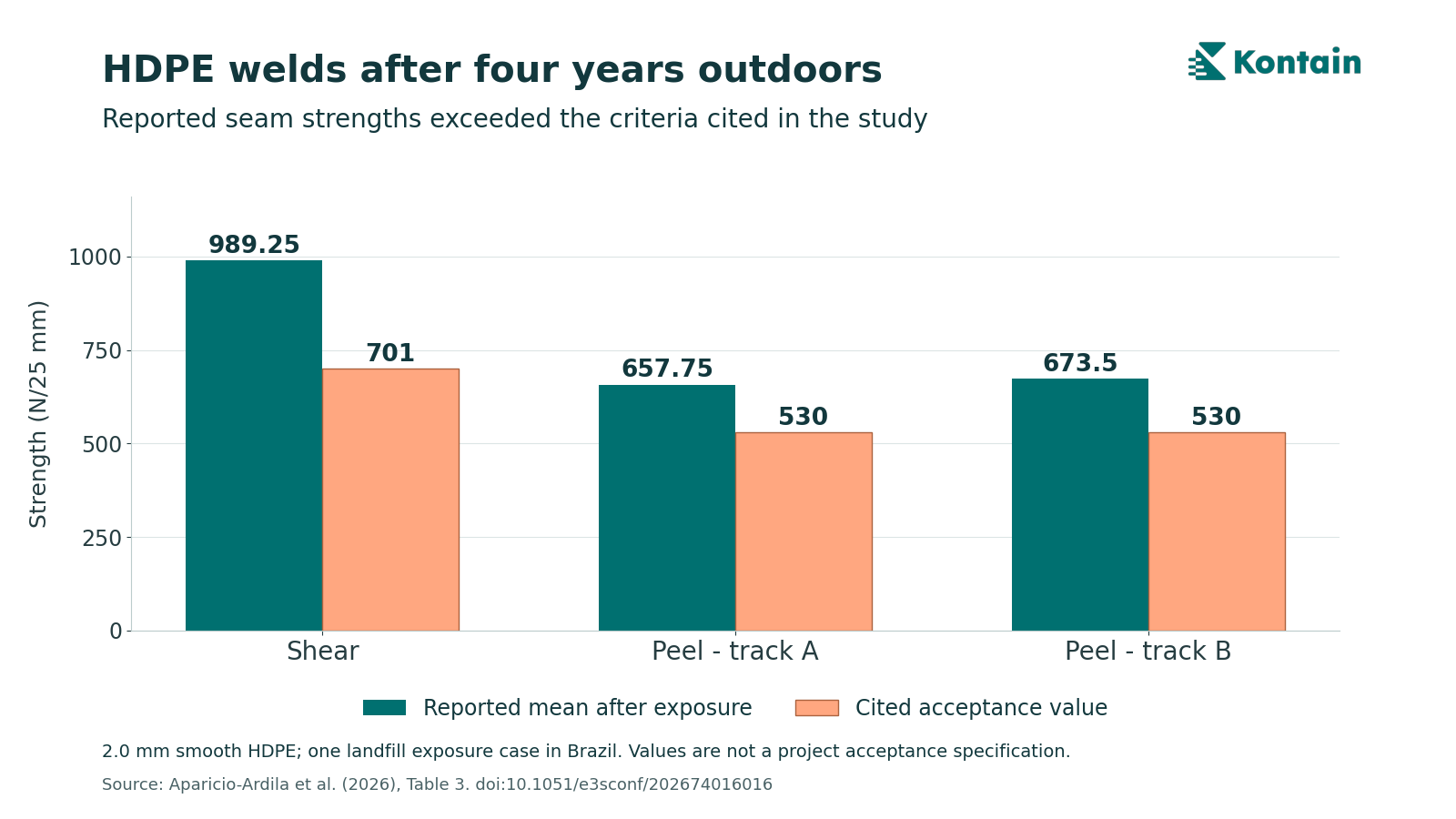
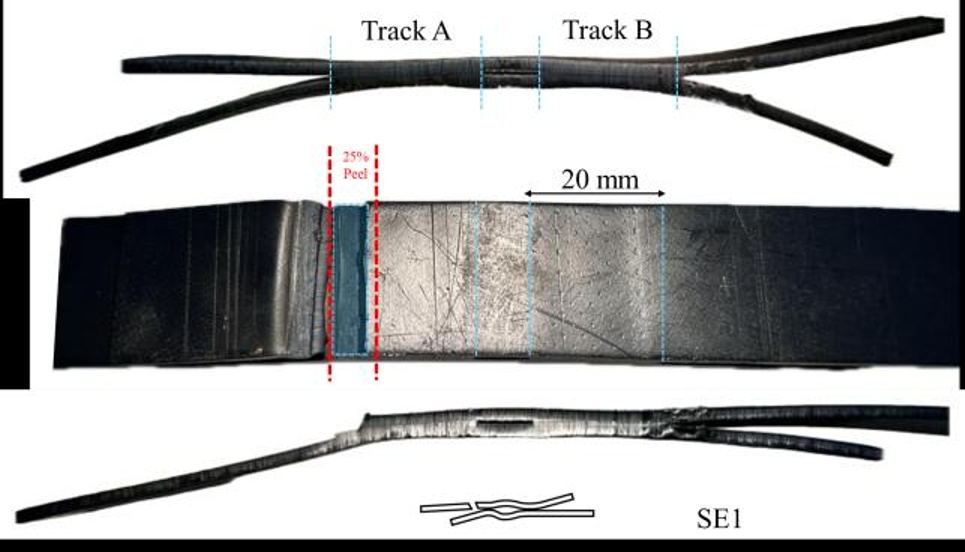
The reported mean seam strengths were approximately 989 N/25 mm in shear and 658–674 N/25 mm in peel. These were around 41% and 24–27% above the respective acceptance values cited in the paper. The authors also reported acceptable shear elongation, peel separation and a seam-edge failure mode, with rupture outside the bonded interface.
| Test | Reported mean (N/25 mm) | Acceptance value cited in study (N/25 mm) | Above cited value |
|---|---|---|---|
| Shear | 989.25 | 701 | 41.1% |
| Peel, track A | 657.75 | 530 | 24.1% |
| Peel, track B | 673.50 | 530 | 27.1% |
Those are encouraging results. The original numerical seam strengths were unavailable, though, so the study cannot tell us how much seam strength had changed since installation.
The researchers also measured standard oxidative induction time, or Std-OIT. This laboratory test indicates resistance to oxidation under specified test conditions and is used to assess antioxidant stabilisation. Its result in minutes is not a prediction of years of service remaining.
| Region tested | Std-OIT after exposure (minutes) |
|---|---|
| Sheet away from weld | 171.24 |
| Heat-affected zone | 136.50 |
| Welded zone | 108.61 |
| Air-channel material | 149.26 |
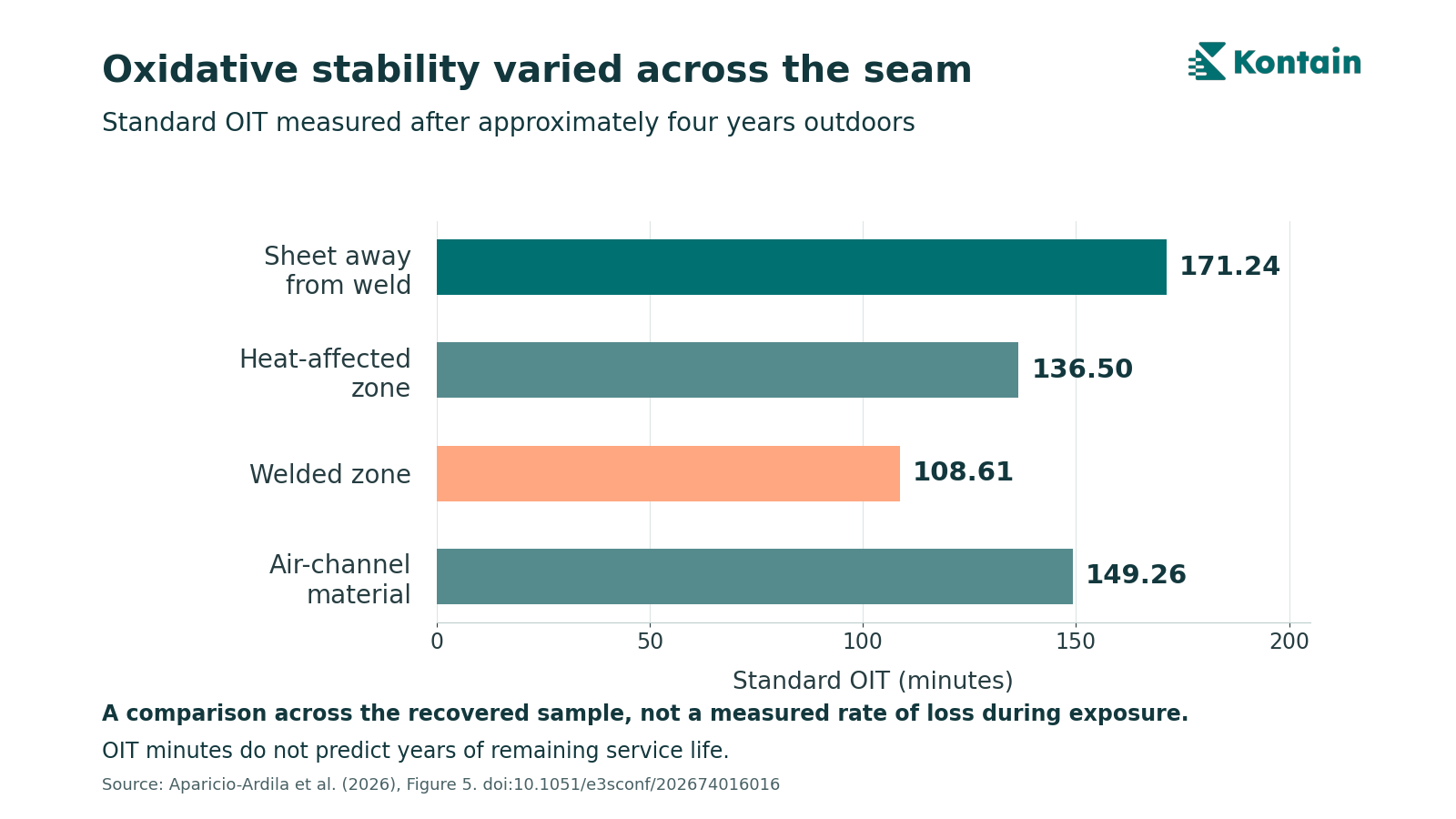
The welded zone had an OIT about 37% lower than the sheet away from the weld at the time of testing. That comparison describes a difference across the recovered sample; it does not establish a 37% loss during outdoor exposure.
Welding changes the thermal history of the material. The pattern is consistent with that influence, but without measurements immediately after welding, the effects of installation and subsequent weathering cannot be separated reliably.
Melt-flow and thermal testing also identified differences between regions. These support the need to consider the weld and adjacent material separately, but do not establish a remaining service life or demonstrate an impending failure.
For designers: include the construction programme in the durability assessment
My practical takeaway is to consider how the liner will be treated between delivery, installation and operation. If prolonged exposure is possible, address it in the specification and construction quality assurance plan.
Define the intended exposure conditions, installation controls, records to retain and the process for reassessment if commissioning is delayed. For higher-consequence applications, consider whether baseline sheet and trial-weld samples, including targeted OIT testing, would help future condition assessments. This is a project-specific decision; the paper does not establish a universal requirement for OIT testing of every seam.
Ask for evidence that addresses the proposed material, welding process and service conditions. A sheet certificate provides useful manufacturing data, but it does not describe every region of the installed weld.
For installers: control the process and keep the evidence
The findings reinforce the value of controlling welding temperature, travel speed and pressure together, supported by trial seams and the specified production testing. The settings used in this study are not a recipe for other materials, machines or site conditions.
Keep welding records traceable to the seam, equipment, operator and conditions. Record the failure mode and separation alongside peel and shear strength, so a passing load is not the only information retained.
For repairs to a weathered liner, demonstrate weldability using representative material and an agreed trial procedure before proceeding. Passing tests on an existing seam does not prove that a new repair weld will perform equally well.
For asset owners: make delayed commissioning a review point
I would treat a substantial delay as a reason to review the liner's condition before putting it into service. Bring the designer and installer together to examine exposure history, visible damage, installation records and any proposed repairs, then agree on targeted testing where needed.
This case supports assessment based on evidence. It does not justify a blanket four-year exposure allowance, and it does not mean an exposed liner automatically needs replacement.
The study covered one material and a particular location on an east-southeast-facing landfill slope. It was weathering before operation, not four years of service in contact with landfill leachate. The findings should not be transferred directly to another climate, formulation, thickness or chemical exposure.
There is also a limitation in the OIT baseline: the manufacturer's original result was reported only as greater than 200 minutes. The paper used 200 minutes to calculate retention, so those percentages are upper bounds, not exact retained values. OIT retention is also not a direct percentage of antioxidant mass remaining.
For an owner deciding whether to commission or repair an exposed liner, the useful next step is a documented assessment of the actual sheet, seams and intended service conditions.
Source
Aparicio-Ardila, M. A., Valentin, C. A., Kobelnik, M. and da Silva, J. L. (2026). Evaluation of a Dual-Wedge Welded Seam in an HDPE Geomembrane after four Years of Environmental Exposure. E3S Web of Conferences, 740, 16016. Read the open-access paper ↗.
The practical recommendations above are an interpretation of the findings, rather than requirements established by this study.
The source paper is published under Creative Commons Attribution 4.0. The specimen photograph is reproduced from Figure 4. Charts are redrawn from the reported data, with no implication of author endorsement.

Ben Lewis
Founder & Technical Lead, Kontain. Technical geosynthetic selection and project-direct supply for Australian civil, mining, water and waste infrastructure.
About Kontain