
Scope note. This article provides practical technical guidance for project and operational discussions. It does not replace project-specific investigation, testing, design, certification or the appointed project team.
The defect was the same. The hydraulic condition was not.
A hole in a geomembrane does not have one fixed leakage rate. Its consequence depends on the hydraulic head that develops above it, how long that head remains, the contact with surrounding materials and whether nearby geometry collects or disperses water.
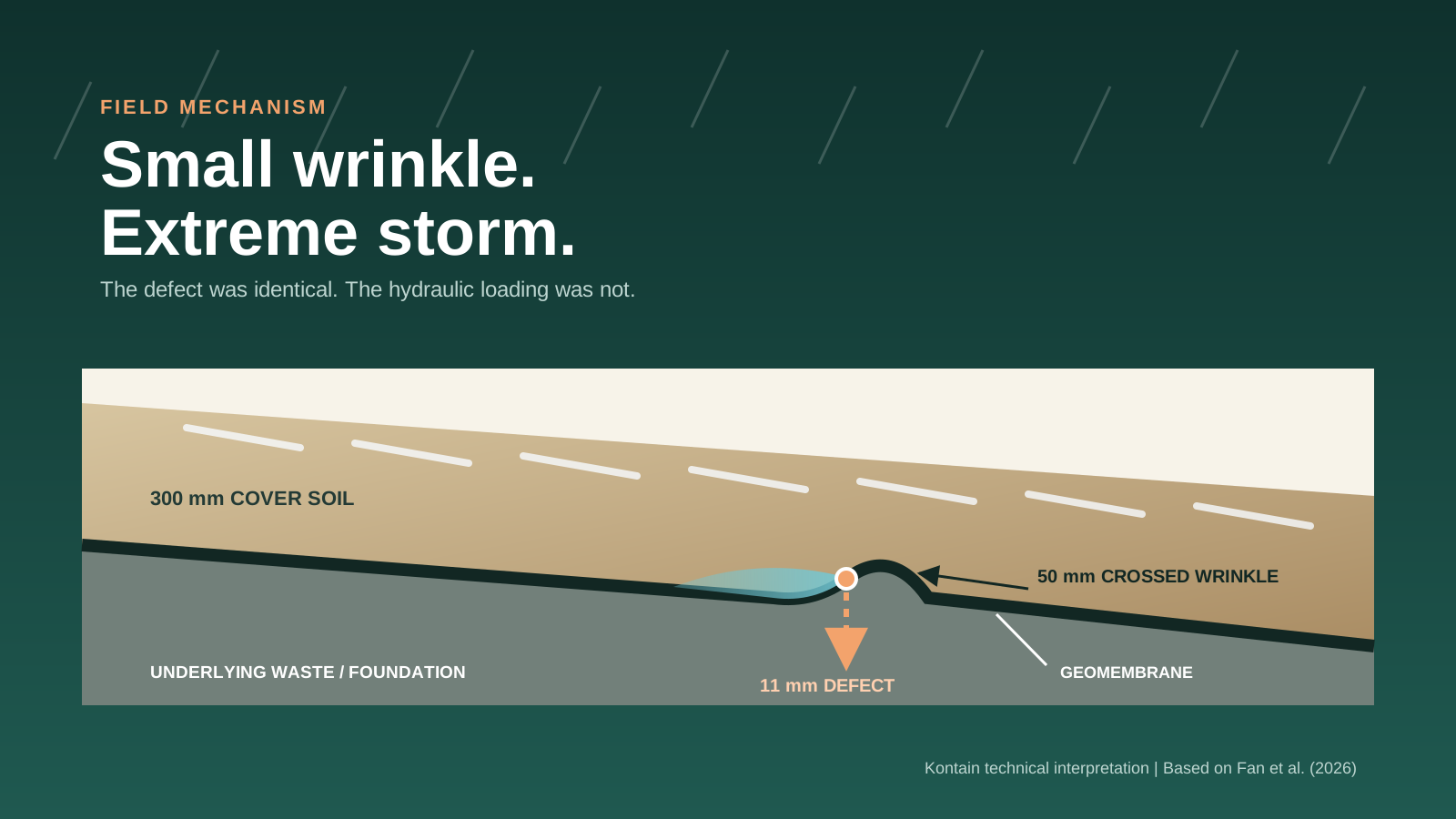
A 2026 field study by Fan, Rowe, Brachman and Van Gulck examined that interaction in a sloping waste cover. Two otherwise comparable test sections contained the same 11 mm circular defect. One section was flat. The other had a pair of crossed wrinkles, each 2 m long and approximately 50 mm high, centred around the defect.
The important finding was not simply that the wrinkled section leaked more. The authors interpreted the crossed geometry as changing how water moved through the cover sand above the barrier, while a single extreme rainstorm supplied most of the hydraulic loading. Geometry and climate event acted together.
What the field experiment actually tested
The two test sections were built at the Queen's University Environmental Liner Test Site in Ontario, Canada. Each was approximately 8 m long and 5 m wide on a 4H:1V south-facing slope. The barrier was covered by 300 mm of poorly graded medium-to-fine sand and exposed to natural rainfall and temperature.
The researchers used a 0.15 mm flexible vapour barrier as the geomembrane layer so that the controlled wrinkle geometry could be formed without introducing other unwanted wrinkles during cold-weather construction. That is a major limitation when applying the results to normal 1.0-2.0 mm HDPE or LLDPE installations. The study demonstrates a hydraulic response consistent with the authors' proposed mechanism, not a direct product-performance comparison for conventional geomembranes.
This was a cover-side seepage experiment, not a composite-liner contact test. The defect discharged into a leakage-collection system, and the numerical model treated the bottom boundary as no-flow except at the hole. It did not model lateral leakage spreading through a gap between a geomembrane and an underlying GCL or compacted clay liner.
That distinction matters. In a conventional composite liner, a wrinkle can create loss of intimate contact beneath the geomembrane, increasing interface transmissivity and allowing water from a defect to spread over a larger area of the underlying low-permeability layer. That established below-liner mechanism remains relevant, but it is separate from the cover-side mechanism examined in this study.
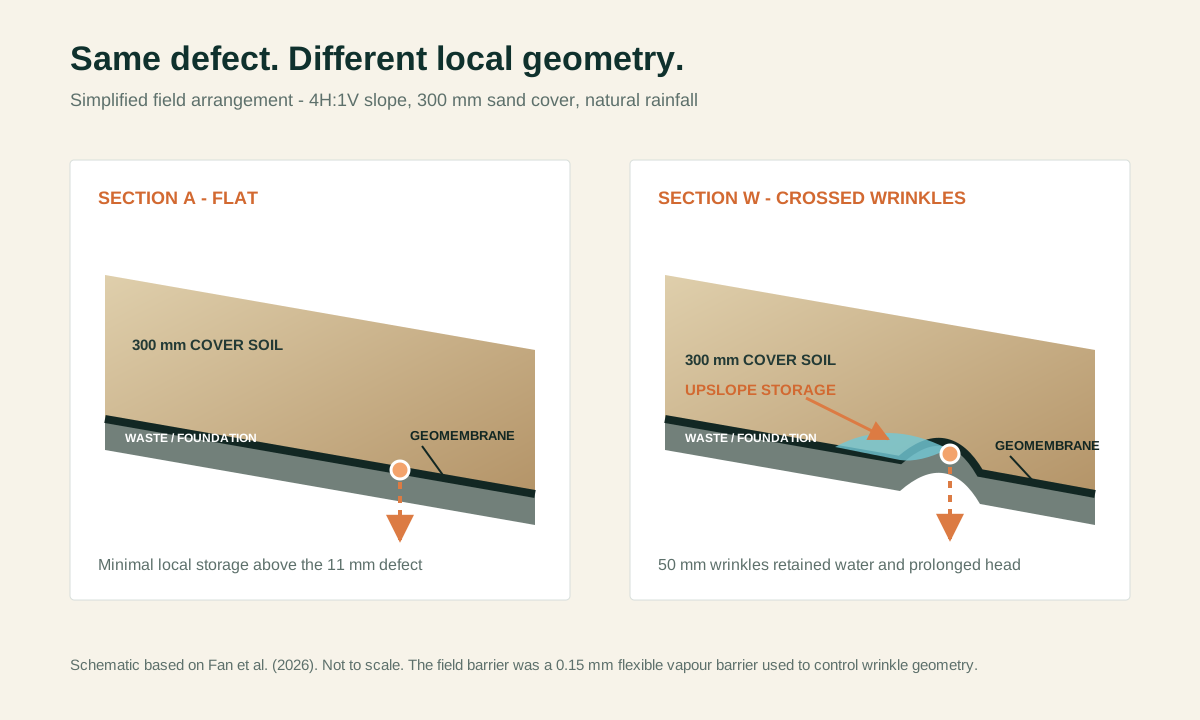
Both sections used the same defect size and leakage-collection arrangement. The crossed-wrinkle case was intentionally conservative because the hole was placed where the wrinkle geometry could maximise water collection and leakage.
The measured result before the extreme storm
From 1 March to 21 August 2022, total precipitation was 486 mm. Over that period, the flat section produced less than 0.1 L of measured leakage. The crossed-wrinkle section produced 4 L.
Most rainfall events produced no measurable leakage because the sand layer stored water or redirected it downslope before sufficient positive head developed above the defect. The authors inferred that the crossed wrinkles impeded downslope interflow within the cover sand, allowing water to remain upslope and increasing both the magnitude and duration of head over the hole.
Measured finding: under the reported geometry and climate, 486 mm of cumulative rainfall produced less than 0.1 L of leakage in the flat section and 4 L in the crossed-wrinkle section.
That does not mean every 50 mm wrinkle will produce the same increase. Defect position, wrinkle orientation, cover-soil hydraulic properties, slope, antecedent moisture and rainfall sequence all affect the response.
One storm dominated the six-month result
On 22-23 August, a 115 mm rainstorm caused the largest leakage response of the monitoring period. The field gauges recorded 9.7 L in the flat section and 6.6 L in the wrinkled section before flooding submerged the gauges and interrupted measurement. Those incomplete values should not be compared as final storm totals.
The authors then used a calibrated three-dimensional transient seepage model to extend the interrupted record. The model estimated approximately 39 L for the flat section and 58 L for the crossed-wrinkle section during that storm. On the corrected model basis, the single event represented nearly 100% of the six-month leakage in the flat section and 96% in the wrinkled section.
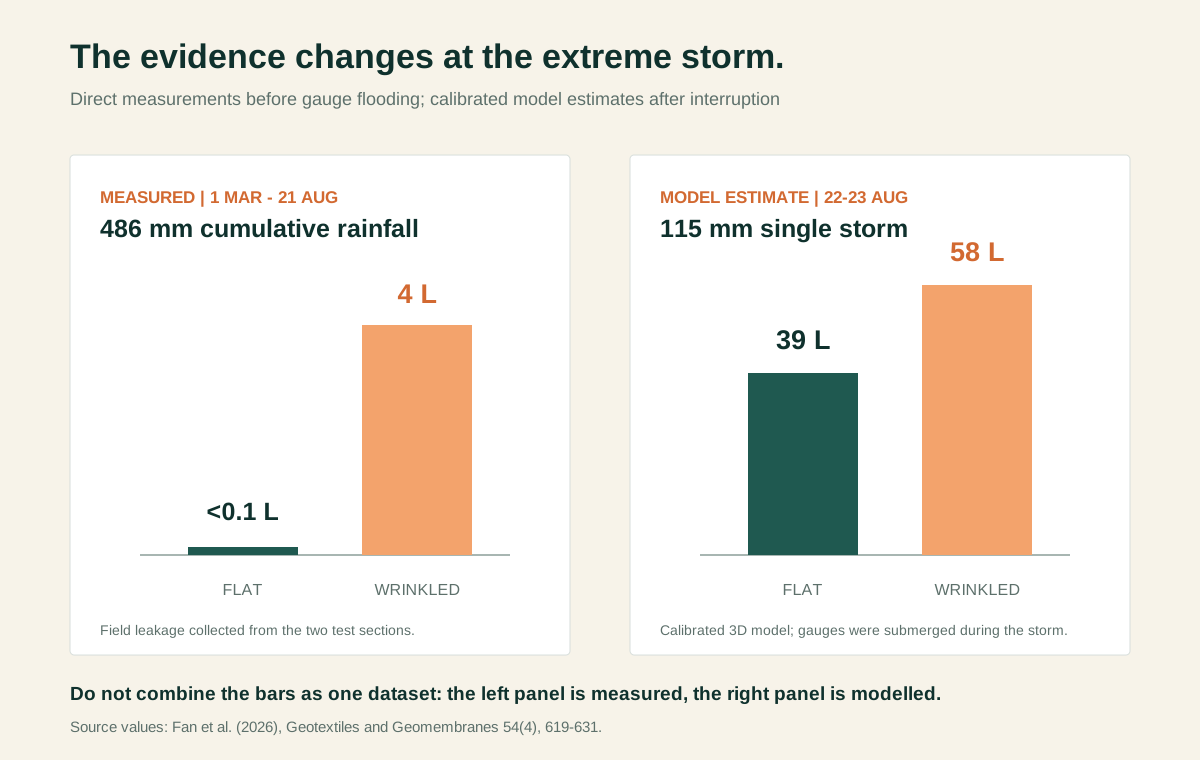
The authors concluded that event-scale rainfall, rather than monthly or annual rainfall totals alone, is needed to represent the leakage mechanism. Their model also indicated that the wrinkle effect became more pronounced as rainfall increased: the estimated wrinkle-related increment was 19 L during the 115 mm event, compared with 0.6-2.1 L during events of 30-45 mm.
Why the authors interpreted the wrinkles as changing cover-side hydraulics
A wrinkle is often treated as a dimensional construction-quality issue. In this experiment, the authors interpreted the crossed geometry as intercepting downslope interflow within the cover sand and retaining more water upslope. The leakage response and three-dimensional model indicated a higher, longer-lasting positive head above the defect, but field pore pressures were not directly measured to confirm that mechanism.
The model suggested that defect position within the wrinkle geometry matters. A hole near the upslope toe of a wrinkle can experience more leakage because ponded water bears directly on it, while a defect on the wrinkle crest may experience less. The presence of a wrinkle alone is therefore not a complete leakage descriptor; its relationship to defects and flow direction matters.
For cover-system condition assessment, mapping total wrinkle length may be useful, but the connected wrinkle network, cross-slope flow obstructions, local depressions and likely defect locations can be more relevant to hydraulic performance than a simple maximum wrinkle height. This cover-side assessment does not replace evaluation of contact and interface transmissivity beneath a geomembrane in a composite liner.
Design and construction implications
The following points are practical inferences from the study, not universal design rules or values reported by the authors:
- Evaluate cover performance using event-scale rainfall and antecedent moisture where extreme storms could control leakage. An annual rainfall total cannot describe the temporary head above a defect.
- For sloping cover systems, treat wrinkle geometry as part of the cover-side hydraulic system. Connected or cross-slope wrinkles may create local storage and preferential catchments even when the wrinkle height appears modest.
- Coordinate geomembrane deployment, temperature, ballast, anchoring and cover placement to limit wrinkles before they are buried. Once covered, the relevant geometry is difficult to inspect or correct.
- Consider the combined condition: defect plus wrinkle plus hydraulic event. A small defect under little or no head may leak very little; the same defect can become consequential when nearby geometry retains water.
- Use product colour and thermal behaviour carefully. A lighter surface may help reduce thermal expansion and field wrinkling, but colour alone does not establish UV durability, antioxidant performance or service life.
- Keep cover-system conclusions separate from bottom-liner leakage. Covers are sloping, transient and often unsaturated; bottom liners commonly operate under different head, confinement and contact conditions.
For cover design review, the useful question is not simply whether the geomembrane has wrinkles. It is whether the installed geometry can collect water, where positive head may persist, what defects could coincide with that zone and which rainfall event controls the consequence. For composite liners, contact beneath the geomembrane and the transmissivity of any resulting gap must be assessed separately.
What the study does not prove
- It does not provide a generic multiplier for leakage through all wrinkled geomembranes.
- It does not directly test conventional 1.0-2.0 mm HDPE or LLDPE sheet; the field layer was a 0.15 mm flexible vapour barrier selected to reproduce controlled geometry.
- It does not represent a high-head base liner, composite geomembrane-GCL liner or geomembrane-compacted-clay liner, and it does not test the conventional below-liner poor-contact mechanism.
- The crossed wrinkles and defect location were deliberately arranged as a conservative, well-defined case.
- The largest storm flooded the measurement equipment, so final storm leakage volumes came from a calibrated model rather than uninterrupted direct measurement.
- The proposed cover-side hydraulic-dam mechanism was inferred from the leakage response and numerical model; pore pressures above the barrier were not directly measured in the field.
- The reported sand, slope, climate and moisture history are project-specific.
These limitations make the study more credible, not less useful. It isolates a mechanism that is difficult to observe at field scale and shows why leakage cannot be assigned to a defect diameter without also considering the hydraulic environment around it.
The practical lesson
The wrinkle did not create the hole, and the storm did not create the wrinkle. In this cover experiment, the measured and modelled response indicated that leakage increased when a defect, crossed cover geometry and an extreme rainfall event coincided.
The defect defined the opening. In this cover test, wrinkle geometry and the storm controlled the transient head above it. In composite liners, contact beneath the geomembrane remains a separate leakage control.
Source study: Felix Y. H. Fan, R. Kerry Rowe, Richard W. I. Brachman and J. Van Gulck, Leakage through waste covers with small geomembrane wrinkles, Geotextiles and Geomembranes, 54(4), 619-631, available online 17 March 2026. An author-uploaded full text is publicly accessible. For the separate composite-liner contact mechanism, see R. Kerry Rowe, Short- and long-term leakage through composite liners.

Ben Lewis
Founder & Technical Lead, Kontain. Technical geosynthetic selection and project-direct supply for Australian civil, mining, water and waste infrastructure.
About Kontain