
Scope note. This article provides practical technical guidance for project and operational discussions. It does not replace project-specific investigation, testing, design, certification or the appointed project team.
Originally published by Kontain on LinkedIn .
Overview
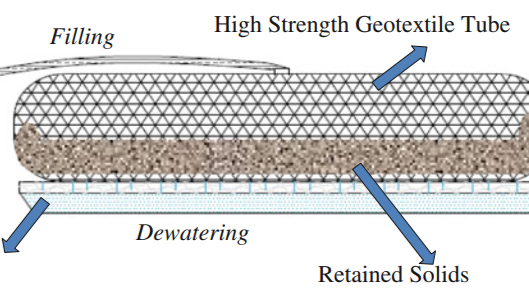
Geobags have been used successfully for decades to dewater slurries from mining, dredging, wastewater, and industrial processes. When they work, they work exceptionally well.
Yet time and again, projects are written off with the same conclusion:
“Geobag dewatering doesn’t work for this material.”
In most cases, that conclusion is wrong.
The failure mechanism is rarely the geobag itself. It is almost always clogging, driven by a misunderstanding of particle size, pore size, and slurry behaviour.
The biggest misconception: finer slurry = finer pore size
This is the mistake we see most often.
When engineers are dealing with fine or colloidal slurries — tailings, biosolids, fly ash, alum sludges — the instinctive response is to specify a tighter, finer geotextile.
That instinct is understandable. It is also frequently incorrect.
In reality:
- The finer and more colloidal the slurry, the greater the risk of clogging
- The tighter the pore size, the faster clogging occurs
For many fine slurries, the correct response is counter-intuitive:
Increase the pore size to maintain flow and allow a filter cake to form.
Why clogging actually happens
Clogging is not about particles “falling through” the fabric.
It is about:
- fines bridging across pores,
- surface blinding,
- and flow being choked before a stable filter cake can develop.
This behaviour is particularly severe for:
- colloidal particles,
- clay-sized fractions,
- organic-rich biosolids,
- chemically active fines.
Once the surface blinds, it doesn’t matter how much flocculant you add — flow collapses and the system stalls.
At that point, the technology gets blamed instead of the design.
Sand behaves very differently (and that matters)
Sand-dominant slurries behave in almost the opposite way.
Sand particles are:
- large,
- free draining,
- mechanically stable.
They:
- settle quickly,
- form a permeable internal skeleton,
- and drain efficiently within the geobag structure itself.
For these materials:
- smaller pore sizes are often appropriate,
- retention is easy,
- clogging risk is low.
This is why sand-filled geobags almost never struggle, while fine slurries often do.
Fly ash: a useful reference case
Fly ash provides a useful reference point because it sits between silt- and clay-dominated behaviour. It is typically dominated by silt-sized, near-spherical particles, with a meaningful clay-size fraction that drives clogging risk.
Published laboratory studies on fly ash dewatering using geotextile tubes (Khachan et al., 2012) show that once dewatering begins, performance is governed primarily by filter cake formation rather than the geotextile itself. Within a practical pore size range, reducing apparent opening size does not materially improve dewatering rates, while overly conservative pore sizes accelerate surface blinding.
This behaviour closely mirrors what is observed in other fine and colloidal slurries, including tailings and biosolids — where clogging, not particle loss, is the dominant risk.
Why biosolids are especially problematic
Biosolids and organic sludges are some of the most challenging materials to dewater.
Not because they are simply “too fine”, but because they are:
- sticky,
- compressible,
- biologically active,
- highly prone to surface blinding.
In these cases:
- standard off-the-shelf geotextiles clog rapidly,
- flocculants help structure the cake but cannot overcome a blinded surface,
- and projects are incorrectly labelled failures.
With adjusted pore size, weave type, and permeability, many of these same slurries dewater successfully.
There is a limit — bigger is not always better
This is not an argument for opening everything up.
Geobags do have an upper pore size limit, beyond which:
- solids loss becomes unacceptable,
- turbidity increases,
- containment objectives are compromised.
The solution is not extremes.
It is optimisation.
That optimisation depends on:
- full particle size distribution (not just d₅₀ or d₈₅),
- colloidal behaviour,
- chemical activity,
- flocculant selection,
- expected filter cake development.
The real lesson: geobags are not a commodity solution
Too many projects treat geobag dewatering as a simple product selection exercise:
“Pick a standard geotextile and see how it goes.”
That approach almost guarantees problems for fine slurries.
Geobags are a system, not a bag:
- slurry characteristics,
- geotextile pore size and structure,
- polymer chemistry,
- filling rates,
- loading cycles
all interact.
When one of those elements is wrong — usually the geotextile — the whole system gets blamed.
I’ve seen too many viable dewatering projects abandoned due to early clogging caused by conservative, misapplied geotextile selection.
The uncomfortable truth is this:
Many “failed” geobag projects were never properly designed in the first place.
With the right understanding of slurry behaviour and pore size optimisation, geobag dewatering remains one of the most effective, flexible, and scalable solutions available — especially for fine and difficult materials.
The technology isn’t the problem. The assumptions are.

Ben Lewis
Founder & Technical Lead, Kontain. Technical geosynthetic selection and project-direct supply for Australian civil, mining, water and waste infrastructure.
About Kontain