
Scope note. This article provides practical technical guidance for project and operational discussions. It does not replace project-specific investigation, testing, design, certification or the appointed project team.
Originally published by Kontain on LinkedIn .
Why Onshore Containment Is Gaining Attention
For decades, offshore disposal of dredged material has been the default approach.
Dredge it. Pump it offshore. Move on.
Simple. Cheap. Accepted.
But that model is breaking down — and not slowly.
The shift isn’t theoretical anymore
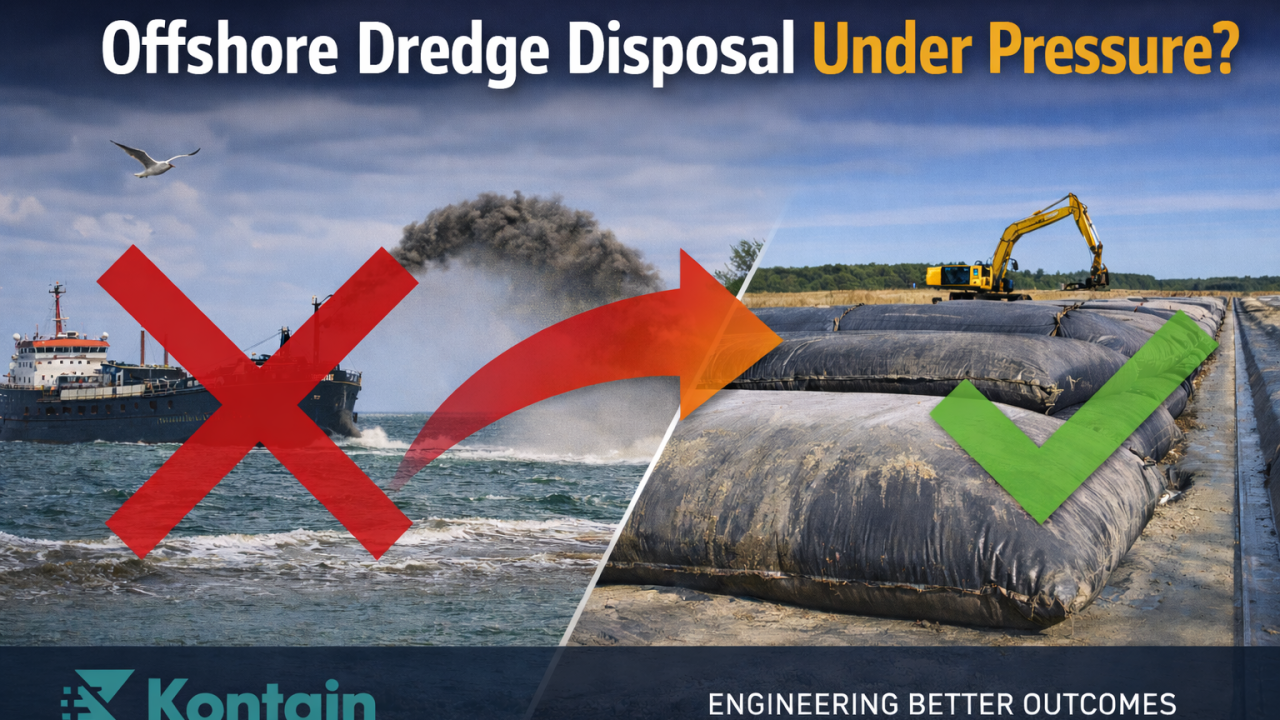
Across Australia and globally, offshore deposition is becoming harder to justify, harder to approve, and in some cases, simply not acceptable.
Not because the industry suddenly changed — but because the understanding of risk has caught up.
Why offshore disposal is losing favour
1. We now understand what actually happens offshore
Fine sediments don’t just “settle harmlessly.”
They:
- create turbidity plumes
- reduce light penetration
- impact seagrass and coral systems
- mobilise legacy contaminants
The old assumption of dilution = acceptable impact doesn’t hold anymore.
2. Regulation has tightened — significantly
Approvals now require:
- detailed sediment characterisation
- plume modelling
- ecological risk assessments
Frameworks like the EPBC Act and international conventions are pushing projects toward containment, not dispersion.
And regulators are increasingly asking:
“Why is offshore disposal the only option?”
3. Social licence is now a real constraint
Offshore dumping is visible. It attracts scrutiny. And it’s difficult to defend publicly.
That alone is shifting decision-making.
So where is the material going?
Increasingly — onshore.
Not because it’s easier. But because it’s controllable.
Onshore deposition allows:
- full containment of contaminants
- water capture and treatment
- engineered, auditable systems
In short:
You own the risk — but you can also manage it.
But onshore isn’t a silver bullet
Traditional approaches rely on:
- large containment ponds
- long drying times
- significant earthworks
Which introduces:
- footprint constraints
- programme delays
- cost escalation
And in many cases, the same question comes back:
“Is there a more efficient way to manage this material?”
This is where geobags are gaining serious traction
Geobags (or geotextile dewatering containers) are not new.
But their role is changing.
They are moving from niche solution → core infrastructure for dredge management.
Why geobags are working
1. They solve the dewatering problem
Slurry goes in. Water comes out. Solids stay contained.
With the right conditioning:
- rapid consolidation
- significantly reduced drying time
2. They reduce footprint
Instead of large lagoons:
- modular placement
- stackable systems
- far smaller land requirements
This is critical for constrained sites.
3. They improve environmental control
- reduced turbidity release
- contained solids
- controlled water discharge
Which aligns directly with modern approval frameworks.
4. They accelerate project timelines
Less civil works. Faster mobilisation. Scalable deployment.
You don’t need to build the entire solution upfront.
What this means for the industry
We’re seeing a clear shift toward:
Contained, engineered, and measurable sediment management
Which means:
- offshore disposal → increasingly restricted
- onshore containment → becoming standard
- geobags → enabling that transition
But here’s the part that’s often missed
Geobags are not a silver bullet either.
Their performance depends on:
- correct geotextile selection
- appropriate dosing and conditioning
- subgrade and drainage design
- stacking and sequencing
Get these wrong, and you simply move the problem onshore.
The real opportunity
The industry is being forced to rethink dredge spoil as:
a material to manage — not waste to discard
That shift is uncomfortable. But it’s also where the innovation sits.
From Kontain’s perspective
We’re seeing more projects ask:
- What is the long-term behaviour of this system?
- What happens to retained contaminants?
- Are we actually reducing risk — or just relocating it?
Those are the right questions.
Because the solution isn’t just:
“offshore vs onshore”
It’s:
“uncontrolled vs engineered.”

Ben Lewis
Founder & Technical Lead, Kontain. Technical geosynthetic selection and project-direct supply for Australian civil, mining, water and waste infrastructure.
About Kontain