
Scope note. This article provides practical technical guidance for project and operational discussions. It does not replace project-specific investigation, testing, design, certification or the appointed project team.
A familiar problem deserves a wider design conversation
Adelaide is home for me, and shallow reactive clays make pavement movement a very practical concern. The same challenge affects many parts of Australia: moisture changes in the ground can move a pavement unevenly, even when its traffic-based design looks reasonable.
South Australia's pavement specification already recognises expansive subgrades as an investigation and treatment issue. The question is how consistently we assess reinforcement among the available responses. [1]
I understand the hesitation. A grid introduces cost, and a designer needs a defensible basis for the decision. Established design methods provide confidence and accountability. But familiarity alone should not decide whether we consider a material with a growing body of laboratory and field evidence behind it.
Research by Sundaram Srivastava and Umashankar Balunaini at IIT Hyderabad adds useful evidence. Their paper, Experimental studies on geogrid efficiency against moderate to highly expansive subgrades, examines how different grids change the transmission of localised upward movement through a pavement. Professor Balunaini kindly shared the full paper for this review. [2]
My view is that suitable geogrids deserve more routine consideration where reactive-ground movement threatens pavement serviceability. Keeping the designed pavement thickness and assessing reinforcement as an additional resilience measure is a sensible starting point. The proposal can stand on that objective without relying on a thickness saving.
What Srivastava and Balunaini actually tested
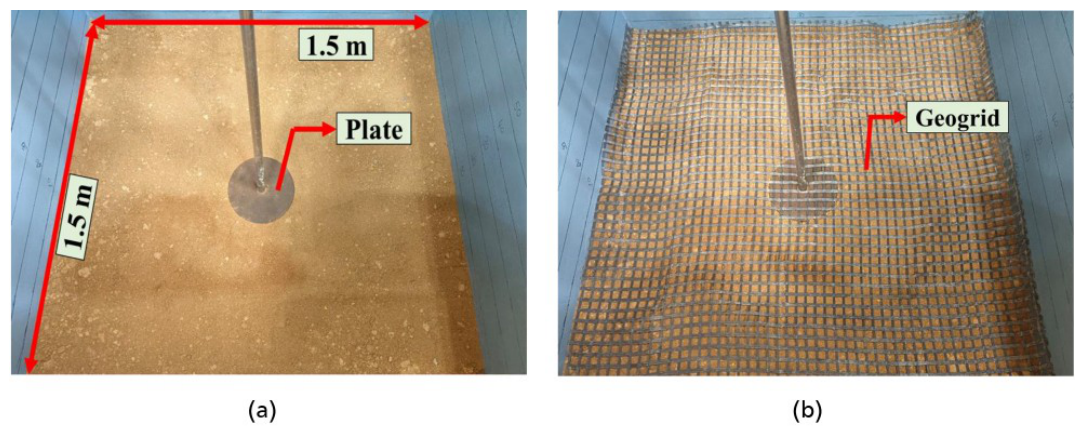
The researchers constructed ten model configurations in a tank measuring 1.5 m × 1.5 m × 1.1 m: two unreinforced controls and eight reinforced sections. Each pavement had a 50 mm layer of non-expansive clay beneath 250 mm of prepared clayey-sand subgrade and 400 mm of crushed-stone wet-mix macadam (WMM). The prepared subgrade had a California Bearing Ratio (CBR) of either 10% or 15%.
A 250 mm diameter plate imposed localised upward movement from below. This simulated differential heave mechanically; the tests did not wet an expansive clay deposit and wait for it to swell. The upper surface was unsealed, with no asphalt layer.
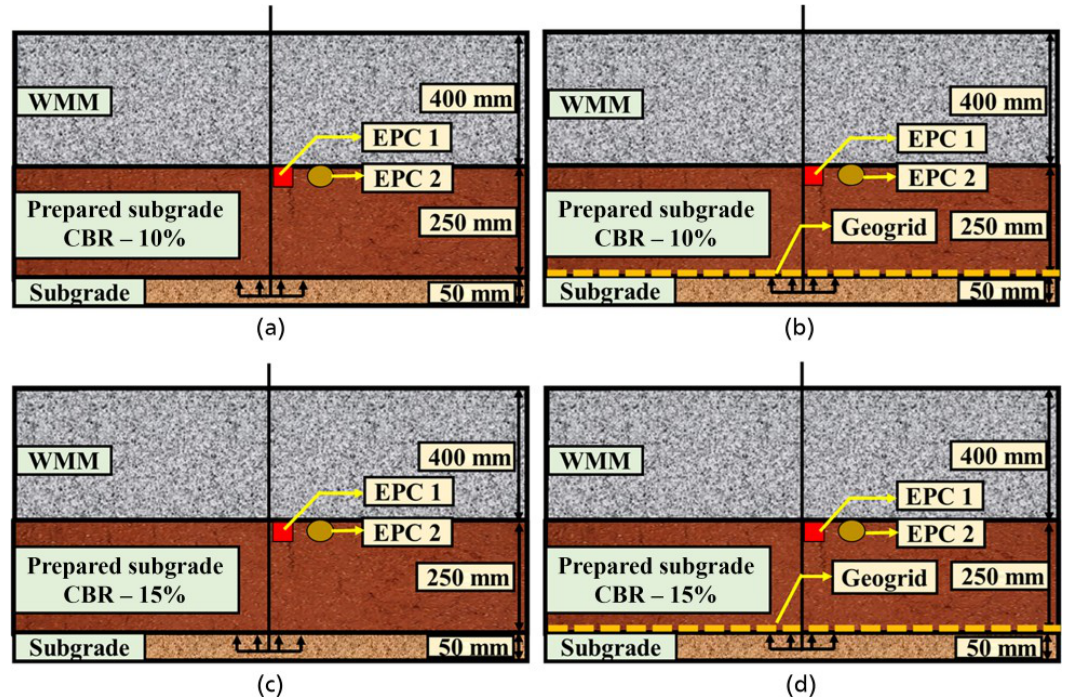
Four biaxial grids were compared: polypropylene PP 30 and PP 40, and polyester PET 100 and PET 200. Their labels refer to nominal ultimate tensile strengths in kN/m. Every grid was installed at the interface between the existing and prepared subgrade. The study therefore tests a particular grid position, layer arrangement and uplift footprint.
Measurements distinguished plate rise at subgrade level, surface heave and vertical stress at two pressure cells. The authors used subgrade-rise reference values of 12.5 mm and 25 mm, termed potential vertical rise (PVR) in the paper. These are study comparison points, not Australian pavement acceptance limits. [2, sections 2–5]
The results are encouraging, and the conditions matter
PP 40 gave the strongest heave-control performance among the four products in this arrangement. With the CBR 10% prepared subgrade, it reduced reported maximum surface heave by 93% at an applied plate pressure of 350 kPa and 95% at 385 kPa, compared with the matching unreinforced sections.
| Prepared subgrade CBR | Applied plate pressure | Unreinforced maximum surface heave | PP 40 surface-heave reduction |
|---|---|---|---|
| 10% | 350 kPa | 4.0 mm | 93% |
| 10% | 385 kPa | 9.7 mm | 95% |
| 15% | 450 kPa | 6.6 mm | 70% |
| 15% | 475 kPa | 11.9 mm | 80% |
The wider comparison is just as useful. At the same 350 and 385 kPa pressures used for the CBR 10% material, PP 40 reduced surface heave in the CBR 15% material by 45% and 42%. Its unreinforced surface heave was already lower: 1.8 and 2.1 mm. A headline of ‘up to 95%’ alone would hide that dependence on the surrounding pavement.
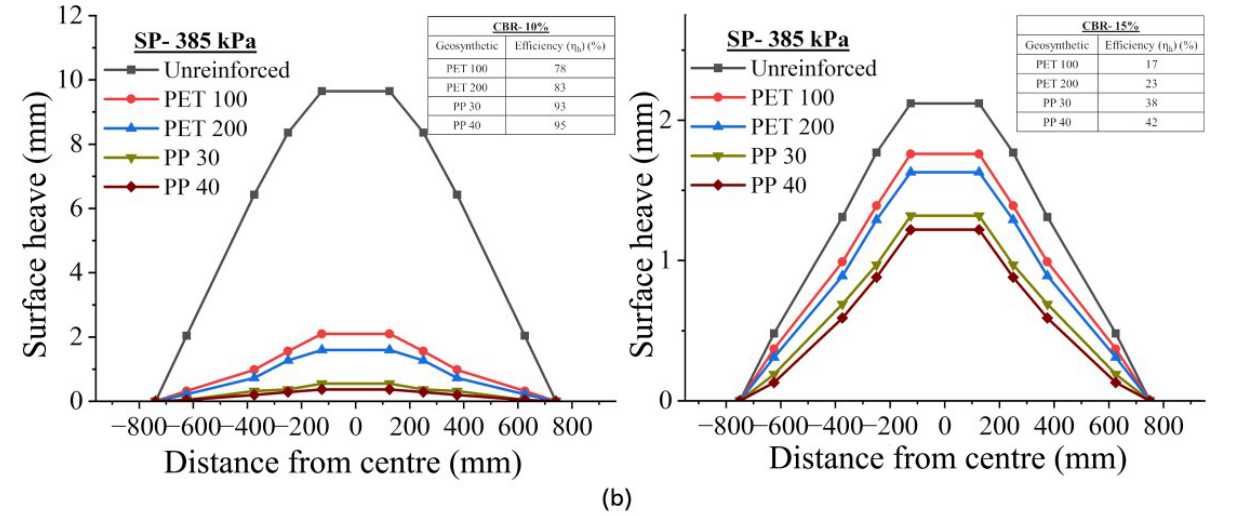
Plate rise and surface heave are different measurements. For CBR 10% at 385 kPa, PP 40 reduced plate rise from 25.0 mm to 2.3 mm. At 350 kPa, vertical stress at the near-centre pressure cell fell from 124.3 kPa to 22.3 kPa. These results show reduced movement and stress transfer within the model; they do not measure asphalt cracking or years of pavement life.
The reinforced CBR 10% section also required 580 kPa, compared with 350 kPa without reinforcement, to reach 12.5 mm plate rise. This is what the paper calls improved swell-pressure resilience: greater applied pressure was needed to reach a specified displacement. It is not evidence that the grid changes the clay's intrinsic swelling properties. [2, Figures 6, 9–11]
Why ‘stiffer PP’ needs a more precise specification
A well-selected PP pavement grid is a credible option. However, this experiment does not prove that PP always outperforms PET, or that a nominal 40 kN/m grid is equivalent to the tested PP 40.
The distinction between strength and useful restraint is particularly clear in Table 1. PP 40 had a reported tensile force at 2% strain of 14.5 kN/m in each direction. PET 200 had 30 and 24 kN/m. PET 200 therefore had higher reported tensile resistance at that strain, yet PP 40 performed better in these heave tests. The grids also had different apertures: 38 × 38 mm for PP 40 and 23 × 22 mm for PET 200.
The study did not isolate polymer type, aperture geometry, rib behaviour and soil interaction as separate variables. Selection should consider the grid–soil system, including load–strain behaviour in both directions, junction performance, aperture compatibility, confinement, installation damage and the movements at which restraint is mobilised. A larger ultimate-strength number is not a complete specification.
The authors interpret the heave response partly through tensile membrane action as the grid deforms over the uplift zone. They suggest that the lower-CBR prepared layer mobilised more of this mechanism. That is not a reason to deliberately weaken a pavement subgrade: the programme did not test the resulting traffic performance. FHWA guidance also describes lateral confinement in reinforced granular bases; the dominant mechanism depends on the loading and configuration. [2] [3]
From heave control to cracking and water entry
The practical objective is to limit differential deformation and redistribute stresses before they damage the surfacing. If reinforcement reduces a driver of cracking, it may help preserve the surface's ability to shed water. Open cracks create additional water-entry paths, potentially worsening moisture variation and weakening moisture-sensitive layers. Drainage and surface maintenance remain essential.
For an unbound pavement grid, that is a mechanism-based case for reducing distress. It is not a claim that the grid physically arrests every crack travelling into asphalt. An asphalt reinforcement interlayer has a different location and function and needs its own design basis.
There is relevant field evidence beyond the new laboratory paper. Zornberg and Roodi (2021) evaluated five full-scale road projects over expansive clay under actual traffic and environmental loading. Their comparison of stabilised and control sections considered longitudinal cracking and deterioration of base-course stiffness, and found that geosynthetics could mitigate this distress. They also warned that unconfined stiffness and tensile strength alone may be insufficient for product selection; soil–geosynthetic interaction matters. [4]
Taken together, the field work and the new controlled experiments support considering reinforcement for reactive-ground distress. Neither establishes that every grid, placement depth or soil profile will deliver the same benefit.
The reactive clay does not have to be visible at formation
There is a useful local reminder here. O'Malley and Cameron's UniSA investigation at Walkley Heights documented profiles where the deeper material was more reactive than the near-surface soil. A relatively benign formation surface is therefore not enough to dismiss movement from below. [5, section 4.1.4]
The engineering interpretation is straightforward: a buried reactive layer can affect the pavement if moisture changes reach it and its movement is transmitted through the overlying material. A grid installed above that layer may still be worth assessing as part of the pavement's response.
The size of any benefit depends on clay depth and thickness, the active moisture zone, the lateral extent of movement, overlying-layer stiffness and grid position. Broad movement of the whole pavement may mobilise little useful grid restraint. The new study did not vary the depth of a real reactive clay layer, so it supplies no maximum effective depth or guaranteed reduction for deeper clay.
Investigate the profile and moisture regime below the prepared surface. A CBR result alone does not describe shrink–swell risk, and a grid does not replace that investigation.
Thickness savings are an option, not the entry price
Geogrids are often introduced through a value-engineering proposal to remove aggregate. That can make the conversation harder: the designer is asked to accept a new material and a thinner pavement at the same time.
We can assess a different proposition: retain the designed layer thicknesses, select and detail the reinforcement for the relevant movement mechanism, and evaluate the additional installation cost against potential maintenance and serviceability benefits. Those future benefits still need a defensible assessment; they should not be booked as guaranteed savings.
Thickness reduction has its own research base. Sharbaf and Ghafoori (2021) used cyclic loading to investigate reinforced flexible pavements and potential base-course reduction. Goud and colleagues (2020) examined traffic-based reinforced-pavement design approaches and material savings using Indian design methods. These support evaluating thickness savings for suitable, validated configurations. They do not establish a universal reduction factor for Australian pavements over reactive clay. [6] [7]
The new heave paper also compares its thinner clayey-sand prepared layer with a thicker sand layer from the authors' earlier work. Because material quality and stiffness change along with thickness, that comparison cannot isolate a geogrid thickness-saving factor. The earlier study also evaluated geotextiles, reinforcing the value of comparing solutions against the actual problem. [2] [8]
A practical path from research to adoption
For designers, contractors and asset owners, I would put reinforcement into the options assessment early, while there is still time to detail and price it properly:
- Define the distress. Separate seasonal heave and shrinkage from traffic rutting, poor compaction, settlement and moisture ingress. Several can act together.
- Characterise the ground. Identify reactive layers, likely moisture-change depth, drainage, trees, service trenches and differences between pavement edges and the centre.
- Set the intended benefit. State whether the proposal retains thickness for resilience or takes a separately justified thickness credit. Use project-specific movement and serviceability criteria.
- Select a system with relevant evidence. Match the grid, adjacent material and placement to the mechanism. Ask for more than nominal ultimate strength or a generic product-family claim.
- Detail construction. Show the grid level, extent, overlaps or connections, cover and compaction requirements. Address separation and filtration separately where needed; an open grid does not provide them automatically.
- Compare alternatives fairly. Include capping, removal and replacement, suitable chemical treatment, drainage and moisture management. Reinforcement can complement these measures, and will not be the best choice on every site.
- Make trials useful. Where uncertainty warrants a trial, include a comparable control, record installation, and monitor levels, cracking, moisture and maintenance across seasonal cycles. Publish the outcomes, including limitations.
The appointed designer and asset owner still need to accept the detail and evidence. A retained-thickness option can make that decision easier to examine while keeping the performance objective clear.
What the new paper leaves open
The results are substantial, but the model uses one localised 250 mm uplift footprint and a bounded tank. Real clay can move over very different areas and timescales. The programme does not establish performance under repeated wetting–drying, long-term creep, combined traffic and environmental loading, or asphalt fatigue and crack propagation. Ten configurations are reported without replicated model-test confidence intervals.
The authors themselves call for field validation, different uplift areas and cyclic swell–shrink research. The reported geogrid mechanical properties were manufacturer-supplied; the paper acknowledges Ministry of Textiles funding and geosynthetic supply from Tech Fab Private Limited. Its product ranking should stay tied to the tested system. [2, sections 2.4 and 7]
Give good research a route into real projects
I would like to see this work lead to more informed adoption. Local research and monitored trials take years. We lose much of their value when the findings remain disconnected from specifications, procurement and the next design review.
Srivastava and Balunaini have added useful evidence to a problem Australian engineers know well. Alongside the field work, it gives designers a stronger basis to assess reinforcement, explain the mechanism and decide where it belongs.
Retain the pavement thickness where that suits the project. Specify the grid and surrounding materials properly. Keep drainage and moisture control in the design. Then measure the outcome so the next team has better evidence to work with.
Kontain supplies geogrids, so I have a commercial interest in their adoption. The useful contribution we can make is to help compare the evidence and material options for the proposed detail. The research reviewed here is not a performance certification for Kontain products. Happy to work through a reactive-ground pavement problem with your design team.
References and further reading
[1] Department for Infrastructure and Transport, South Australia. RD-PV-D1: Pavement Investigation and Design, section 5.1 on expansive-subgrade investigation. Official specification. This reference establishes local investigation context; it is not cited as a blanket geogrid approval.
[2] Srivastava, S. and Balunaini, U. (2026). Experimental studies on geogrid efficiency against moderate to highly expansive subgrades. Geosynthetics International, 33(3), 399–412. doi:10.1680/jgein.25.00072. Full paper reviewed; selected original figures reproduced above for discussion. First published online in 2025; the supplied journal issue is dated 2026.
[3] Federal Highway Administration. Geotechnical Aspects of Pavements, NHI-05-037, section 7.3.4, Base Reinforcement. Technical reference. Background on granular-base reinforcement mechanisms and design considerations.
[4] Zornberg, J. G. and Roodi, G. H. (2021). Use of geosynthetics to mitigate problems associated with expansive clay subgrades. Geosynthetics International, 28(3), 279–302. doi:10.1680/jgein.20.00043. The field-study scope and conclusions summarised here are verified against the publisher's abstract.
[5] O'Malley, A. P. K. and Cameron, D. A. (2005). The influence of trees on soil moisture, dwellings and pavements in an urban environment. University of South Australia report, November 2005; section 4.1.4, Walkley Heights. Read the report. Local soil-profile evidence, not a geogrid trial.
[6] Sharbaf, M. and Ghafoori, N. (2021). Laboratory evaluation of geogrid-reinforced flexible pavements. Transportation Engineering, 4, 100070. doi:10.1016/j.treng.2021.100070. University repository and abstract. Cyclic-loading and thickness-reduction evidence, distinct from reactive-heave testing.
[7] Goud, G. N., Mouli, S. S., Umashankar, B., Sireesh, S. and Madhira, R. M. (2020). Design and sustainability aspects of geogrid-reinforced flexible pavements—an Indian perspective. Frontiers in Built Environment, 6, 71. doi:10.3389/fbuil.2020.00071. Design analysis using traffic-benefit and layer-coefficient approaches.
[8] Srivastava, S. and Balunaini, U. (2025). Performance of geogrid- and geotextile-reinforced low to moderately expansive subgrades. Geosynthetics International, 32(6), 870–884. doi:10.1680/jgein.24.00127. Companion model study; summary checked against its publisher abstract and discussion in the 2026 paper.

Ben Lewis
Founder & Technical Lead, Kontain. Technical geosynthetic selection and project-direct supply for Australian civil, mining, water and waste infrastructure.
About Kontain