
Scope note. This article provides practical technical guidance for project and operational discussions. It does not replace project-specific investigation, testing, design, certification or the appointed project team.
Start with the project problem
It is easy to compare two geogrids by the number at the end of a tensile test.
It is harder, and more useful, to ask what either grid will change inside the road.
For an owner paying to keep access open, the objective is not to own a stronger roll of plastic. It is to manage rutting, maintenance and material use. For the designer, that means connecting the grid's properties to the behaviour of the aggregate around it.
Looking inside the base layer
Subramanian and Zornberg used reduced-scale moving-wheel tests and particle tracking to investigate lateral restraint. One stabilised section carried 230% more repetitions to the same failure rut than the unreinforced comparison. Measured vertical stresses were 30% lower at mid-base and 17% lower at the base-subgrade interface. The programme comprised two controls and one stabilised section. Its purpose was to identify mechanisms, not reproduce a specific full-scale pavement. 2026 study and author-hosted paper.
A 230% increase means 3.3 times the baseline repetitions in that test. It does not mean every geogrid will triple the life of a haul road. All three sections also had a nonwoven separation geotextile beneath the base.
Restraining movement is different from simply adding tensile capacity
Lateral restraint concerns how the reinforcement interacts with aggregate as it tries to move sideways under loading. FHWA guidance identifies lateral confinement as the principal base-reinforcement mechanism and distinguishes it from separation. An open grid does not automatically keep wet subgrade fines out of the base. FHWA pavement reference manual, section 7.3.4.
Our interpretation is that a product comparison should begin with the proposed grid-aggregate combination and its position in the pavement. Tensile properties remain relevant, but they are not a complete performance specification.
An impressive ultimate-strength value does not show whether a particular arrangement will mobilise useful restraint at the movements the road can tolerate.
Five questions before claiming a benefit
First, define the problem. Is the concern rutting within the aggregate, deformation of the subgrade, contamination of the base, water management or a combination? A reinforcement claim should address the mechanism that matters.
Second, identify the site materials. Record the aggregate grading, particle shape, proposed compaction and the subgrade condition the design actually relies on. A product tested with one aggregate is not automatically qualified with every quarry source.
Third, show the intended grid level and construction tolerances on the drawings. "Place geogrid in pavement" leaves too much unresolved. Include the separation and drainage details rather than assuming the grid provides both.
Fourth, state the benefit being taken. Is the design seeking lower rutting at the same thickness, a material reduction at the same performance target, or another defined outcome? Do not claim the full life-extension benefit and the full thickness saving from the same result without a method that supports both.
Fifth, ask how far the evidence is being transferred. A reduced-scale test can illuminate a mechanism while still being insufficient to justify a project-specific design factor.
Give the owner a comparison they can use
We would put the conventional and stabilised options side by side using the same traffic, wet-weather assumptions and acceptable distress.
Compare the delivered quantities, installation cost, excavation and haulage, maintenance assumptions and disruption associated with repairs. Identify which savings are calculated and which remain expectations.
If the answer depends heavily on an uncertain performance multiplier, show a conservative case as well. That makes the commercial decision clearer than presenting one attractive percentage with no sensitivity check.
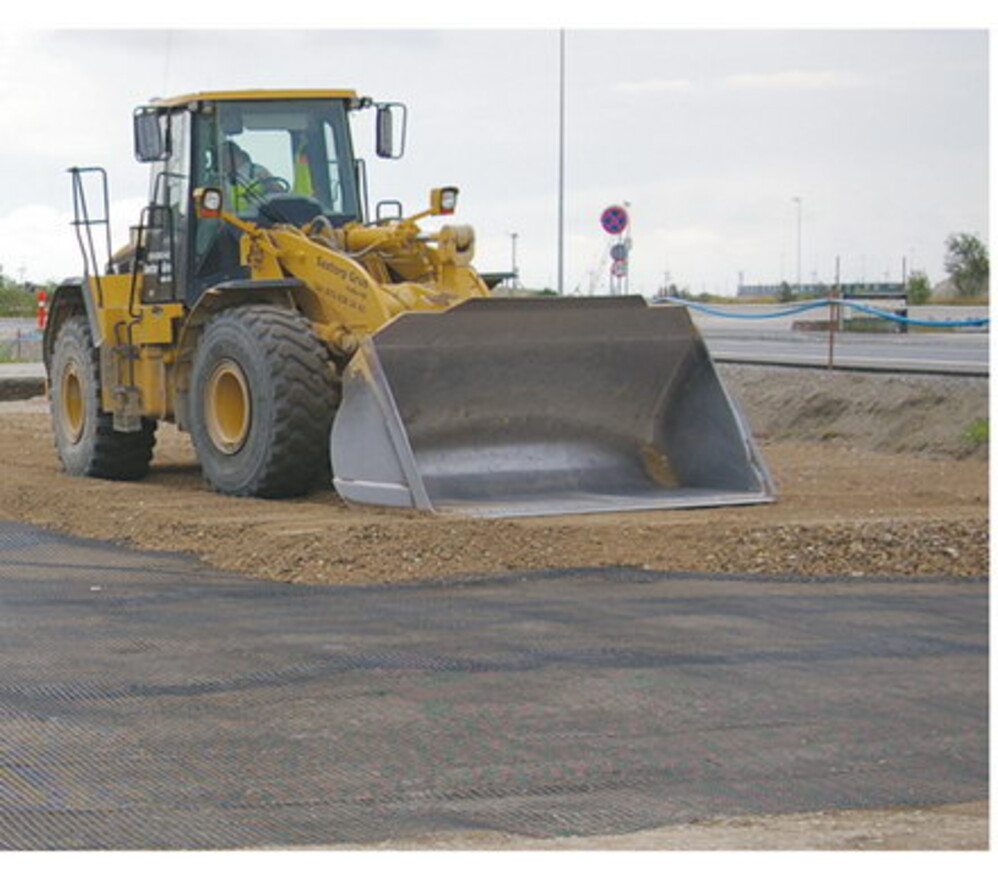
Where a field trial is justified, agree the pass count, load conditions, moisture record, rut measurement and decision criteria before construction. A photograph of a truck on a grid is not a comparative performance trial.
Roads and working platforms are not interchangeable
The study concerns repeated moving-wheel loading. It does not establish the bearing capacity of a crane or piling platform, where load footprints, edge conditions and failure mechanisms require their own assessment.
The same restraint concept may be relevant, but the design evidence still has to match the duty.
The practical lesson is not that strength is unimportant. It is that the purchased product and the installed system answer different questions.
Start with the movement you need to control. Then select and position the geogrid on evidence that it can help control it.

Ben Lewis
Founder & Technical Lead, Kontain. Technical geosynthetic selection and project-direct supply for Australian civil, mining, water and waste infrastructure.
About Kontain