
Scope note. This article provides practical technical guidance for project and operational discussions. It does not replace project-specific investigation, testing, design, certification or the appointed project team.
Why this keeps happening
Why crystal-clear filtrate can still leave a wet, difficult-to-handle cake
I am getting tired of hearing about geobag projects that have not dewatered properly, discharged poor-quality filtrate, taken far longer than expected or left an asset owner with a large volume of wet material they cannot manage.
Not because the technology cannot fail. It can.
The frustration is that many of these failures are predictable. Yet once something goes wrong, the conclusion is often simply:
“Geobags do not work.”
At one end of the spectrum, people see geobags as passive dewatering: connect a hose, fill the bag and walk away.
At the other end, someone remembers a problematic project and says, “Never again.”
Both views miss the point.
The equipment is relatively simple. The process still requires engineering, testing and competent operation.
A successful system depends on the interaction between:
- The material being pumped
- The geotextile construction and opening-size distribution
- The conditioning chemistry and active polymer dose
- Product make-down, hydration and dilution
- Pumping, mixing and pipeline shear
- Flow, pressure and filling cycles
- Operator decisions
- Site drainage and post-filling management
Ignoring any one of these can compromise the whole project.
A woven geobag is not just a strong fabric container
There are important differences between woven textiles that can be difficult to see once the fabric has been manufactured into a bag.
Woven geotextiles may use monofilament, multifilament, slit-film or tape, fibrillated-tape yarns, or combinations of these. A basic separation geotextile can look similar to an engineered dewatering textile. The problem is selecting it on appearance, headline tensile strength or price without understanding how that construction behaves as a filter.
A nominal opening size of 300, 425 or 500 microns is not, by itself, evidence that a fabric will work.
A smaller opening may improve initial retention but blind more quickly. A larger opening may release water faster but allow unacceptable solids loss. The selection must be considered against the actual feed and the conditioned floc; there is no universally correct opening size for every sludge. (Muthukumaran and Ilamparuthi, 2006)
The fabric is also under biaxial tension as the bag fills. Yarn movement and fabric orientation can change hydraulic behaviour, so a single relaxed opening-size result does not fully describe a filled geobag. (Zhao et al., 2022; Man et al., 2019)
If a supplier cannot explain the fabric construction, test method, tensile behaviour, seam configuration, hydraulic characteristics and why the textile suits the actual material, the datasheet is not enough.
Not all floc is equal — and the clearest water may be a warning
For fine silts, wastewater sludge and organic material, polymer conditioning is often the most important operational variable.
But “add polymer” is not a design, and crystal-clear water is not automatically the correct target.
The real objective is to use the lowest effective active-polymer dose that meets the project’s filtrate requirement while maintaining:
- Strong, retainable floc
- Sustained drainage through the fill-and-rest cycles
- Predictable loss of bag height and volume
- A cake that continues to consolidate and firm
- A final material that can actually be handled or transported
High-molecular-weight polyacrylamide, or PAM, of an appropriate charge can build very large particles at relatively low doses. That makes it effective, but the useful dose window can be narrow. The largest floc in a bucket is not necessarily the best-draining floc in a bag.
The floc must also survive the mixing system, pump, bends, valves and pipeline before it reaches the geotextile. A good sample taken upstream of a high-shear pump may bear little resemblance to what arrives at the fill port.
Performance can be affected by:
- Polymer chemistry, charge density and molecular weight
- Active dose per dry tonne of solids
- Product make-down, inversion and maturation
- Dilution-water quality
- Injection location and mixing energy
- Pipeline length and residence time
- Pump, valve and recirculation shear
- Variability in the incoming solids
Polymer type must be selected against the actual feed. Dose cannot rescue an incompatible product.
What the EM640CT digestate study actually tells us
A recent Water Research paper examined the cationic, high-molecular-weight emulsion PAM FLOPAM EM640CT on anaerobic digestate from a Western Australian red-meat facility. The prepared solution contained 0.41% active polymer.
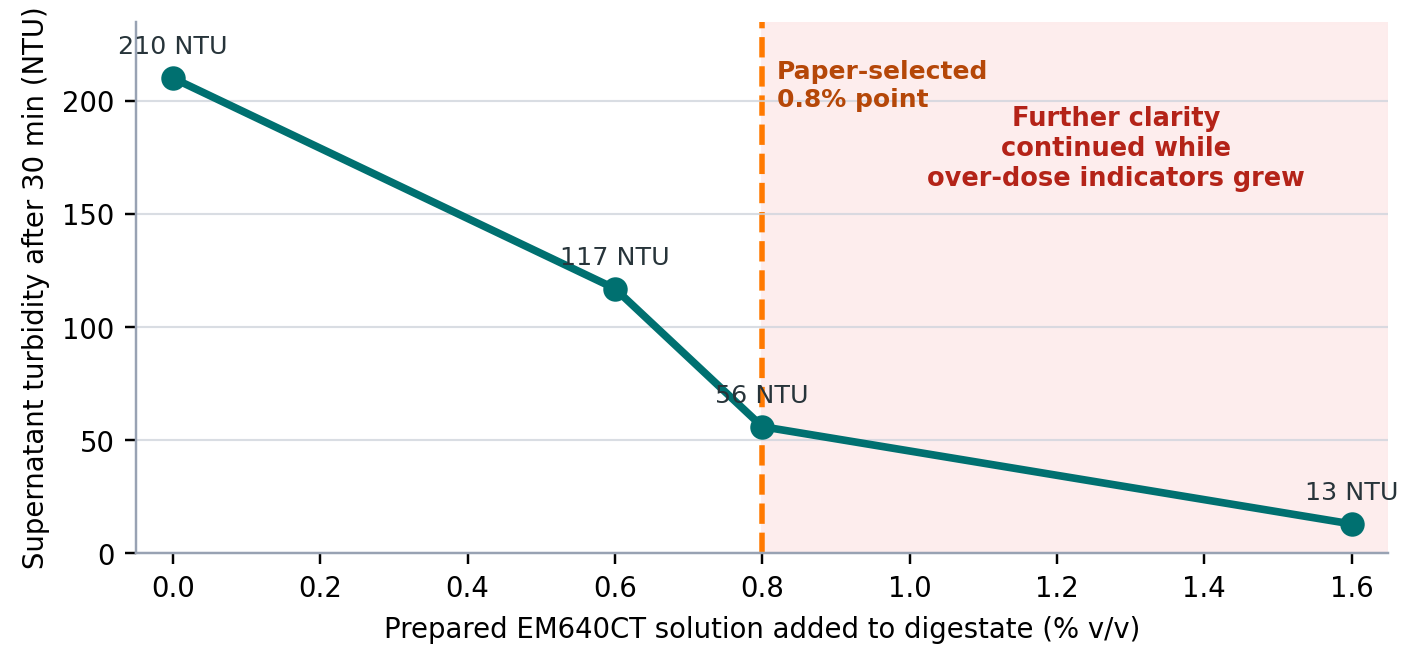
At a prepared-solution addition of 0.8% v/v, the authors selected an apparent optimum: turbidity fell from 210 to 56 NTU and settling time reduced by about 65%.
Increasing the addition to 1.6% v/v reduced turbidity further to 13 NTU. Optically, that looked better. However, the solids became more water-rich and variable. Above 0.6% v/v, the NMR results showed an additional water population that the authors associated with excess polymer trapping water in a loose or “fluffy cake” structure. (Bertizzolo et al., 2023)
That conflict is the important finding: water clarity kept improving after the solids structure had begun to show signs of over-conditioning.
The study used 30-minute settling tests, not filtration through a woven geobag. It does not quantify a geobag drying-time or fabric-blinding penalty. However, it provides a credible explanation for something experienced operators see in the field: very clear filtrate alongside bulky, soft solids that consolidate poorly.
The reported 0.6–0.8% v/v transition corresponds to approximately 24.6–32.8 mg/L of active polymer. The feed total-solids concentration was not reported, so the paper cannot be converted to one defensible kg active polymer/t dry solids value.
For context only, if a comparable sludge entered the bag at 2–4% total solids, that transition would equate to approximately 0.62–1.64 kg active polymer/t dry solids. That is a conditional calculation, not a field setpoint. The correct dose still has to be established on the actual sludge, with the actual geotextile and shear history.
Under-dosing and overdosing can both restrict drainage
The failure mechanisms are different:
Under-dosed material may contain small or weak flocs, persistent cloudy bulk water and fines that pass through or lodge within the weave before a protective filter cake forms. The fabric can effectively blind from within.
Material in the useful operating window generally shows distinct, resilient flocs with open water between them. The filtrate meets the project limit, drainage remains sustained, the bag loses height during rest and the retained cake progressively firms.
Over-dosed material may show exceptionally clear filtrate and rapid visible separation, but also very large, fluffy, stringy or gelatinous flocs. The retained solids remain bulky and water-rich, late-stage drainage falls away and a polymer-rich smear or compressible skin may blind the surface of the geotextile.
Over-sheared material can resemble an under-dose because formed flocs fragment before reaching the bag. Automatically adding more polymer can then create a real overdose without correcting the shear problem.
A slight haze or small, controlled amount of fines in the filtrate may therefore represent the better dewatering point for some organic sludges, provided the water remains within the approved discharge, reuse or return-water criteria.
If very low TSS is mandatory, it may be better to provide a separate polishing step than to force the geobag process into polymer overdose simply to make the water look perfect.
Dilution gives the operator control
Strong emulsion PAM products are easy to overfeed when the working solution is too concentrated or the dosing pump has poor resolution.
For a product such as EM640CT, which is reported as approximately 39–45% solids, a delivered working solution based on 0.25–0.5% as-supplied product can provide far better field control. Using product solids as an approximate basis:
- 0.50% as-supplied product is approximately 0.20–0.23% active polymer
- 0.25% as-supplied product is approximately 0.10–0.11% active polymer
At the same active-polymer dose, the 0.25% solution requires twice the solution flow of the 0.50% solution. That larger flow improves dosing-pump resolution and makes small 5–10% changes more controllable.
There are limits. Additional make-down water consumes pump capacity and may reduce net solids throughput. More importantly, dilution must not compromise correct inversion and maturation. If the supplier or make-down unit requires a higher preparation concentration, invert the product correctly first and then post-dilute with clean water before final injection.
The dose should be recorded as kg active polymer/t dry solids, not merely pump percentage, litres per hour or litres per cubic metre. If feed total solids changes, a volume-paced setting silently changes the dose applied to the solids.
There is a practical way to find the upper dose limit on site
The upper useful limit is reached when another increment of active polymer produces mainly an optical improvement in filtrate clarity while sustained drainage, bag shrinkage or cake firmness no longer improves — or begins to worsen.
That limit should be found deliberately:
- Define the maximum acceptable filtrate TSS or turbidity and the required operational outcomes before testing.
- Sample the actual geobag feed after upstream treatment and, where practical, downstream of the last major shear point.
- For pre-conditioned DAF sludge, begin with zero additional geobag polymer. Then bracket the current top-up dose — for example 25%, 50%, 75%, 100% and 125% — while keeping upstream chemistry stable.
- Replicate the real order of addition, residence time and shear. A gentle bench mix can overstate field floc strength.
- Pour the samples through the exact proposed fabric. Compare filtrate volume at fixed times, visible fines and any slippery or gelatinous residue left on the weave.
- Include repeated fill-and-rest cycles. A single jar, cone or pillow pour will not reveal progressive cake or fabric blinding.
- Trend feed solids, active dose, filtrate flow, TSS or turbidity, bag-height loss and cake solids together.
- Select the lowest dose that meets the water-quality limit and produces the best sustained drainage and firming trend.
During start-up or a material change, line samples may need to be checked every 10–15 minutes until the response stabilises. During stable operation, a documented check at least hourly — and after any change in sludge source, flow, solids, upstream chemistry, pump duty or water quality — is a sensible starting point, adjusted for project risk and residence time.
The operator should compare the current sample with one lower-dose sample. If the lower dose drains similarly and produces a denser retained solids layer, the current dose is probably above the useful knee.
Most importantly, wait at least one full process residence time before adjusting again. Otherwise several changes can be in the pipeline at once and the response at the bag becomes impossible to interpret.
This is a learned operating skill. Feed properties can change during the day, between lagoons, after rainfall or following a process adjustment. A polymer setting that worked on Monday should not automatically be treated as correct on Friday. If operators are given no tested operating envelope, sampling procedure, control limits, training or escalation path, that is a design and commissioning failure — not merely an operator problem.
Initial drainage is not final dryness
Polymer conditioning can dramatically improve how quickly a bag sheds free water and becomes ready for another fill. That does not mean ultimate cake dryness improves by the same amount.
A geotextile-bag study on drinking-water sludge found that optimum conditioning substantially increased first-day drainage, yet final cake moisture after eight days was similar to the unconditioned material. It is a different sludge and not a biosolids dose prescription, but it demonstrates the difference between early hydraulic performance and final cake condition. (Avancini et al., 2021)
As solids accumulate, the cake increasingly controls flow. A thin, permeable cake can support retention and drainage. A thick, compressed or polymer-rich cake can become the governing restriction.
With biosolids, an external crust can also develop while wetter material remains inside. A bag may look dry from the surface and still contain solids that are difficult or uneconomic to transport.
Controlled surface cleaning can sometimes reopen drainage paths. Aggressive pressure cleaning can strip away the filtering layer, restart turbid weeping or damage the textile and seams. Cleaning therefore needs an objective, an approved method and monitoring.
Post-filling management must also cover fill-rest cycles, rainfall and ponding, effluent capture, access, UV exposure, final-solids verification, handling and — where bags are stacked — settlement and stability. A filled geobag remains an asset that must be managed.
“Design and construct” is not a complete specification
Too many project documents contain a single requirement along the lines of:
“Dewater the material using geobags.”
The rest is left to the contractor.
Some installers are excellent and bring considerable practical knowledge. But leaving every technical decision to the installation contractor creates unclear responsibility, particularly where procurement is price-driven.
A useful performance specification should define, at minimum:
- The expected feed envelope and variability
- Dry-solids loading rather than wet volume alone
- Required filtrate quality
- Target final solids, strength or handling condition
- Testing requirements using the actual material
- Textile and seam requirements
- Filling height, pressure and flow controls
- Polymer-selection and dosing responsibilities
- Monitoring, hold points and corrective actions
- Pad drainage, drying and handling requirements
Designers should not be expected to become specialist geobag operators. They should, however, work with knowledgeable suppliers and contractors early enough to define the outcomes and allocate responsibility properly.
A one-line D&C clause transfers ambiguity. It does not eliminate risk.
What should a technical geobag supplier contribute?
A proper technical supplier should add value well before the purchase order.
During feasibility, that means interrogating the feed data, checking the footprint and programme, estimating dry-solids capacity and being honest about uncertainty.
During design, it means helping select and test the textile and chemistry, reviewing filling hydraulics, bag geometry, seams, working heights, cycling, settlement and any proposed stacking.
During procurement and commissioning, it means providing traceable product data and quality records, then establishing sampling points, dosing calculations, an operating envelope and operator support when the feed changes.
Yes, Kontain supplies Kontainer™ Geobags, so I clearly have a commercial interest in the technology.
But I have deliberately built the business around technical support because selling a bag into the wrong process is not a successful outcome. It damages the client, the contractor and confidence in the entire method.
I do not claim that every answer can be known upfront. A credible supplier should state what has been verified, what has been assumed and what still needs to be tested.
Simple does not mean set and forget
Geobag dewatering can be highly effective. It can provide high-volume dewatering with relatively simple equipment, low energy demand and flexible deployment.
But it is not passive dewatering from the moment the hose is connected.
It requires the right textile, appropriate conditioning, controlled hydraulics, competent operation and continued asset management.
Most importantly for organic sludge: do not keep increasing polymer simply to chase crystal-clear water. The clearest filtrate can occur after the best dewatering point has already been passed.
I have prepared a new Kontain technical note, Flocculant Dosing for Biosolids Geobag Dewatering, to give contractors, operators and asset owners a practical basis for identifying under-dose, over-dose and over-shear; converting dose to active kg/t dry solids; using controlled dilution; and finding the upper useful dosing limit on site.
My aim is to work earlier with designers, asset owners and contractors so these systems become better specified, more measurable and less dependent on trial and error.
Early collaboration is far cheaper than recovering a problematic project later.
The industry does not need more confidence without evidence.
It needs clearer responsibility, better testing and greater technical ownership.

Ben Lewis
Founder & Technical Lead, Kontain. Technical geosynthetic selection and project-direct supply for Australian civil, mining, water and waste infrastructure.
About Kontain