
Scope note. This article provides practical technical guidance for project and operational discussions. It does not replace project-specific investigation, testing, design, certification or the appointed project team.
Originally published by Kontain on LinkedIn .
Overview
Hoop tension, the square law, hidden settlement in stacks, and how to engineer the risk out of passive dewatering.
Geotextile dewatering containers — geobags, dewatering tubes, call them what you like — get sold on their simplicity. Pump slurry in, water passes through the fabric, solids stay behind, refill after it drains. That simplicity is the technology's biggest advantage. It's also why the risk gets underestimated.
The control that matters most during filling isn't the volume you pump in. It's the fill height. And the reason fill height matters is not linear — which is the part most filling procedures miss.
The square law
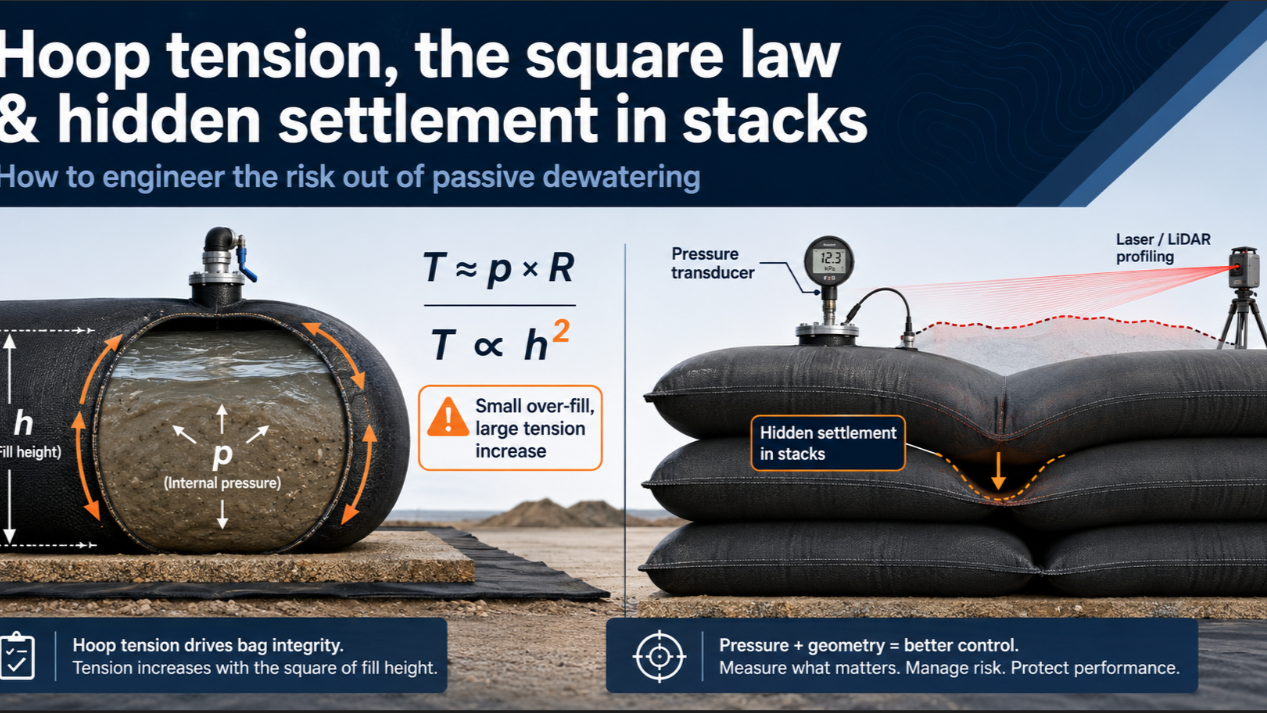
A geobag is a flexible tension structure. It doesn't hold slurry by mass; it resists internal pressure through tension in the fabric. The governing quantity is hoop tension — the circumferential load in the geotextile — and it follows the membrane relationship:
T ≈ p × R
Tension per unit width equals the internal pressure times the local radius of curvature. Now watch what happens as you fill higher. The internal pressure rises with the slurry head (p ≈ ρ·g·h). But the radius of curvature of the bag's cross-section also grows as the bag fills and rounds out (R increases with h). Both terms climb with fill height at the same time, so:
T ∝ ρ · g · h²
Hoop tension scales with the square of fill height, not with height itself. That single fact should change how you think about over-filling. Push the fill height up 20% and you haven't added 20% to the fabric load — you've added about 44%. A 50% over-fill roughly doubles it. The bag gives almost no warning, because the thing that fails — fabric and seam tension — is racing ahead of the thing the operator is watching, which is height.
Rearranged, that relationship gives you a design ceiling:
h_max = √( T_allow / (k · ρ · g) )
where T_allow is the fabric's allowable hoop tension and k is a geometry factor. Two honest caveats before anyone runs with that. The real settled-tube cross-section is more complex than a clean cylinder, so k has to be calibrated to the actual bag width, fabric, fill density and support — treat h_max as a project design model, not a universal formula. And T_allow isn't the fabric's rated strength; it's the wide-width tensile strength knocked down for seam efficiency and a factor of safety, ideally from testing rather than a brochure value.
Fill height is the field proxy for a stress you can't see
You can't measure hoop tension with a tape on site. You can measure height. That is why height is the right field control — it's the visible proxy for an invisible stress state, provided the limit was derived from that stress state in the first place.
This flips the operating question. The site question is usually "how much can we get in this bag?" The engineering question is "what fill height keeps the fabric within its allowable tension, with a factor of safety?" A height limit set because the bag looks full, or because the flow slowed down, is just an instruction. A height limit converted from a hoop-tension calculation is an engineering control. For low-consequence sediment work the first is often fine. For tailings, contaminated sediment, or stacked dewatering, it isn't.
The hidden trap in stacks
Stacking is where this gets quietly dangerous.
Lay bags side by side and you don't get a flat platform — you get notches and valleys between them, and drainage and settlement make those gaps deeper over time. Place the next layer across them and the upper bag sags down into the notch as it fills.
That creates a hidden increase in effective fill height. The operator measures the crest of the upper bag and reads a height within the limit — but part of the bag has dropped into the gap, so the true membrane geometry, the local curvature, and the tension are all more severe than the visible height suggests. Ports and seams take the stress concentrations. And the upper bag imposes uneven load on lower bags that may not have consolidated yet.
So the same fill-height rule can't apply to every layer. The base layer, on a prepared pad, can usually take the most. Every layer above it sits on an irregular, compressible, still-settling surface, and the factor of safety has to compound as you climb. Higher stack, more conservative filling — unless project-specific testing and monitoring say otherwise.
Where pressure monitoring earns its place
Here is the part worth thinking harder about. If you can't see tension, and height lies to you in a stack, what can you trust? Pressure.
Pressure is what drives hoop tension (T ≈ p·R), so a pressure limit maps to the tension state more directly than height does. More importantly, pressure is geometry-independent — a transducer doesn't care whether the bag has sunk into a notch; it reads the actual load. That is exactly the blind spot height monitoring has in a stack. Calibrate the internal pressure that corresponds to allowable hoop tension, set a pump cut-off and alarm at it, and you have a control that fails safe.
It isn't a silver bullet, and it shouldn't be sold as one:
- During active pumping the gauge reads dynamic pump head and surge, not just the static slurry head that governs the resting tension — so you interpret it against pump-on and pump-off conditions, not as a single number.
- A single gauge in the fill line reads the line, not the bag. Pressure varies along the bag, and a sand bridge, blockage or poorly supported port can create a local concentration the gauge never sees.
- Slurry fouls and abrades sensors, and a gauge on every bag is a real cost and logistics question across hundreds of units.
The sensible answer is a hierarchy, not a gadget. Height marks and a line gauge as the baseline; a pressure transducer with live readout, alarm limits and logged data as the next step; and pressure paired with laser, ultrasonic or LIDAR profiling at the top, so you measure load and true geometry instead of trusting either alone. Pressure transducers are mature, off-the-shelf hardware. Using them to govern geobag filling is still an emerging control rather than established practice — promising, worth trialling and calibrating, not something to claim as proven yet.
Why this matters for a risk-averse industry
Australian mining is conservative about anything involving water, tailings or process residue, and after the failures the industry has watched, it should be. That conservatism isn't a reason to avoid geobag dewatering — it's a specification for how to do it. The industry adopts processes that are monitored and auditable, not ones that rely on an operator's judgement on the day.
Layer-specific safety factors, a fill height derived from hoop tension, a pressure cut-off, logged filling histories, laser verification on the big stacks — none of that is complex next to the processing plant down the hill. The bags stay passive. The filling becomes engineered. That is the difference between "we used some bags" and a system a tailings engineer will put their name to.
Bottom line
Manage geobag filling around hoop tension, not guesswork. You can't measure tension in the field, so height and pressure become the control points — but remember the square law, where a small over-fill produces a large jump in tension, and remember that in a stack the height you measure is not the height the fabric feels. Controlled filling — height converted from tension, pressure monitored, placement staged, upper layers held back, and a hard stop when a limit is reached — is what lets a genuinely simple technology be safe enough for the places that need it most.

Ben Lewis
Founder & Technical Lead, Kontain. Technical geosynthetic selection and project-direct supply for Australian civil, mining, water and waste infrastructure.
About Kontain