
Roof and rib skin control
Continuous coverage limits ravelling and local falls between installed support points through coal roadways and intersections.
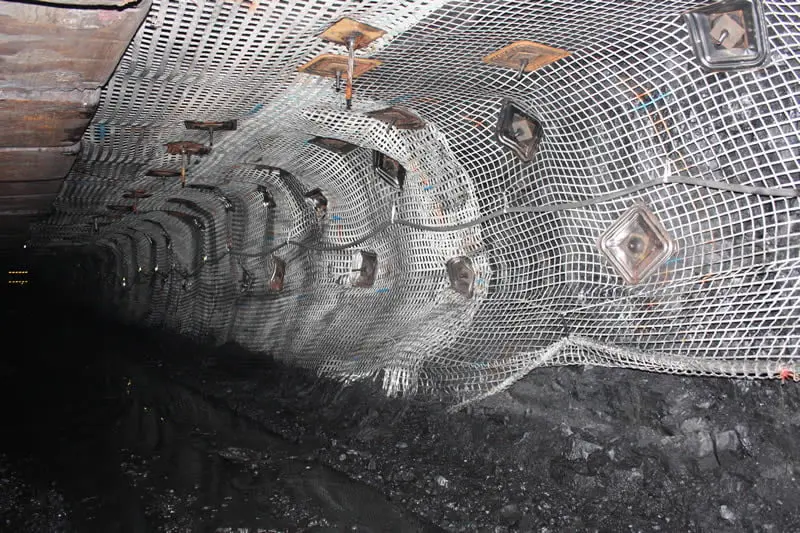 Underground polymer mesh application context
Underground coal · roof · rib · longwall recovery
KMG is a coated, high-tenacity PET grid installed as a continuous surface membrane between the mine's designed bolts, plates and straps. It controls ravelling and broken roof or rib material while carrying local membrane loads into the designed support points.
Coal-mine strata control
Mine Grid works with the mine's primary strata-control system. The grid spans between bolts, plates and straps, retains loose or fractured surface material and transfers membrane load back to those support points. It is used through development roadways, intersections, pillar wrapping and engineered longwall recovery zones.
Continuous coverage limits ravelling and local falls between installed support points through coal roadways and intersections.
Flexible textile construction follows shoulders, ribs and irregular profiles without forcing a stiff sheet across changing geometry.
High-capacity grades can form the continuous reinforced screen carried over shield canopies near the planned finish of a longwall panel.
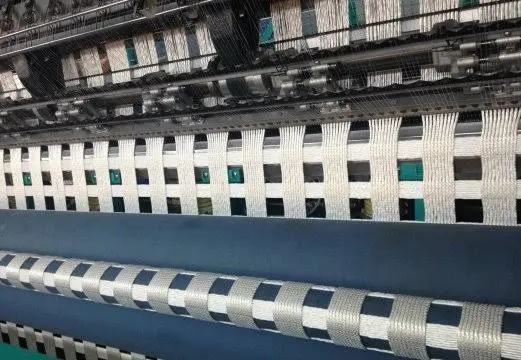
Why woven PET
Extruded polypropylene grid is stiff and can feed cleanly through mechanised installation equipment. Woven KMG is selected where tensile capacity, conformity and continuous load-carrying coverage are the stronger priorities.
High-tenacity filament bundles scale the KMG range from 60/60 to 800/800 kN/m without relying on thicker moulded ribs.
The flexible textile field follows uneven roof, shoulders and ribs and can drape through longwall recovery arrangements.
Balanced grades resist changing load direction; directional grades concentrate capacity in the established governing axis.
Five-metre-wide rolls reduce panel joints and help maintain one coherent membrane field across the roadway profile.
Grade and support selection
The mine's geotechnical or strata-control engineer selects and releases the KMG grade, warp direction, bolt or cable pattern, plates, straps, joints, terminations and monitoring requirements as one support package.
Ravelling, slabs, joints, weak bands, convergence, abutment loading and dynamic demand.
Roof and rib profile, tunnel width, intersections, exposure period and the area requiring continuous coverage.
Bolt rows, spacing, plates and straps establish the clear membrane span and how load reaches the support system.
Expected fragment size and aperture compatibility; tensile strength cannot retain material that passes through the opening.
Balanced grades suit variable demand; directional grades place the stronger warp in the governing membrane axis.
Allowable sag, convergence, access, equipment clearance, monitoring and the mine's TARP thresholds.
Product tensile data does not determine bolt spacing by itself. The installed response depends on ground behaviour, clear span, retained load, aperture, plates, straps, anchorage, allowable deformation and the mine's operating method.
Mine Grid documents
The technical schedule covers the six KMG grades, construction, selection inputs and longwall recovery use. The installation guide covers support design, handling, deployment, orientation, joints, repair, recovery work, inspection and QA records.
Underground coal projects